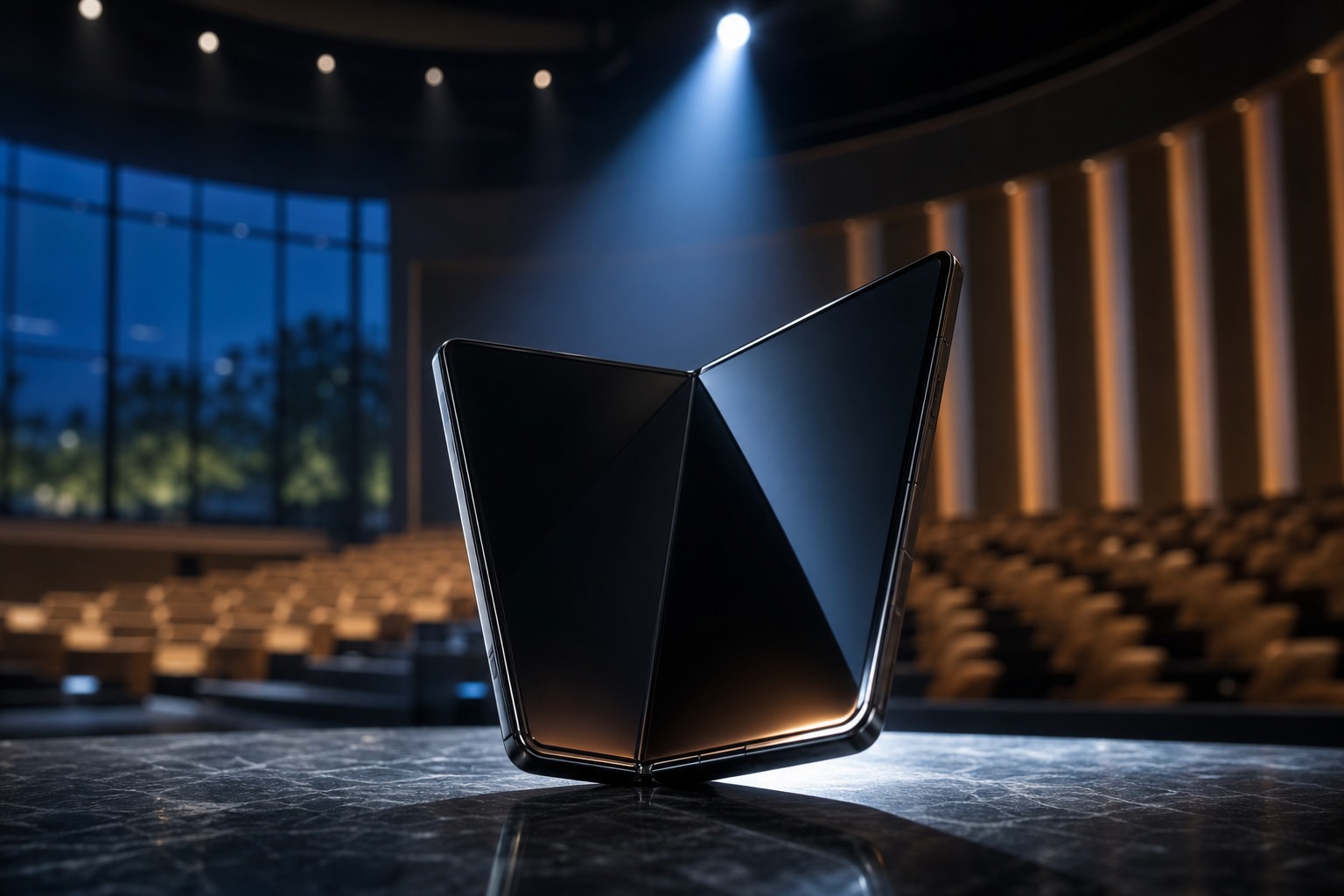
Apple takes the stage at Apple Park on Wednesday at 10:00 a.m. Pacific under a two-word tagline — "Surprise and Shine" — for the first product launch in the company's history not run by Tim Cook. New chief executive John Ternus inherits the keynote, and with it the most expensive iPhone lineup Apple has ever attempted to sell.
The hardware is expected to include the iPhone 18 Pro, iPhone 18 Pro Max, and a folding handset that Apple watchers have been calling the "iPhone Ultra." Reuters reported Tuesday that analysts expect the foldable to carry a price above $2,500. IDC's Popal told the wire service the category could generate more than $45 billion in revenue for Apple by the end of 2027. Apple is also expected to hold back its lower-end refreshes, including the Air, until spring.
That is the bull case. The bear case arrived from an unlikely direction: an analyst who covers the company for a living, publishing two days before the invite-only crowd files in.
The KeyBanc problem
KeyBanc reiterated an Underweight rating on Apple this week with a $250 price target, well below where the stock has been trading. The firm's model assumes a $150 increase on the iPhone 18 Pro to $1,249 and a $200 increase on the Pro Max to $1,399, with the foldable starting near $2,199. The word the note used was "sticker shock."
The unit math is the part worth reading twice. KeyBanc models roughly 80 million iPhone 18 builds across Apple's fiscal fourth quarter of 2026 and fiscal first quarter of 2027, against roughly 91 million in the same stretch a year earlier. That is a double-digit percentage decline in build plans heading into the holiday quarter, at the exact moment Apple raises average selling prices. Higher price, fewer units — the two can offset, but only if the mix holds.
KeyBanc also flagged the calendar itself. Over the past five years, Apple shares have averaged a decline of 0.72% on the day of a product announcement and 1.22% over the following five trading days. Launch day has not historically been a buying catalyst.
Apple closed Tuesday at $316.22, down $3.75 or 1.17%, and slipped another fraction to $316.15 in after-hours trade. The stock finished last Friday at $319.97 after a 2.51% drop. Its 52-week range runs from $225.95 to $344.57.
What the balance sheet says
The pressure on Wednesday's event is not financial distress. Apple's fiscal third quarter, ended June 27, 2026, produced revenue of $109.4 billion, up 16% year over year — a fourth consecutive quarter above $100 billion. Gross margin came in at 50.1%, which included roughly two points of benefit from tariff refunds. Diluted earnings per share were $2.02, up 29%, including an $0.11 benefit from the same refunds. Apple set June-quarter records in iPhone, Mac and Services, with Mac revenue clearing $10 billion.
Strip out the refund benefit and the underlying business still grew. What Wednesday tests is whether Apple can convert a maturing hardware franchise into a higher-priced one without losing volume — and whether the Siri overhaul announced at WWDC26 gives buyers a software reason to trade up rather than a hardware one. Leadership transitions tend to compress that question into a single keynote, which is roughly what happened when the handoff was announced and attention shifted immediately to the supply chain.
Where the tape closed
Tuesday was ugly beneath the headline. The Dow Jones Industrial Average closed at 52,786.07, down 628.18 points or 1.18%, its second straight loss. The S&P 500 finished at 7,673.52, off 45.08 points or 0.58%. The Nasdaq Composite held up best at 26,421.41, down 85.58 points or 0.32%. The CBOE Volatility Index rose 2.94% to 15.75, still historically low. The 10-year Treasury yield ticked up to 4.792%.
Software was the wound. Intuit closed at $318.93, down 4.14%. Salesforce fell 3.90% to $249.12. Adobe, AppLovin and MicroStrategy all finished lower by 3% or more, and the S&P software and services group underperformed the broad market. Oracle was the exception among large-cap software, rising 2.36% to $162.52 ahead of its fiscal first-quarter report Thursday after the close — consensus sits near $1.74 in earnings per share on roughly $19.14 billion in revenue, against a record $638 billion in remaining performance obligations.
Energy did the damage on the other side. WTI crude settled at $93.98, up $2.50 or 2.73%, with Brent settling at $97.92 after touching $99.46 intraday. Crude is up more than 8% in September alone. Iran-allied Yemeni militants struck several Saudi energy facilities, and U.S. forces hit three Iranian oil tankers over the weekend. Goldman Sachs raised its December 2026 Brent and WTI forecasts by $5, to $85 and $80, and its 2027 numbers to $80 and $75, while noting a non-base case in which Brent exceeds $120 next year. Goldman's Daan Struyven said markets "are increasingly pricing a prolonged Mideast conflict." President Trump said Monday that oil prices "will drop precipitously … when we WIN the war with Iran." The energy complex has been reorganizing around that conflict for weeks.
Single-name extremes were wide. Guidewire fell 19.9% after a soft fiscal 2027 outlook despite 15% revenue growth and 19% constant-currency ARR growth — the stock had been carrying roughly 82 times trailing earnings. FICO dropped 16.7%, Lululemon 17.4%, UiPath 16.6% and AlTi Global 21.9%. On the winning side, Quanex rose 22.2%, Brundage-Bone 16.0%, Tyra Biosciences 15.2%, Titan Machinery 14.8% and Aehr Test Systems 13.1%. Several of those names had already shown up on Tuesday's upgrade list.
GameStop's quiet quarter
GameStop reported fiscal second-quarter results Tuesday for the period ended August 1. Net sales fell to $790.2 million from $972.2 million. Operating income more than doubled to $160.2 million, a second-quarter record, from $66.4 million. Net income was $298.7 million against $168.6 million, with adjusted net income of $161.1 million and adjusted EBITDA of $174.0 million. Collectibles revenue rose 57% to $356.3 million and now accounts for 45.1% of total sales. The company holds $5.4 billion in cash, securities and digital assets plus a $4.9 billion eBay stake, and raised its fiscal 2026 adjusted EBITDA outlook above $650 million. Shares still closed down 1.41% at $18.89. Shrinking the top line while doubling profit is a legitimate strategy; the market is not yet paying for it.
What lands next
Chewy reports Wednesday before the open, with consensus near $0.36 in earnings per share on $3.32 billion in revenue against $3.1 billion a year ago; the stock closed Tuesday at $23.27 after the company trimmed its fiscal 2026 sales outlook in June. American Eagle, Signet, Academy Sports and AeroVironment also report Wednesday.
Then the macro takes over. August producer prices land Thursday alongside Oracle and Adobe. August consumer prices arrive Friday, with the University of Michigan preliminary sentiment reading. The Federal Open Market Committee meets September 15–16 with the funds range at 3.50%–3.75%, and CME FedWatch has odds of a September hike near 60%, up from roughly 49% a week ago. August payrolls came in at 162,000 with unemployment at 4.1% and average hourly earnings up 3.1% year over year, and June and July were revised up by a combined 55,000.
Apple gets one morning of undivided attention before the inflation data reclaims the tape. Ternus will need it.
This article is for informational and educational purposes only and does not constitute investment advice or a recommendation to buy or sell any security.
Found this helpful? Share it with others.