Morning Watchlist: Wednesday Edition
A quick note from Behind the Markets
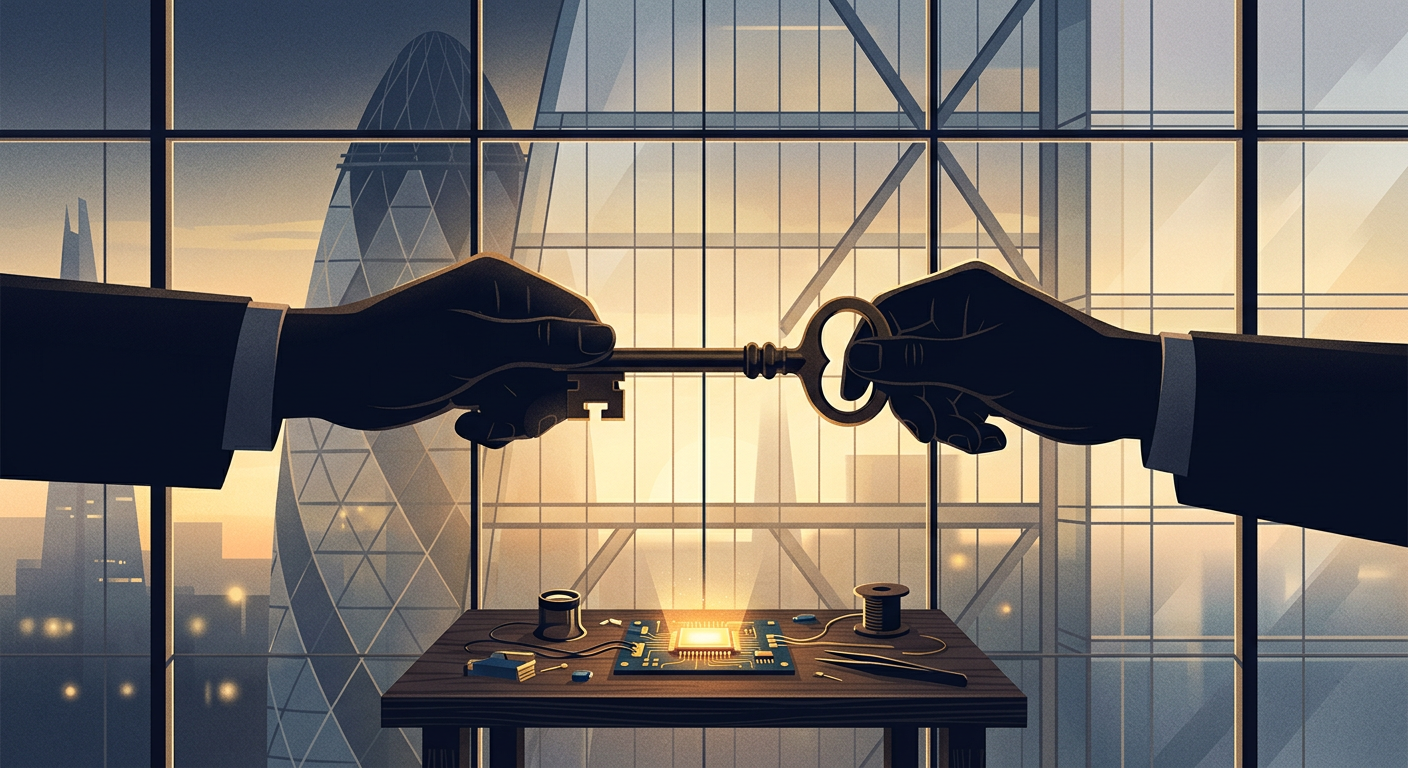
For fifteen years, one man ran the most valuable company on Earth. On Tuesday, he handed over the keys.
John Ternus — the engineer who has run Apple's hardware since 2021 — is now its CEO. Tim Cook moves upstairs to executive chairman. The crowd will spend the week writing eulogies for one era and predictions for the next.
We spent the morning asking our usual question: while everybody argues about the name on the corner office, who quietly gets paid?
It's shaping up as a week of handoffs, actually. An oil giant just handed $3.4 billion to a company that keeps computers cold. And on Thursday, Tesla plans to hand the world a car with no steering wheel.
Three stories this morning. Three pairings. Let's get into it.
1) The Corner Office Changed Hands
Monday was Tim Cook's last day as Apple's CEO. He took the job in 2011, two months before Steve Jobs died, and leaves it with Apple worth around four trillion dollars. Ternus, who joined the company in 2001 as a product designer, started Tuesday — and he gets exactly one week to settle in. Apple's "Surprise and Shine" event lands next Wednesday, September 9th, kicking off what's been described as the company's most ambitious product cycle ever, including a foldable iPhone Ultra and the iPhone 18 Pro.
He also inherits the headaches: unpopular price increases across most of Apple's hardware and services, and a memory-chip crunch pushing component costs up across the industry.
Here's the thing about CEO handoffs. They're loud. Supply contracts are quiet. Whoever sits in the corner office, every iPhone that ships still needs the same chips inside it — and the biggest product ramp in Apple's history means more of them.
The pairing: Cirrus Logic (CRUS) — Buy
Cirrus Logic makes the audio and mixed-signal chips inside Apple's devices. And here is the number that scares everyone: per its latest annual report, 91% of its sales come from Apple. It's a bakery that sells nearly all its bread to one supermarket — a terrifying arrangement, right up until you notice the supermarket just announced the biggest expansion in its history.
That fear is exactly why the stock is cheap. Cirrus has fallen more than 25% in three months, to about $109 — within a few dollars of its 52-week low, down from a high near $180 — even though the June quarter set records: revenue of $459.7 million and earnings up 29% from a year ago. The whole company costs about $5.5 billion, or roughly 13 times earnings. The S&P 500: about 21. The analysts who cover it rate it a Buy, with an average target of $165.
You're being paid to hold the concentration fear at the precise moment the customer's pipeline gets busiest. The risks, plainly: 91% concentration cuts both ways — if Apple ever pulls a socket in-house, the thesis dies the same afternoon. Apple's price hikes could dent iPhone demand, and Cirrus's efforts to diversify into smart-energy and imaging chips won't contribute meaningfully until 2028. This is a one-customer bet on that customer's biggest year.
2) The Oil Giant Bought an Air Conditioner
On Monday, SLB — the company formerly known as Schlumberger, the largest oilfield-services firm on the planet — agreed to pay about $3.4 billion in cash for Kelvion, a century-old German maker of heat exchangers and cooling systems. Kelvion's biggest business, at $1.2 to $1.3 billion of its expected revenue: cooling data centers.
CEO Olivier Le Peuch didn't bury the reason. His exact words: "AI is driving the most significant infrastructure investment cycle in our lifetime."
Read that carefully. A company that spent a hundred years keeping oil wells flowing just decided its future includes keeping computers cold — and paid roughly 11 times earnings-before-costs for the privilege. Chips get the headlines. Heat is the bill. Every AI data center is a gym full of sprinters: the computing is the workout, the heat is the sweat, and somebody has to run the air conditioning.
The pairing: Modine Manufacturing (MOD) — Buy
Modine has been keeping machines cool since 1916 — a radiator maker from Racine, Wisconsin that quietly became one of the key cooling suppliers to the data-center boom. In its latest quarter, data-center sales grew 90%, and management is guiding to 20–35% total sales growth this fiscal year.
And the stock? At about $178, it has fallen roughly 45% from its 52-week high of $323 on supply-chain worries and profit-taking — leaving a $9.5 billion company, at about 21 times next year's expected earnings. That's the market's average multiple for several times the market's growth. All eight covering analysts rate it a Buy; the average target sits above $300, and UBS recently called the weakness a buying opportunity.
SLB just told you what this niche is worth. The market is still marking one of its leaders down. The honest risks: this year's reported profits actually fell — the trailing multiple is a steep 66, so the cheap number depends on next year arriving on schedule. Supply-chain costs are a real, current drag. And cooling demand rides the AI construction cycle; if that slows, so does this.
3) The Car With No Steering Wheel
On Thursday, in Austin, Tesla holds an invite-only event to show off the Cybercab — a vehicle designed with no steering wheel and no pedals. The market didn't wait for the doors to open: on Monday, Tesla jumped 5.5% to about $368, one of the best performers in the S&P 500, on volume nearly half again its normal level. Nevada recently approved a limited robotaxi rollout, and the crowd smells the next act.
Should you chase a stock that just rallied hard into a magic show? We've seen how that movie tends to go — stocks that surge into an event grade the event harshly.
So we asked the quieter question instead. A car with no driver still has to see. Whoever wins the robotaxi race — Tesla's camera-first approach, Waymo's laser-covered minivans, someone nobody's named yet — every one of those vehicles replaces a driver's two eyes with a suite of electronic ones. Whichever student passes the driving test, the optometrist gets paid.
The pairing: ON Semiconductor Corporation (ON) — Watch
ON is the leading maker of automotive image sensors — the chips that turn light into the data a driver-assist or self-driving system actually thinks with. At about $74, it trades near 19 times next year's expected earnings — under the S&P 500's 21 — while generating $1.5 billion in free cash flow. Twenty-nine analysts land at a consensus Buy with an average target near $108.
So why Watch and not Buy? Because the crowd got here first. The stock is up nearly 50% in a year, and on the profits it has actually reported, it costs about 47 times — the gap between 47 and 19 is a recovery the market has RSVP'd to before it's fully shown up. Our entrance: a pullback if Thursday's show disappoints and the autonomy complex fades with it, or another quarter of earnings that closes that gap the honest way. What kills it: robotaxi timelines slipping industry-wide, or the broader auto-chip recovery stalling out.
Before You Go
That's the watchlist. A four-trillion-dollar corner office changing hands, and the 91%-one-customer chipmaker priced like the story ends — right as the product cycle begins. An oil giant's $3.4 billion receipt for the business of keeping AI cool, and the Wisconsin radiator maker marked down 45%. And a car with no steering wheel that will need eyes no matter whose badge is on the hood. One housekeeping note: Broadcom reports after Wednesday's closing bell — our Nutanix trigger from Sunday's edition is officially on the clock.
The names change on the doors. The suppliers keep cashing the checks. As always, the best opportunities stand one step behind the headline.
See you tomorrow.
Found this helpful? Share it with others.
Written by Behind the Markets