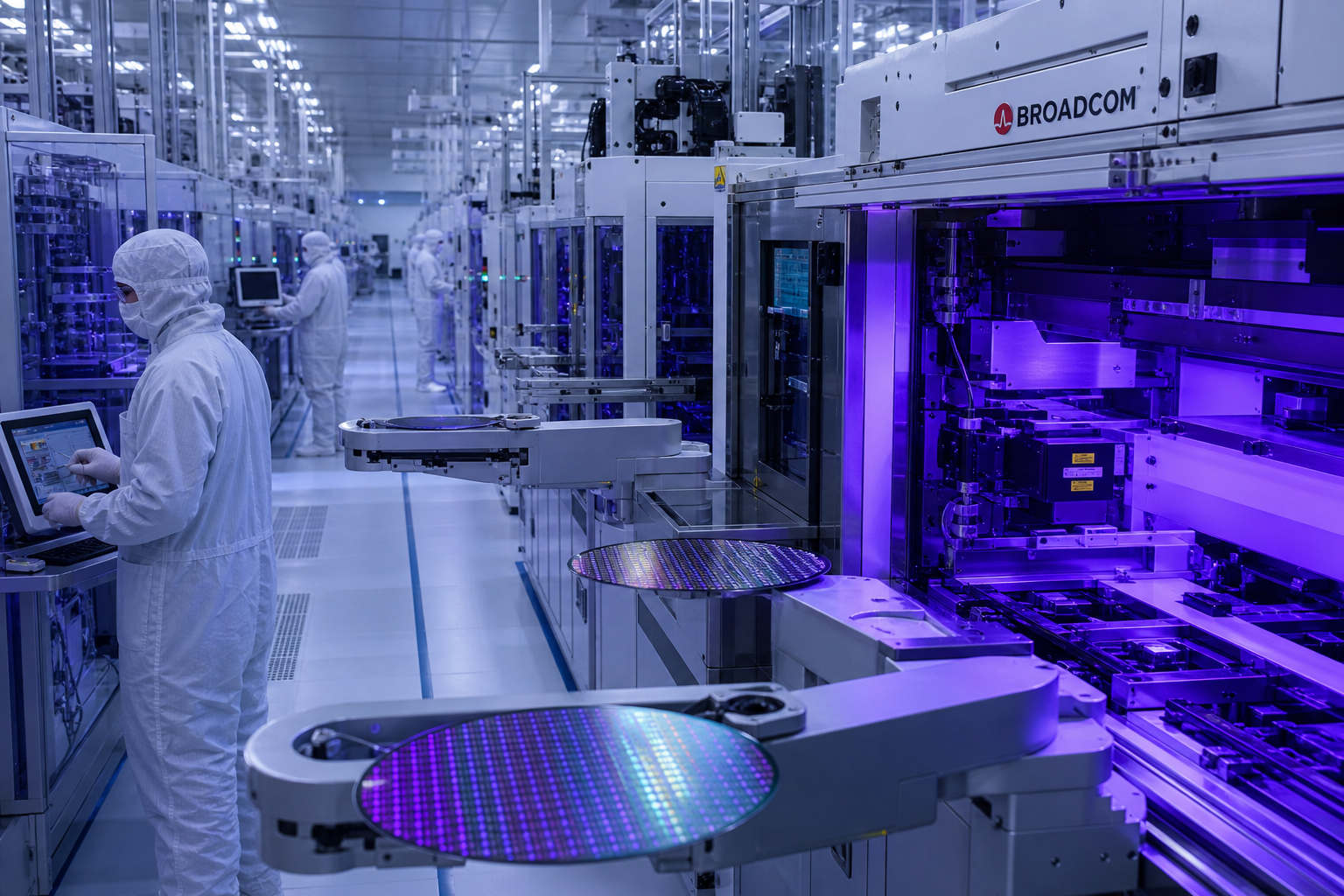
Key Bullet Points:
- Broadcom extended its partnership with Apple through 2031 to develop and supply custom AI and connectivity chips, cementing AVGO's position as one of the most critical suppliers in the entire technology supply chain — shares surged over 4% on Monday to $375.30
- Broadcom's AI semiconductor revenue hit a record $10.8 billion last quarter — up 143% year-over-year — but the real jaw-dropper is the backlog: bookings exceeded $30 billion in the quarter versus the $10.8 billion actually shipped, signaling demand is nearly triple what the company can deliver
- The chip sector roared back on Monday as the Dow crossed 53,000 for the first time, the Nasdaq surged nearly 3%, and Wall Street's biggest banks called the late-June semiconductor selloff a "short-term reset" and a "buying opportunity"
- JPMorgan declared the semiconductor upcycle "not near a peak," projecting that meaningful new chip supply won't arrive before 2028 — while BofA named Nvidia, Texas Instruments, and Cadence as likely front-runners in the recovery
- The Magnificent Seven lost a staggering $2.3 trillion in market value in June alone — but the money didn't leave tech, it rotated: investors poured capital into semiconductor infrastructure stocks, setting up the chip sector for what could be the defining trade of the second half of 2026
The Most Important Deal Nobody's Talking About
While every headline on Wall Street this week is about SpaceX joining the Nasdaq-100, Broadcom quietly made a move that could matter far more over the next five years.
On Monday, Broadcom confirmed it had extended its partnership with Apple through 2031 to develop and supply custom application-specific integrated circuits — ASICs — that will power multiple generations of Apple products. The chips span AI processing, connectivity, and radio functions, tying Broadcom into the heart of every iPhone, iPad, and Mac that Apple ships for the rest of the decade.
The deal doesn't just secure revenue. It secures relevance. In a world where tech giants are increasingly designing their own chips — Google, Amazon, and Meta have all invested billions in custom silicon — Apple just told the market that for its most critical component relationships, it's betting on Broadcom.
Shares of Broadcom surged 4.1% on Monday to $375.30, pushing the company's market capitalization to $1.78 trillion. That makes Broadcom one of the most valuable companies on the planet — and one of the least discussed relative to its importance.
$30 Billion in Demand. $10.8 Billion Shipped.
The Apple deal is the headline, but the numbers underneath it tell a more dramatic story.
In its most recent quarter, Broadcom's AI semiconductor revenue hit a record $10.8 billion — up an astonishing 143% year-over-year and above the company's own forecast. Networking alone accounted for nearly 40% of that AI semiconductor revenue, reflecting Broadcom's dominance in the switches, routers, and custom accelerators that connect the massive GPU clusters powering artificial intelligence.
But the most striking number wasn't what Broadcom shipped. It was what it couldn't.
Bookings for AI semiconductors exceeded $30 billion during the quarter — nearly three times the $10.8 billion in revenue actually delivered. That gap between demand and supply isn't a warning sign. It's a flashing neon billboard that says the AI infrastructure buildout is far from over.
CEO Hock Tan called it simply: "The momentum continues."
For the full fiscal year 2026, analysts project Broadcom's revenue to grow 66% with profit growth of more than 92%. Total annual sales are running near $64 billion, with annual income of $23 billion. The average Wall Street price target sits at roughly $498 — implying more than 30% upside from current levels, with the most bullish analysts seeing $582.
The Great Rotation — Inside Tech
To understand why Broadcom matters right now, you have to understand what happened to the market in June.
The Magnificent Seven — Apple, Microsoft, Amazon, Alphabet, Meta, Nvidia, and Tesla — collectively lost $2.3 trillion in market value in a single month. Microsoft fell 17%, its worst monthly decline since the year 2000. Amazon dropped 12%. Meta sank 11%. It was a bloodbath for the stocks that had carried the market for three years.
But here's the twist: the Nasdaq finished June nearly flat.
The money didn't leave technology. It rotated within it. Investors pulled capital out of the mega-cap platform companies — whose AI spending was being questioned — and poured it into the semiconductor stocks that actually build the AI infrastructure. The Philadelphia Semiconductor Index surged even as the Magnificent Seven crumbled.
AMD climbed 171% year-to-date. Micron soared 305%. And Broadcom, sitting at the intersection of AI custom chips, data center networking, and now a locked-in Apple partnership, became one of the primary beneficiaries of that rotation.
Wall Street Says: Buy the Dip
The late-June semiconductor selloff — the SOX dropped 5.4% in the holiday-shortened week, its second straight weekly decline — spooked plenty of investors. But on Monday, Wall Street's biggest banks stepped in with a unified message: this is a buying opportunity, not a warning.
JPMorgan's Mislav Matejka declared that the semiconductor weakness should "be seized as an opportunity," adding that the chip upcycle "is not near a peak" and that "meaningful supply is not likely to arrive before 2028." In other words, the supply shortage that's driving chip stocks higher isn't going away anytime soon.
Bank of America called the selloff a "short-term reset ahead of a renewed rally," naming Nvidia, Texas Instruments, Analog Devices, Cadence Design, and Synopsys as likely front-runners in the recovery.
UBS was even more blunt: "The pullback was noise, not a signal."
The market listened. On Monday, the Dow Jones Industrial Average crossed 53,000 for the first time in history, closing at a new record. The Nasdaq Composite surged nearly 3%. The S&P 500 climbed more than 2%. Chip stocks led the charge, with Broadcom among the biggest winners.
The AI Infrastructure Machine
What separates Broadcom from many of its semiconductor peers is the breadth of its AI exposure.
Nvidia dominates GPU computing. AMD is challenging with its MI450 platform. But Broadcom operates across the entire AI data center stack — from the custom AI accelerators it designs for hyperscalers like Google and Meta, to the networking silicon that connects thousands of GPUs into coherent clusters, to the storage and connectivity chips that move data at scale.
The company doesn't just sell to the AI industry. It IS the AI industry's plumbing.
And with the Apple partnership now locked through 2031, Broadcom has something most chip companies don't: guaranteed, multi-year demand visibility from the world's most valuable consumer electronics company, layered on top of explosive AI growth.
What Comes Next
The second half of 2026 begins with the semiconductor sector at a crossroads.
The bulls point to $30 billion in AI chip backlog, 143% revenue growth, analyst targets above $500, and two of Wall Street's most powerful banks telling investors to buy the dip. Earnings season kicks off this week — PepsiCo reports Thursday, Delta Air Lines on Friday, and the big banks starting with JPMorgan next week — and the Fed's minutes from Chairman Warsh's first meeting are due any day.
The bears worry that the Magnificent Seven's $2.3 trillion June wipeout was just the beginning — that the AI spending cycle will slow, that the rotation into chips is already crowded, and that a hawkish Fed could choke the rally before it reaches full speed.
Broadcom's response to that debate was to lock down Apple for five more years and ship $10.8 billion in AI chips while sitting on three times that in unfilled orders.
The market's response on Monday was to push the Dow past 53,000 and send chip stocks surging.
Sometimes the loudest answer isn't a word. It's a number.
Found this helpful? Share it with others.