Key Bullet Points:
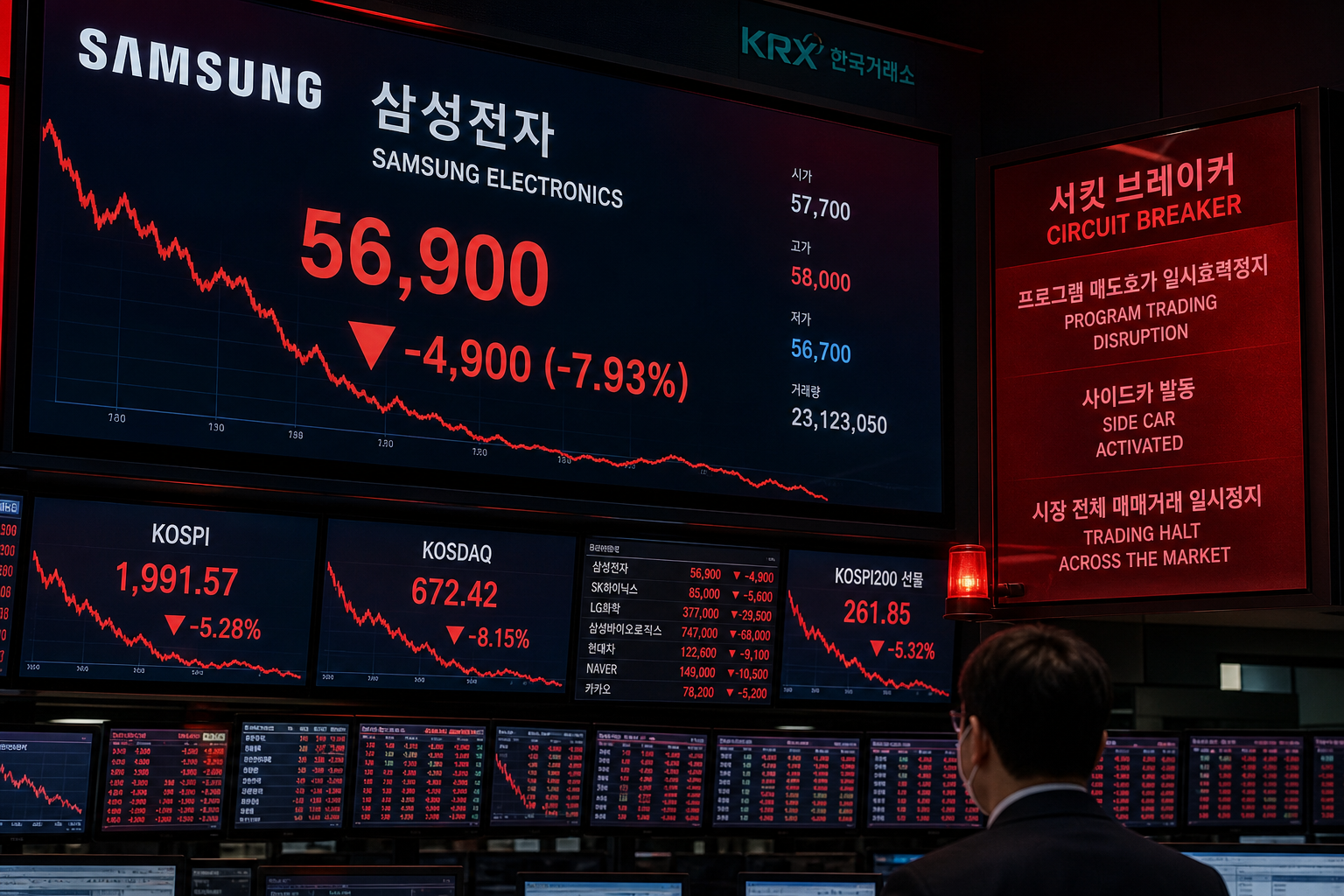
- Samsung Electronics reported a staggering 89.4 trillion won ($58.4 billion) in Q2 operating profit — up 1,810% year-over-year — with revenue hitting an all-time record of 171 trillion won, and the stock responded by crashing nearly 10%, wiping out $100 billion in market value in a single session
- The selloff was so violent it triggered a circuit breaker on South Korea's KOSPI index, halting all trading for 20 minutes after the benchmark plunged more than 8% — the first earnings-driven circuit breaker for Samsung in memory
- The contagion ripped through Wall Street: Micron plunged nearly 7% to $918, KLA Corp cratered 11.5%, SanDisk dropped 13%, and the Nasdaq Composite fell 386 points (-1.48%) — erasing Monday's entire AI-fueled rally in a single day
- Analysts say Samsung's results were "already priced in" after the stock's pre-earnings run-up, and the real fear is deeper: that memory chip oversupply is building and the AI data center rollout may be peaking sooner than the market assumed
- The Fed's FOMC minutes from Chairman Warsh's historic first meeting land today at 2 p.m. ET, with the dot plot split 9-9 between hawks and doves — and traders are bracing for the first real window into how the new chairman thinks about inflation
The Greatest Quarter Ever — and Nobody Cared
Samsung Electronics just delivered what may be the most impressive set of earnings in semiconductor history. And the market punished it.
On Tuesday, the South Korean chipmaking giant reported preliminary second-quarter operating profit of 89.4 trillion won — roughly $58.4 billion — a jaw-dropping 1,810% increase from a year earlier. Revenue surged 129% to an all-time record of 171 trillion won. It was the company's third consecutive quarter of record earnings.
To put that in perspective: Samsung's quarterly operating profit alone now exceeds the annual revenue of most Fortune 500 companies. The company's operating margin expanded to approximately 52.3%. DRAM average selling prices climbed 44% year-over-year. NAND prices jumped 53%.
And then Samsung shares crashed nearly 10%.
The selloff was so sudden, so violent, and so widespread that South Korea's stock exchange was forced to activate a circuit breaker — halting all trading on the benchmark KOSPI index for 20 minutes after it plunged more than 8%. A sell-side sidecar had already been triggered earlier in the session at 10:23 a.m. local time, suspending program sell orders for five minutes. It wasn't enough.
By the close, Samsung had lost roughly $100 billion in market value. On the day it reported the greatest earnings in the history of the semiconductor industry.
"Already Priced In" — The Three Words That Killed the Rally
Wall Street's explanation was blunt: the numbers were incredible, but they were expected.
Samsung's shares had rallied aggressively in the weeks leading up to the earnings release, as investors front-ran the AI-driven memory chip boom. By the time the actual numbers hit, the stock had already "priced in perfection." And when perfection arrived, there was nobody left to buy.
Analysts drew a direct comparison to what happened with Micron Technology earlier this year — another memory chip maker that reported blowout earnings only to see its stock sold off as traders took profits.
"Samsung's strong earnings were widely expected and had largely been priced in after its shares rallied ahead of the report," analysts noted. "The pattern resembles what happened recently with Micron Technology, which also saw profit-taking after a strong earnings surprise."
But the "sell the news" explanation only tells half the story.
The Deeper Fear: Is the AI Boom Peaking?
Beneath the profit-taking was a more unsettling concern — one that has been quietly building across Wall Street for weeks: the possibility that the AI data center buildout, the very engine that turned Samsung into a money-printing machine, may be approaching its peak.
Memory chip prices climbed throughout the quarter as AI spending broadened beyond high-bandwidth memory into conventional DRAM and NAND products. But some analysts worry that the pace of data center expansion is starting to slow, and that the current trajectory of chip demand is unsustainable.
SK Hynix, Samsung's closest competitor, added fuel to the anxiety by announcing a $28 billion share sale through Nasdaq-listed American depositary receipts — one of the largest equity offerings in global history. The timing raised eyebrows: why would the world's second-largest memory chip maker need to raise that much capital now, unless it expected the cycle to demand massive spending just to keep up — or feared it might need a war chest if the cycle turns?
The result was a feedback loop of selling. Samsung crashed. SK Hynix followed. And then the contagion crossed the Pacific.
The Global Ripple Effect
On Wall Street, the damage was immediate and broad.
Micron Technology — the closest American equivalent to Samsung in the memory chip space — plunged nearly 7%, opening at $922 and falling to as low as $891 before closing around $918. The drop came just one day after Micron had rallied on Monday's chip-sector rebound, effectively erasing those gains and then some.
KLA Corporation, a key semiconductor equipment maker, cratered 11.5%. SanDisk dropped 13%. Kioxia, Japan's largest flash memory producer, fell more than 12%.
The Nasdaq Composite dropped 386 points, or 1.48%, to close at 25,735 — wiping out Monday's entire rally. The S&P 500 fell 0.61% to 7,491. Even the Dow, which had just crossed 53,000 for the first time on Monday, slipped as Caterpillar and Goldman Sachs weighed on blue chips.
SpaceX, which was making its first full day as a Nasdaq-100 component, fell to roughly $151 — down sharply from its $162 close before the holiday weekend.
The Fed Minutes: Warsh's First Meeting Under the Microscope
As if the Samsung-driven chip carnage weren't enough, today brings another potential catalyst: the release of the FOMC minutes from Chairman Kevin Warsh's first meeting at the helm of the Federal Reserve on June 16-17.
The headline from that meeting was already known — the Fed held rates steady. But the details are what traders are watching for.
The dot plot from the June meeting split 9-9 between committee members favoring a rate hike and those preferring to hold or cut. Only 18 of 19 policymakers submitted projections, and Warsh confirmed during his post-meeting press conference that he was the one who abstained — an unusual move that left the market guessing about the new chairman's true leanings.
The minutes, due at 2 p.m. ET today, will provide the first real window into the internal deliberations of the Warsh-led Fed. With June payrolls coming in at just 57,000 — roughly half what economists expected — and inflation still running above the Fed's 2% target, the committee is caught between conflicting signals.
Hawks point to sticky inflation. Doves point to a weakening labor market. And the new chairman, so far, has refused to show his hand.
What It Means for Your Portfolio
The Samsung crash crystallizes the central tension of the 2026 market: the AI revolution is generating real, unprecedented profits — Samsung's 19-fold earnings growth proves that beyond any doubt — but the stocks that benefit from it have run so far, so fast, that even record-breaking results can trigger a selloff.
The Magnificent Seven already lost $2.3 trillion in June. Chip stocks rallied Monday and gave it all back Tuesday. The KOSPI triggered a circuit breaker on the best earnings report in semiconductor history.
Earnings season officially kicks off this week with PepsiCo reporting Thursday and Delta Air Lines on Friday. The big banks — JPMorgan, Goldman Sachs, Bank of America, Wells Fargo, and Citigroup — follow on July 14.
If Samsung's 1,810% profit growth couldn't hold a rally for a single trading session, the question every investor should be asking is: what can?
The answer might come at 2 p.m. today, when the Fed's minutes reveal whether Washington sees what Wall Street is only beginning to fear — that the easy money from the AI boom may already be in the rearview mirror.
Found this helpful? Share it with others.