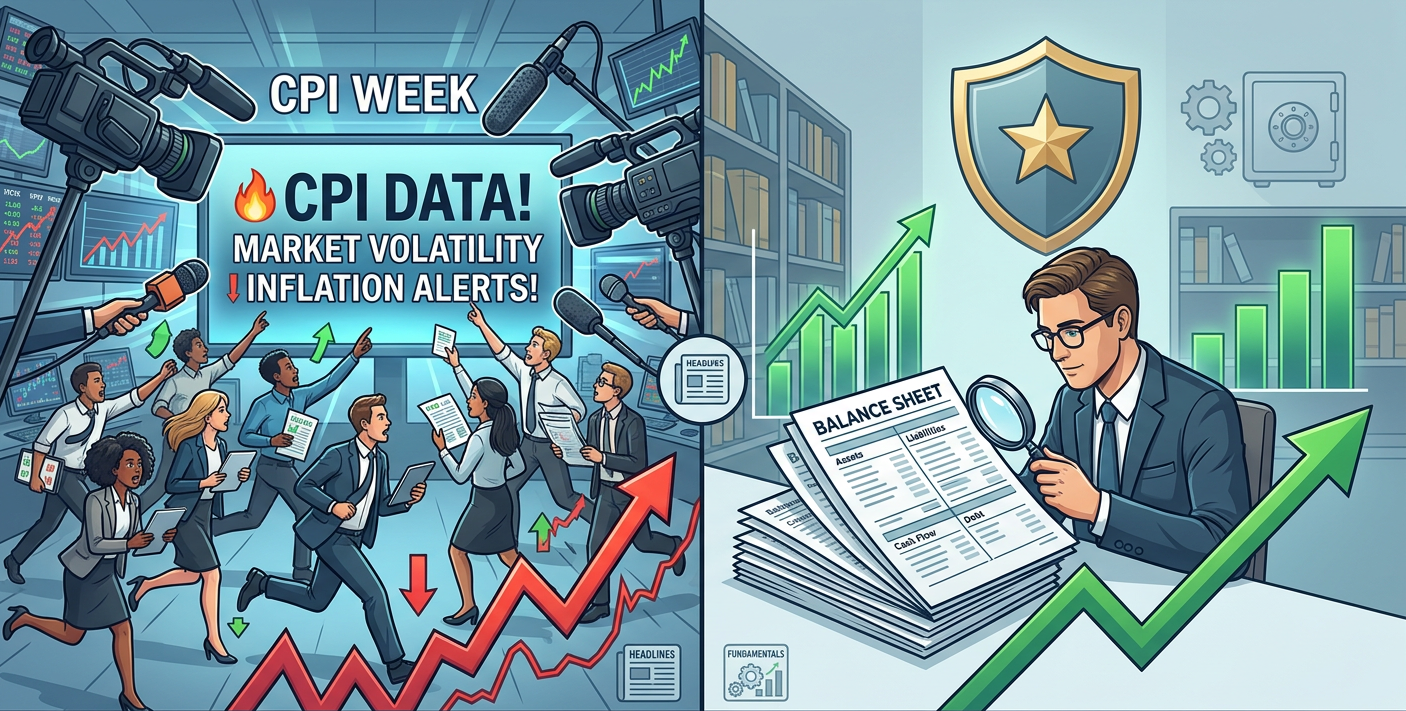
CPI Is the Headline. Cash Flow Is the Truth. Here's How to Trade the Week Ahead.
A quick note from Behind the Markets
Monday mornings are when Wall Street tries to reset the story. They'll tell you last week "proved" something — soft landing, rate cuts, whatever sells the most ad inventory.
Smart investors don't care about the story. They care about the plumbing: inflation prints, credit terms, and whether real-world cash flows can survive higher-for-longer.
This is a loaded week: June CPI drops Tuesday morning (the last inflation read before the Fed's July 28–29 meeting), bank earnings kick off the season, and a key crypto-regulation deadline lands Friday. And it comes right after oil round-tripped toward $80 on the renewed Iran flare-up — so the "inflation is beaten" crowd may be early. Here's what actually matters.
1) CPI Week: The Market Will Trade One Number. The Economy Will Pay a Thousand Bills.
Tuesday at 8:30 a.m., June CPI hits — and because it's the last major inflation print before the July 28–29 Fed meeting, the market will treat every tick as gospel. Retail gets whipsawed because the trade is faster than the reality. Recent readings ran hot (headline near 4.2% in May, driven by the energy spike), then energy cooled in June — but Friday's Iran-ceasefire collapse just pushed oil back toward $80, muddying the "inflation has peaked" story.
Here's the bigger point: even if inflation cools on paper, prices don't "un-charge" your credit card, sticky inflation shows up as margin compression for companies that can't pass costs through, and if rates stay elevated, the punishment hits borrowers first. The contrarian angle: a "good" CPI print can still be bad for your portfolio if it sparks a speculative rally into companies that need cheap capital to survive. So don't ask "what will the Fed do?" Ask: which businesses can self-fund and keep pricing power when the consumer taps out?
Company: Motorola Solutions (SYM: MSI)
Mission-critical public-safety communications — sticky, recurring, government-funded revenue with real pricing power
Motorola Solutions is about as insulated from a CPI headline as a company gets. Its bread and butter is mission-critical infrastructure — the land-mobile radios, command-center software, and video-security systems that police, fire, and emergency services literally cannot operate without. Roughly two-thirds of revenue comes from government and public-safety budgets, which are among the least discretionary dollars in the economy, and much of it is recurring software and services. That's genuine pricing power (agencies don't rip out their radio network because inflation ticked up) and a business that self-funds without begging the capital markets. It carries a wide competitive moat and a low beta (~0.88), exactly the "survives any print" profile this section is about.
MSI trades around $420, in the middle of its 52-week range ($359–$492). The honest caveats: it's not cheap at ~34x earnings (a premium that leaves little room for a stumble), free cash flow growth has been soft recently, tariffs are pressuring hardware margins, and there's a real (if occasional) risk that governments push back on pricing — as happened in the UK. You're buying durability and pricing power at a full price, not a bargain.
Bottom line: CPI is the headline. Cash flow is the truth. Trade the truth — own the businesses that get paid no matter what the print says.
2) Earnings Season Starts: The Real Bear Market Is in Footnotes
Earnings season is where narratives go to die. The Street will obsess over EPS beats and "AI initiatives." But the real signal is what management is forced to admit when nobody's really listening: refinancing costs rising, maturities coming due with no obvious path, covenant language tightening, inventory building where it shouldn't, and "strategic alternatives" (corporate code for: we need a lifeline).
Here's the underappreciated setup: a lot of companies aren't defaulting — they're getting quietly re-priced. They refinance at worse rates, sell assets, cut capex, or dilute shareholders and call it "strengthening the balance sheet." Wall Street applauds because the company survived; retail gets diluted and told to be grateful.
The edge this week is a checklist, not a single stock — and it's the lens for every earnings call you'll hear. Run each one through it: Is interest expense growing faster than operating income? Are they refinancing at sharply higher rates or shortening maturities to get a deal done? Are receivables stretching (customers paying slower)? Is inventory outgrowing sales? Did they announce a buyback and an equity raise in the same quarter? Did "strategic review" or "exploring alternatives" appear anywhere? Those sentences tell you more than the headline beat the algorithms trade in the first two seconds.
Bottom line: This week, ignore the "beats." Track the refinancing terms, the cash flow, and the dilution risk.
3) Energy: OPEC+ Keeps Adding Supply — So Stop Buying Oil on Geopolitics Alone
Retail loves the simple oil trade: "the world is dangerous, so oil goes up." But supply still matters — and OPEC+ just agreed to add another 188,000 barrels per day in August, its fifth straight monthly increase. Here's the tension that defines this week: rising OPEC+ supply is bearish, yet Friday's Iran-ceasefire collapse yanked oil back toward $80. That's a violent tug-of-war, and it's precisely why you don't play energy as a directional "vibes" bet.
When supply is rising and geopolitics keeps whipsawing the price, the market eventually stops paying for drama and starts paying for break-evens, low decline rates, discipline, and — best of all — contracted cash flows that don't care where crude closes on Friday.
Company: ONEOK (SYM: OKE)
Diversified midstream operator with ~90% fee-based cash flows — durability, not drama
ONEOK is the "own durability" answer to a volatile oil tape. It's a midstream company — it gathers, processes, transports, and stores natural gas, NGLs, and refined products across 60,000+ miles of pipeline — and roughly 90% of its earnings are fee-based, meaning it gets paid for the volume moving through its pipes, largely regardless of the commodity's price. That's the opposite of a leveraged bet on $90 oil. It raised 2026 guidance after a strong first quarter (EBITDA up 13%), and it pays a hefty dividend yielding roughly 4.8% — the kind of contracted, cash-generative durability that survives a mediocre or whipsawing tape.
OKE trades around $88–93 after rising nearly 20% this year, at about 16x earnings. The honest caveats: after that run it's no longer cheap (its PEG has crept above 2, pricier than peers like Enterprise Products or Energy Transfer), it still carries some volume/commodity sensitivity at the margins, and like all midstream it uses meaningful debt and has a large ($2.8–3.2B) capex plan. You own OKE for the durable, fee-based income stream — not for a commodity moonshot.
Bottom line: Energy isn't a vibes trade when supply is growing and geopolitics is whipsawing. Own durability — contracted cash flow — not drama.
4) Crypto's "Boring" Week: A Regulation Deadline Is a Liquidity Event
Crypto doesn't die from price. It dies from access. And this week has a real access catalyst: the GENIUS Act's implementing rules are due Friday, July 18 — the deadline for regulators to turn last year's stablecoin law into a concrete rulebook on issuer licensing, capital, and custody. As of early July, agencies hadn't finalized them, and the law has no fallback if they miss — which means the outcome genuinely reshapes who can operate. Stablecoins are the settlement rails; when the rules firm up, liquidity shifts toward the blessed venues and away from the rest.
The retail mistake is buying the hottest token. The edge is positioning around the pipes: compliant issuers, custodians, and regulated infrastructure. There's not a single ticker for this theme, and here's why. The most obvious compliant names have already re-rated hard on exactly this theme (Coinbase — which is even seeking a national trust charter tied to this framework — and stablecoin issuer Circle), so you'd be chasing. And the "safe" pick people reach for — the big regulated derivatives exchange — is actually facing a competitive threat here, because regulators are moving to allow crypto-native "perpetual futures" that could erode its franchise (it's even suing over it). So this week, treat this theme as a watch-and-position exercise: keep a list of the compliant issuers, custodian banks, and regulated infrastructure names, watch what the July 18 rules actually say, and let the ones that get "blessed" — ideally on a pullback, not a headline pop — come to you.
Bottom line: Watch the rulebook, not the chart. Liquidity follows legality — but don't chase the names that already front-ran the news.
5) Housing Isn't "Back" Just Because Rates Stop Rising for a Week
Wall Street loves to call a bottom; it makes them feel in control. But housing doesn't turn on vibes — it turns on affordability, credit availability, and job security. Even if mortgage rates drift down, the real questions are whether buyers can qualify and whether lenders want the risk. And if the economy softens, housing is where the second-order effects show up first: consumer balance sheets crack, delinquencies climb at the margins, and builders cut incentives only when forced.
So don't chase the "housing is strong" headline. Focus on who benefits from repair, remodeling, and necessity spend when people stay put — which is exactly what millions of homeowners locked into cheap mortgages are doing: renovating instead of moving.
Company: Lowe's (SYM: LOW)
Home-improvement retailer levered to repair, remodel, and maintenance — the "stay-put" spend
Lowe's is a direct play on the "trapped-in-place" homeowner. With mortgage rates high, people who'd normally trade up are staying and fixing up instead — repairs, remodels, appliances, paint, maintenance — which flows straight through Lowe's aisles. It's the #2 home-improvement retailer (~$86 billion in sales), a Dividend Aristocrat yielding ~2.3%, and it's leaning hard into the higher-margin Pro (contractor) customer and AI-driven tools to win share. Crucially for a value hunter, the stock has been punished — down roughly 24% from its February high — as the market frets about the housing freeze.
That pullback is the setup and the warning, so be clear-eyed: this is a genuinely tough housing tape. Lowe's comparable sales were barely positive last quarter (+0.6%), fiscal-2026 earnings actually declined, big-ticket discretionary remodels stay soft while rates are high, and analysts have been trimming price targets (though most still sit above today's price, averaging ~$264). This is "buy a quality operator while its cyclical end-market is out of favor" — not a bet that housing roars back tomorrow.
Bottom line: Housing recoveries are slow and uneven. Don't confuse "less bad" with "good" — but do own the businesses that get paid when people stay put and fix up.
Before You Go
Here's the contrarian question for the week: if the market rips on a "good" inflation print… will you chase the rally — or use the liquidity to rotate into balance sheets that can survive any print?
That one decision is the difference between trading headlines and building wealth.
Found this helpful? Share it with others.
Written by Behind the Markets