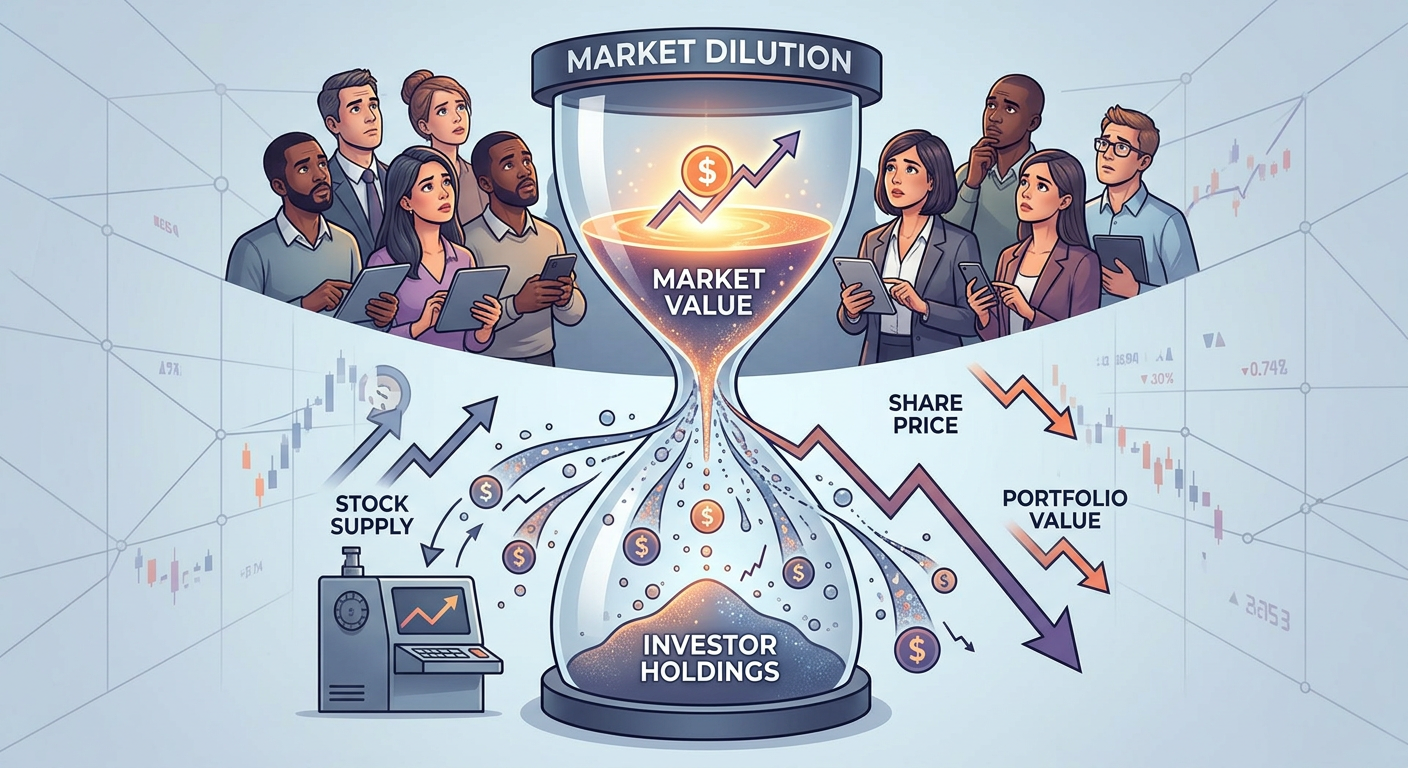
Watch Terms, Not Price: The Quiet Ways This Cycle Waters You Down
A quick note from Behind the Markets
Wall Street is going to spend today arguing over whether the next Fed move is a cut or a hold.
We're watching something more important: who can finance themselves when credit gets mean.
Because the real bear market doesn’t start with a crash.
It starts with “liquidity solutions” and shareholder dilution.
1) The New "Default Cycle" Won't Look Like 2008 — It'll Look Like Dilution
Most retail investors are trained to watch for bankruptcies. Wrong move. This cycle's pain shows up earlier and quieter: emergency equity raises marketed as "strengthening the balance sheet," convertibles that cap your upside, sale-leasebacks that look clever until rent becomes the new interest expense, and "strategic alternatives" that appear right after management promised everything was fine.
Here's the contrarian point: a company can avoid default and still destroy shareholders. The Street claps because it "survived." Your ownership gets watered down.
So here's your checklist for the next few quarters — and it's a discipline. Before you trust any earnings headline, pull the filings and check: How much cash is on the balance sheet, and is free cash flow positive or burning? When do the debt maturities actually hit, and at what rate would they refinance today? Is the share count quietly creeping up quarter after quarter? Does management have a history of "creative financing" — convertibles, dilutive raises, sale-leasebacks? A company that scores badly on those can look fine on the income statement right up until liquidity becomes the whole story.
Bottom line: Survival is not the same as shareholder-friendly. In this market, dilution is the default.
2) AI Isn't Just Chips — The Next Bottleneck Is Power (And That's Where the Money Goes)
Everyone wants the flashy AI exposure: GPUs, model launches, "agent" demos. But enterprise AI at scale is brutally physical — electricity, transformers, switchgear, cooling, and grid interconnects. You can't conjure grid capacity overnight; you have to build it, which creates multi-year backlogs and pricing power for the right suppliers. That's the real AI trade: follow the bottleneck, not the buzzwords.
Company: nVent Electric (SYM: NVT)
Electrical connection, protection, and liquid-cooling systems for data centers — a direct power-and-cooling bottleneck play
nVent makes the unglamorous-but-essential gear that powers and cools AI data centers: enclosures, bus systems, power connections, and — critically — liquid-cooling solutions for the high-density racks that today's AI chips demand. The business is booming: record Q1 2026 sales up 53% year-over-year (organic up ~34%), a $2.6 billion backlog with visibility into 2027, and management raised full-year guidance to ~$4.45–4.55 EPS. This is exactly the "power-and-infrastructure" bottleneck you want to be on top of.
Now the honest part, and it's important: this is not an undiscovered stock. NVT has surged more than 30% to all-time highs (around $180), Goldman just removed it from its conviction list, and it's carrying $80 million in tariff headwinds. It's a genuinely great business riding a multi-year wave — but you'd be buying after a big move, at a premium, so treat it as a watchlist name to accumulate on pullbacks rather than one to chase on a green day. (For a lower-profile way to play the same bottleneck, Advanced Energy Industries and Powell Industries are worth your own diligence — though both have also run.)
Bottom line: The AI boom is turning into a power-and-infrastructure boom. Follow the bottleneck — but mind the price you pay, because the crowd already found this one.
3) Reshoring 2.0: The Trade Isn't "Buy the Champion" — It's Buy the Boring Enablers
Every time Washington talks up domestic manufacturing, the market chases the "national champions." But policy doesn't guarantee execution, and big politically-important companies have a habit of becoming expensive disappointments. The cleaner angle is two layers down: specialty materials, testing and inspection, packaging and advanced manufacturing services, niche automation, and the logistics that make onshore production actually work. These businesses just need the buildout to keep happening.
Company: Keysight Technologies (SYM: KEYS)
The dominant electronic test-and-measurement company — every new chip, device, and network has to be validated on its instruments
Keysight is a picks-and-shovels enabler of the entire electronics and reshoring buildout. Whatever gets designed and manufactured — chips, 5G/6G gear, EV electronics, data-center hardware, defense systems — has to be tested and validated, and Keysight's instruments and software are the industry standard for doing it. That's a toll-booth position on the electronics economy, with recurring software and services attached, and revenue recently growing ~19% with strong free cash flow.
Same honesty as above, though — arguably more so: KEYS has roughly doubled (up ~106%) over the past year to around $310–340, and by most valuation screens it's now expensive (well above estimated intrinsic value). The "underfollowed, mispriced" version of this trade is largely gone — the market has repriced quality test-and-measurement for the AI/reshoring era. It's a wonderful franchise; it's just no longer cheap. Watchlist it, define a price you'd actually pay, and let volatility bring it to you. (If you want a genuinely beaten-down, contrarian version of the "inspection/automation" theme, machine-vision maker Cognex has not run — but it has real cyclical headwinds, so do the work.)
Bottom line: Reshoring winners won't all be household names — but the boring enablers have been discovered too. The edge now is buying them right, not just buying them.
4) Biotech M&A Watch: Big Pharma Has a Problem… and Mid-Caps Are the Fix
Biotech is one of the few places where Wall Street pessimism can hand retail a real edge. When the tape is ugly, valuations compress and financing dries up — and suddenly teams that wanted to "go it alone" start taking calls. Meanwhile big pharma's patent cliffs don't care about sentiment. So the setup is durable: de-risked mid-caps get cheaper, big pharma needs pipeline, and deals happen when the sector feels dead.
The actionable move isn't guessing the next takeout — it's building a watchlist around strategic logic. Screen for assets that plug into an existing sales force, platform tech that de-risks a buyer's pipeline, or categories where a buyer can pay up and still call it "accretive." And here's a real-time reality check from this week's homework: the cleanest de-risked names have already been noticed — profitable leaders like United Therapeutics and Neurocrine have roughly doubled and no longer offer a margin of safety, while several obvious mid-caps have flipped from target to acquirer (BioMarin bought Amicus; Alkermes bought Avadel). So the discipline is twofold: own the strategic logic, but also insist on a price that isn't already pricing in the buyout. The best entries come when the sector is hated and the de-risked names are cheap — not after they've run.
Bottom line: When biotech feels the worst, the bid shows up. Your edge is being early, selective, and unwilling to pay up for a takeout that may never come.
Before You Go
Wall Street wants you watching price. I want you watching terms. In this market, the winners aren't the loudest stories — they're the companies that fund themselves, keep leverage under control, and avoid "creative" financing that enriches everyone except shareholders.
And when the good businesses have already run? Patience is a position too.
Found this helpful? Share it with others.
Written by Behind the Markets