Morning Watchlist: Monday Edition
A quick note from Behind the Markets
It's Labor Day. The market is taking the holiday — no opening bell until tomorrow. We're not taking it off, because a closed market is the best time to study one: nothing is flashing red or green to distract you from what actually matters.
Sunday's edition mapped the week ahead. Today we go a different direction — three stories built to outlast a long weekend. A price record almost nobody celebrated, set at every truck stop in America. A corner of technology that quietly caught fire while the crowd argued about Broadcom. And the most beloved store in the country, whose stock has a problem the store can't fix.
Three stories this morning. Three pairings. Let's get into it.
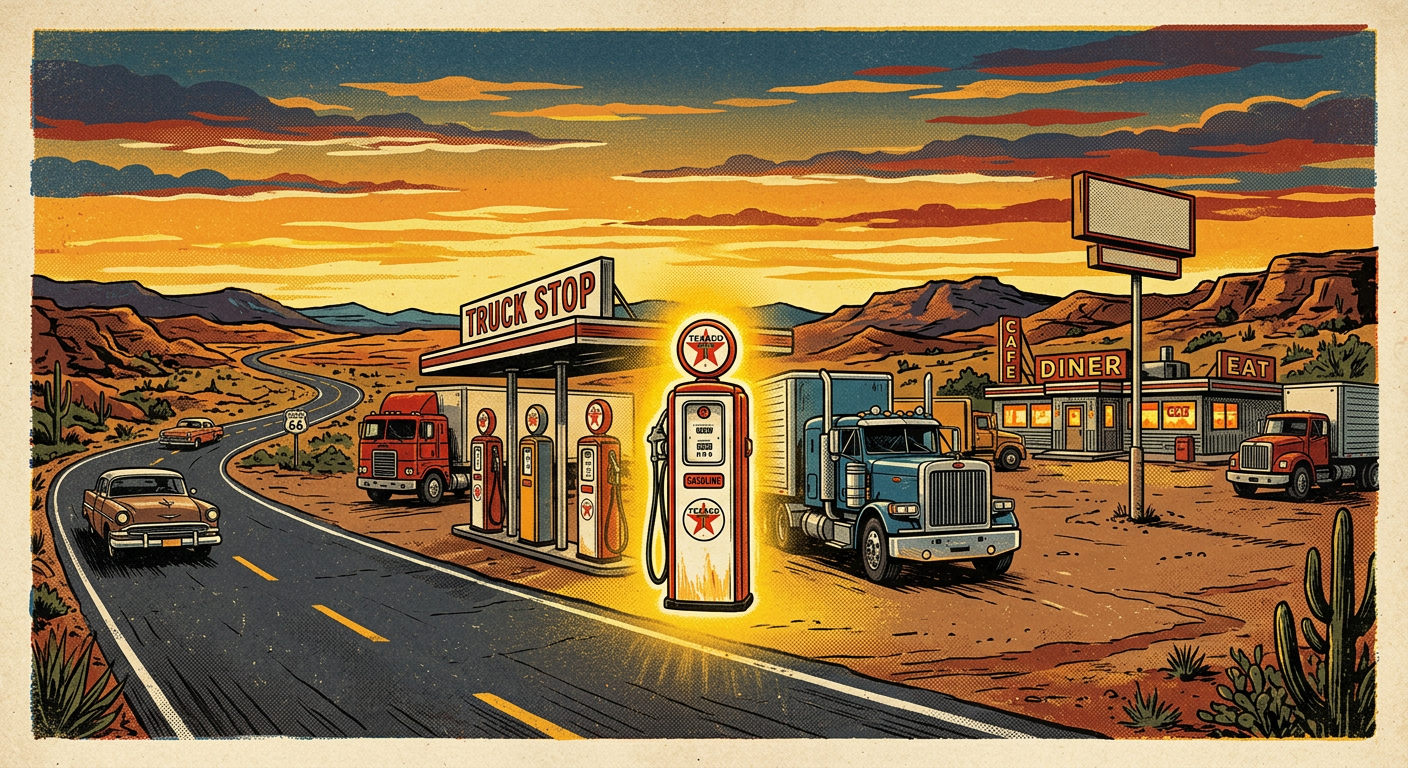
1) The Record Nobody Celebrated at the Truck Stop
Gold's record made headlines. Diesel's didn't.
On Thursday, retail diesel hit $5.82 a gallon — an all-time record. And the number behind that number is wilder: the diesel "crack spread" — the gap between what a refiner pays for crude oil and what it sells diesel for, which is to say the refiner's profit margin — topped $106 a barrel on September 1st. Also a record. It had never crossed $100 in history until August.
Why is this happening? Because the world is short refineries, not oil. Strikes on Iran have been disrupting fuel shipments through the Strait of Hormuz since late winter. Ukrainian drones have knocked out Russian refineries, and Moscow answered with fuel export bans. So American refiners are exporting diesel as fast as they can make it, domestic inventories have fallen to record seasonal lows — and heating season, when diesel's sister fuel heats millions of homes, starts now.
The obvious trade is the refiners. The crowd found that one months ago — refining stocks have been soaring all summer. We'd rather stand one step behind the headline, where a stranger business collects the same record price.
The pairing: Darling Ingredients (DAR) — Buy
Darling is the biggest name in one of the least glamorous industries on Earth: rendering. Its trucks collect used cooking oil from restaurants and leftovers from slaughterhouses — and its Diamond Green Diesel joint venture with Valero turns that grease into renewable diesel, a fuel that sells into the very market that just set the all-time record. Think about that business model for a second. Restaurants pay to have the old fryer oil hauled away. Then the hauler sells what it hauled — refined — at record diesel prices. You get paid at both ends of the truck route.
The second quarter beat expectations on Diamond Green Diesel's strength — $387 million of net income on $1.7 billion in revenue — and the company announced a $1 billion share buyback and agreed to sell roughly $150 million of production tax credits, turning policy support directly into cash. At Thursday's close of $65.75, Darling is a $10.4 billion company trading at about 17 times earnings. The S&P 500: about 21. Wall Street's targets sit roughly 29% higher.
The honest risks: we are not early. The stock has more than doubled off its 52-week low of $29.15 and sits about 6% from its high. Renewable fuel margins lean on Washington's tax credits, record crack spreads eventually mean-revert, and grease prices rise with diesel too. And the cheerful way to lose this trade: peace breaks out in two war zones at once. We'd take that deal.
2) While Everyone Argued About Broadcom, the Software Aisle Caught Fire
Wednesday night, the market marked Broadcom down over a guidance rounding error. Here's what happened the same night, three tickers down the earnings calendar, while nobody watched.
Snowflake — the cloud data platform — reported revenue of $1.55 billion, up 35%, with earnings of $0.62 a share against the $0.45 Wall Street expected. That's the third straight quarter its growth rate accelerated. The CEO's words: "we have added 7 points of acceleration in just 2 quarters" — about half of it from AI products. Thursday, the stock jumped 16.6%.
And it wasn't alone. NetApp, the data-storage company, grew revenue 30% with earnings up 66% and record flash-storage sales, and raised its full-year outlook. Hewlett Packard Enterprise earned $1.11 against a $0.95 estimate and rose 5% Thursday.
Step back and read those together. Corporate IT budgets — frozen for two years while every spare dollar chased AI chips — are moving again, and this time the money is landing on software, storage, and servers all at once. When every vendor on the shelf beats in the same week, the story isn't any one vendor, it's the whole shelf.
The pairing: TD SYNNEX (SNX) — Buy
TD SYNNEX is one of the world's largest technology distributors — $70 billion a year of other people's products flowing through its warehouses. When a company buys NetApp storage, HPE servers, or Fortinet firewalls (Fortinet just named it a global distributor), odds are the order moves through a distributor like this one. It's the beer distributor of corporate tech: whichever brand the bar pours, the delivery truck gets paid. Its Hyve division even assembles AI servers for the giant cloud companies, and is expanding two Nevada campuses to build more.
The June quarter was a record: revenue of $19.6 billion, up 31%, with adjusted earnings up 62%. And the price of all that? At about $263, roughly 13 times next year's expected earnings. The S&P 500: 21. Fifteen-plus analysts call it a Buy with an average target near $334.
What would prove us wrong: distribution runs on pennies-per-dollar margins, so small stumbles cut deep; the Hyve server business depends on a handful of enormous customers; and the next report lands September 24th — a high bar after a record quarter.
3) America's Favorite Warehouse Has a Price Problem
Let's be clear up front: Costco may be the best retailer alive. It just finished a fiscal year with $297.3 billion in sales, up 10.2%, and on Wednesday it reported August sales up another 9.9%.
And the stock fell anyway — because comparable sales grew 5.4% against the 6.1% the Street wanted. That's now a familiar pattern. Costco shares sit about 15% below their 52-week high and have lost roughly 8% over the past six months while the business kept growing double digits. Even a friendly analyst — DA Davidson, with a $1,000 target — holds a Neutral rating and points to sales metrics decelerating month over month.
Here's the problem, and it isn't the warehouses. At around $930, Costco trades at roughly 56 times earnings. The S&P 500 costs 21. BJ's Wholesale — the club we paired in Sunday's edition — costs 19. It's the best house on the block, listed at triple the neighborhood's price per square foot. A great house. A bad deal. And when a stock is priced for perfection, "very good" counts as a miss — August proved it again.
The pairing: Costco (COST) — Sell
A Sell here means what it always means in this letter: for readers who already own it and are sitting on years of gains, this is a sensible place to take some off the table — not a bet against the company. The case against us is real, and we'll state it plainly: Costco has embarrassed valuation skeptics for a decade, its members are famously loyal, and it has a history of paying surprise special dividends. But six months of a falling stock against 10% sales growth is what a deflating multiple looks like in real time. When the story stays this good and the stock stops going up, the price was the problem all along.
Before You Go
A diesel record that pays the grease collector, an IT spending thaw that pays the middleman, and a beloved warehouse whose stock costs triple the club next door. One theme runs through all three: the story and the price are different things. Buy the good story at the fair price, and hand the perfect story at the perfect price to somebody else.
The bell rings again tomorrow morning — and with it, GameStop's report, Canada's tariffs going live, and the rest of the four-day sprint Sunday's edition laid out. Enjoy the holiday first.
We'll see you tomorrow.
Found this helpful? Share it with others.
Written by Behind the Markets