Morning Watchlist: Sunday Edition
A quick note from Behind the Markets
It's Sunday morning, and the market gets one more day off — closed Monday for Labor Day. That makes this a four-day week. It may be the most important four-day week of the quarter.
Here's why. On Friday morning the August jobs report landed: 162,000 jobs added against expectations of roughly 56,000, unemployment steady at 4.1%. After July's outright job losses, that's not a labor market cooling — that's one that just sat up in bed.
Meanwhile the Fed has gone quiet for its pre-meeting blackout, the September 15–16 meeting waits at the end of the tunnel, and Friday brings the last big number before the vote: the August CPI.
Four stories this morning. Four pairings. Let's get into it.
1) The Fed Goes Quiet. The Bond Market Won't.
Going into Friday, futures had a September hike priced near a coin flip. By mid-morning Friday, the payroll surprise had pushed those odds to about 60%, from 49% the day before; the two-year yield ticked up to 4.37% while stocks mostly shrugged. And with the Fed in blackout, there will be no soothing speeches this week. Just data, and the bond market arguing with itself about it, all four days, at the highest yields in a generation.
Here's the thing about that argument: somebody hosts it.
Tradeweb is the electronic marketplace where a huge share of the world's bonds change hands. Friday morning it reported August numbers: $2.8 trillion in average daily volume, up 13.7% from a year ago — including $282.5 billion a day in U.S. government bonds, up 28.9%. Think of it as the farmers' market for bonds: it doesn't grow the produce and doesn't bet on prices. It charges a nickel a bag — and Washington backs a bigger truck up to the gate every month.
The pairing: Tradeweb Markets (TW) — Buy
The stock closed Thursday near $106, and the crowd has been walking away from it for over a year even as volumes set records. At about 25 times earnings it isn't in the bargain bin — the S&P 500 costs about 21 — but this is a business with a 43.6% operating margin, $2 billion of cash, almost no debt, and 15 analysts at a consensus Buy averaging a $124 target. Whether the Fed hikes or holds, the arguing itself is the revenue.
The honest risks: August's growth tilted toward lower-fee trading, so volume records don't automatically become revenue records — fee pressure is the bear case in one word. And if the bond market ever truly calms down, the stalls empty out. We're still waiting for that calm.
2) The Loudest Stock of 2021 Is Cheaper Than Its Wallet
Tuesday, when trading resumes, GameStop reports full second-quarter results. Yes, that GameStop. Forget 2021 and look at what this company is now.
In May, Ryan Cohen made an unsolicited bid of roughly $56 billion for eBay. The board rejected it — and Cohen kept buying anyway. GameStop now holds 43.4 million eBay shares worth about $4.9 billion — a 9.75% stake, making it eBay's second-largest shareholder. Add the roughly $5.05 billion in cash and securities from its preliminary results, and about $10 billion sits in the wallet.
GameStop's entire market value: about $8.25 billion.
Read that again. The market is selling the wallet for less than the bills inside — and throwing in a retail business that earned $150–170 million in operating income last quarter, more than double a year ago, even as sales fell to $780–800 million from $972 million.
The pairing: GameStop (GME) — Watch
So why not just buy the discount? Because the wallet belongs to a man who likes to spend. This quarter's profit includes about $238 million of eBay-related gains — and about $75 million of losses on digital assets. The stock now trades on eBay's tape as much as its own, and the discount only pays if the cash comes back to shareholders instead of funding the next pursuit. Tuesday we hear the plan. At about $18.40 Thursday, we want proof of discipline — a buyback, a stated intention, anything. A discount you can't collect isn't a discount. What kills it: another mega-bid, or the crypto line item growing.
3) The Biggest Bill in Tech Comes Due Thursday
Thursday after the close, Oracle reports — the AI trade's real exam this week. Oracle carries a $638 billion backlog of contracted cloud work, and to build the data centers that deliver it, it spent its way to negative $23.7 billion of free cash flow last fiscal year — with roughly $70 billion of capex planned for this one, funded partly by about $40 billion of new debt and stock. Broadcom just got marked down for a wonderful quarter. Now the crowd decides whether Oracle's construction bill is a war chest or a warning.
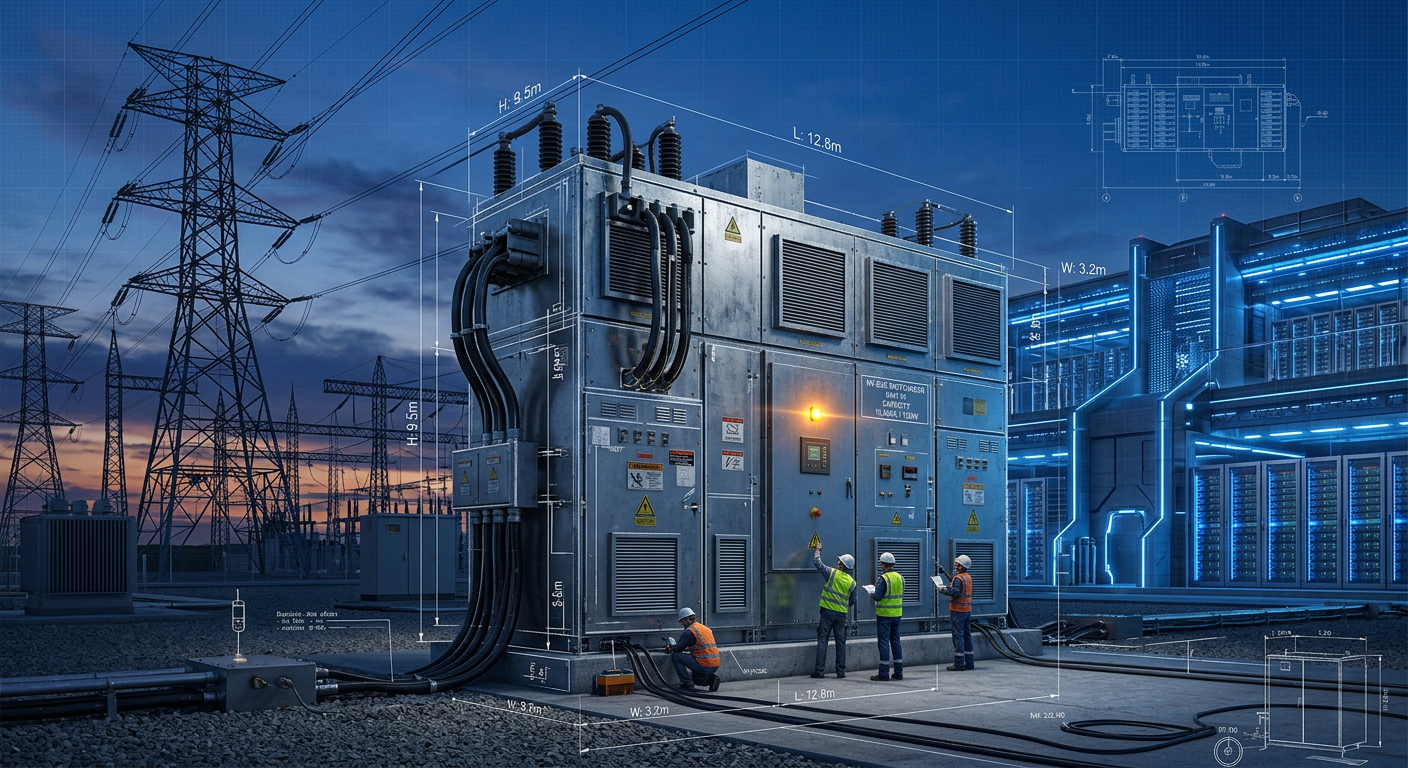
Here's what doesn't change Thursday night: the buildings already ordered still get built, and every one needs the same unglamorous thing. Your house has one gray box between the power line and everything you own. A data center's gray box is the size of a school bus, and Powell Industries has been building them for 79 years.
The pairing: Powell Industries (POWL) — Buy
Powell makes the switchgear — industrial-scale circuit breakers and control gear — between the grid and the servers. In its August report, quarterly orders nearly tripled from a year earlier to $934 million, including a single data-center order above $400 million, pushing backlog to $2.375 billion — the largest in the company's history, and more than two years of revenue already signed. Five years ago, commercial and industrial work was 3% of that backlog. Today it's 40%. The company changed lanes, and the new lane is a freeway.
And the stock? It closed Thursday near $175 — nearly half off its 52-week high of $328 — because that same August report missed earnings estimates by a nickel. Market cap: about $6.4 billion, squarely in our wheelhouse; four covering analysts average a $280 target. At about 27 times next year's expected earnings it's not cheap — you're paying for the backlog converting on schedule. The risks, plainly: if Oracle blinks on capex, this whole aisle gets marked down with it; orders this lumpy can disappoint in any quarter; and Powell has to build capacity fast enough to cook what it already sold.
4) Friday Prints Your Grocery Bill. Twice.
Friday morning is the week's crescendo: the August CPI hits at 8:30 — July's ran 3.7% against a 2% target — while Kroger, the country's biggest traditional grocer, reports the same morning. One number says what food costs; the other says what shoppers are doing about it.
We already know part of the answer. They're paying cover charges to escape.
BJ's Wholesale runs membership warehouse clubs across the eastern U.S., and its August report was quietly one of retail's best: comparable sales up 11.9% — up 3.1% even excluding gas — membership fee income up 9.9%, a record 8.5 million members, raised full-year guidance. The model is a nightclub that makes its money at the door: the fee is the profit, and the groceries inside sell near cost. When food inflation runs hot, a membership card becomes the cheapest thing in the cart — and with oil in the $90s, the CEO credited "the value we offer at the pump." Expensive gas is BJ's best salesman.
The pairing: BJ's Wholesale Club (BJ) — Buy
At Thursday's close near $93, BJ's costs about 19 times next year's expected earnings — under the S&P's 21 — with a raised outlook and 23 analysts at consensus Buy, average target near $106. The honest risks: the discount to the market is thin; if crude retreats, the pump advantage narrows — and it slipped about 2.5% Friday morning; and 3.1% ex-gas comps are solid, not spectacular. But inflation is a headwind for almost every retailer — for the one selling memberships to escape it, it's a raise.
Before You Go
That's the watchlist: the marketplace hosting the bond market's argument, a wallet selling for less than the cash inside, the gray box behind the AI build-out, and the club charging cover at the door of food inflation. Two housekeeping notes. Friday's hot jobs number is exactly the "wrong if" we wrote on our August 30th Robert Half sell — the grading started Friday, and next Saturday's review will do it out loud. And Lululemon's Thursday-night report got a brutal early verdict: the stock was down about 17% Friday morning. We'll read the print with fresh eyes before Heidi O'Neill's first day Tuesday — the same day Canada's tariffs go live, with Apple's show Wednesday.
The week's biggest moment comes last: Friday, 8:30 AM, the August CPI — the final word the Fed hears before it meets, with a hike still live on the table. Everything else is the warm-up act.
Enjoy the long weekend, we'll see you tomorrow.
Found this helpful? Share it with others.
Written by Behind the Markets