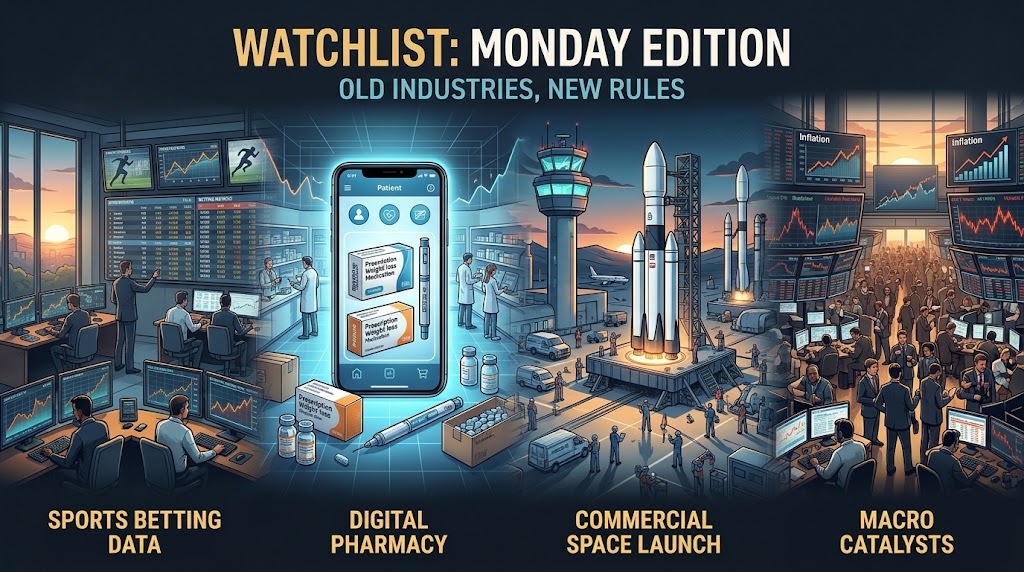
Morning Watchlist: Monday Edition
A quick note from Behind the Markets
It's Monday, and the new week opens with an economy that keeps refusing to cooperate with the people predicting its slowdown. Friday morning's jobs report showed 165,000 jobs added in October — nearly triple the roughly 60,000 Wall Street expected — with September revised higher too. Strong economy, sticky rates: by Friday morning, markets put the odds of a December Fed hike near 78%.
But the stories that caught our eye weren't about the economy. They were about three old industries getting new rules — who sells sports bets, who sells weight-loss drugs, and who gets to launch rockets. When the rules of a market change, the crowd argues about the players. We look at who runs the market.
Three stories this morning. Three pairings.
Let's get into it.
1) The Bookmaker Tore Up Its Own Forecast
Thursday night, DraftKings reported a quarter that was merely disappointing — revenue of $1.33 billion, up 16% but short of estimates, and a wider loss than expected.
Then it did something louder. It cut its full-year profit forecast (measured as adjusted EBITDA — roughly, operating cash profit before a list of accounting items) from a range of $700 to $900 million to $175 to $275 million. Not trimmed. Torched. The reason, by the company's own telling: it is pouring as much as $700 million this year into "Predictions," its prediction-markets product, with hundreds of millions more budgeted for next year. Friday morning, the stock traded below $20 — down more than 25%, against a 52-week high near $37.
Why would a bookmaker set fire to half a billion dollars of its own profit? Because of who's at the door. Prediction markets — exchanges like Kalshi and Polymarket, where people trade yes-or-no contracts on real-world outcomes, sports very much included — grew from about 9% of legal U.S. sports-betting volume in January to roughly 27% during the World Cup, by H2 Gambling Capital's estimate. During the tournament, Kalshi's app had more daily users than DraftKings' or FanDuel's, according to Apptopia. This is a land war now. DraftKings just published the cost of defending its turf.
We have no interest in guessing which army wins. We'd rather own the company both armies already pay.
The pairing: Sportradar (SRAD) — Buy
Sportradar collects and sells official sports data — the live feeds any betting operator needs to set odds and settle wagers the moment the whistle blows. Last Tuesday it reported its own third quarter: revenue up 24%, U.S. revenue up 47%, and — this is the part we underlined — its first quarter with prediction-market money in the numbers. The customer list now reads like both sides of the battlefield: the sportsbooks on one side; Kalshi, Polymarket, Novig, and Robinhood — its first brokerage partner — on the other, plus roughly ten market-making firms signed and, by management's count, more than 300 potential customers behind them. The new contracts mix fixed fees with payments tied to trading volume, so the land war's growth becomes Sportradar's growth.
An auction with one bidder is a sale. An auction with two bidders is a price. For twenty years, sports data had one kind of buyer. It just got a second.
The stock jumped 10% on the report, to about $14 — and it is still down nearly half this year, carries over $200 million more cash than debt, and the average analyst target sits near $18. The honest wart: at roughly 30 times next year's expected earnings, this is not the single-digit cheap we usually hunt — the discount here is in the growth, not the multiple. The kill: courts or regulators shutting down sports prediction contracts, which would erase the new buyers overnight — or Brazil's betting restrictions, which Truist says threaten about €60 million of annual revenue.
2) The Pharmacy Counter Moved Into the App
On Friday morning, Reuters reported that Eli Lilly — the roughly $1.2 trillion drugmaker — agreed to sell its obesity drugs directly on Hims & Hers, the telehealth platform. Zepbound from $299 a month. Its new pill, Foundayo, from $149. Cash prices, no insurance card required. Until now, Hims customers had to leave the site and buy from Lilly's own storefront.
Novo Nordisk — Lilly's great rival — has been selling Wegovy on the same platform since March.
Step back and look at what that is. The two giants of the most important new drug market in the world now stock the same independent shelf. Lilly says 40 to 45% of Zepbound sales already run through self-pay channels — no insurer, no pharmacy-benefit middleman, no drugstore line. The pharmacy counter is quietly relocating into the phone. And when the two biggest brands in the business both insist on your front window, the shop is winning.
The pairing: Hims & Hers (HIMS) — Watch
Hims & Hers runs the storefront: about 2.9 million subscribers as of mid-year, up 19%, buying everything from hair-loss treatment to, now, both houses' weight-loss drugs. The stock went into the weekend in the mid-$20s — up 7% in Friday's premarket on the Lilly news, still down more than 20% this year, with Wall Street's average price target up at $32.82.
So why Watch and not Buy? Because the report card lands today. Hims reports third-quarter results Monday — the Street expects revenue up about 49%, to roughly $893 million — and the options market is pricing a move of nearly 17% in either direction. We don't buy lottery tickets on the morning of the drawing. There's also a real question inside the numbers: Hims built much of its weight-loss growth on compounded copies — cheaper, pharmacy-mixed versions that once drew a Novo lawsuit — and Friday's deal keeps Lilly knockoffs permanently off the menu. Branded drugs bring credibility and traffic; they may bring thinner margins. The entrance: a post-earnings markdown, or proof on the call that the branded pivot pays. The kill: a weight-loss guide-down that says the storefront gave up its best margin for the privilege of the window display.
3) Washington Cleared the Runway
Quietly, late last week, the Transportation Department said it plans a comprehensive overhaul of commercial space-launch licensing beginning next year — with a stated goal of an FAA that can support 1,000 launches a year by 2030, several times today's pace. SpaceX, newly public and the biggest name on the pad, rose almost 7% Friday morning on the news, to about $132.
Here's how to think about launch licensing. Every rocket waits in line for its paperwork the way every driver waits at the DMV. Washington just promised to open more windows. The crowd bought the company at the front of the line — but SpaceX already launches more than anyone, so a faster line changes its year the least. The company a faster DMV changes most is the one with the second-longest line.
The pairing: Rocket Lab (RKLB) — Watch
Rocket Lab is the busiest American launch company not named SpaceX — its small Electron rocket flies constantly — and it builds satellites and spacecraft components besides. It reports tonight, after the close: the Street expects revenue up about 65%, to roughly $257 million, with a loss of about two cents a share. The stock closed Thursday near $46, down about 27% over three months, and the balance sheet carries almost no debt.
So why not buy the second spot in line? Price, and a rocket that hasn't flown. At roughly 26 times sales — that's price-to-sales, what you pay for each dollar of revenue, before any profit; the industry average is about 7 — the stock is priced as if Neutron, the bigger rocket it needs to chase the heaviest contracts, were already on the pad. It isn't: Neutron has slipped to 2027. Tonight's call is the exam. The entrance: a Neutron timeline that finally holds, or a washout print that puts the multiple back on earth. The kill: another Neutron slip — or the small-cap selloff (the Russell 2000 fell more than 4% Friday morning) dragging every high-multiple name down with it.
Before You Go
That's the watchlist. A bookmaker burning its forecast to fight a land war — and the data seller both armies pay. Two drug giants crowding onto one storefront's shelf. And a cleared runway for the company second in line. Two of this morning's three names report today; that's deliberate. We'd rather tell you what to look for before the test than explain the grade after it. And keep Tuesday morning circled: the October CPI, the Fed's last inflation reading before December 9 — our Sunday note has the full checklist.
Found this helpful? Share it with others.
Written by Behind The Markets