Morning Watchlist: Wednesday Edition
A quick note from Behind the Markets
We're at the midpoint of the week, and the entire market is staring at one clock. After Wednesday's closing bell, Nvidia reports earnings — the biggest report of the season, with Wall Street expecting roughly $93 billion in quarterly revenue.
We'll be watching too. But regular readers know the drill by now. The loudest number of the week is almost never the best opportunity of the week. So while the crowd refreshes one earnings feed, we went shopping one step behind three other headlines.
Three stories this morning. Three pairings. Let's get into it.
1) The Bill for the AI Boom Just Arrived
Here's the story hiding underneath the Nvidia countdown. Bloomberg reported that Nvidia has begun notifying customers — the Microsofts, Googles, and Oracles of the world — that AI server prices are going up more than 15% for systems shipping early next year.
Not because Nvidia is feeling greedy. Because of memory. Every AI server is stuffed with memory chips, and there suddenly aren't close to enough of them. TrendForce estimates that contract prices for DRAM — the workhorse memory in every server — jumped 90–95% in the first quarter alone, with another 58–63% projected for the second. Memory is now roughly a quarter of the cost of a high-end AI rack.
The crowd found the obvious winner months ago: Micron, the big American memory maker, is up more than 600% over the past year and crossed $1,000 a share this month. That ship has sailed, been photographed, and put on a postcard.
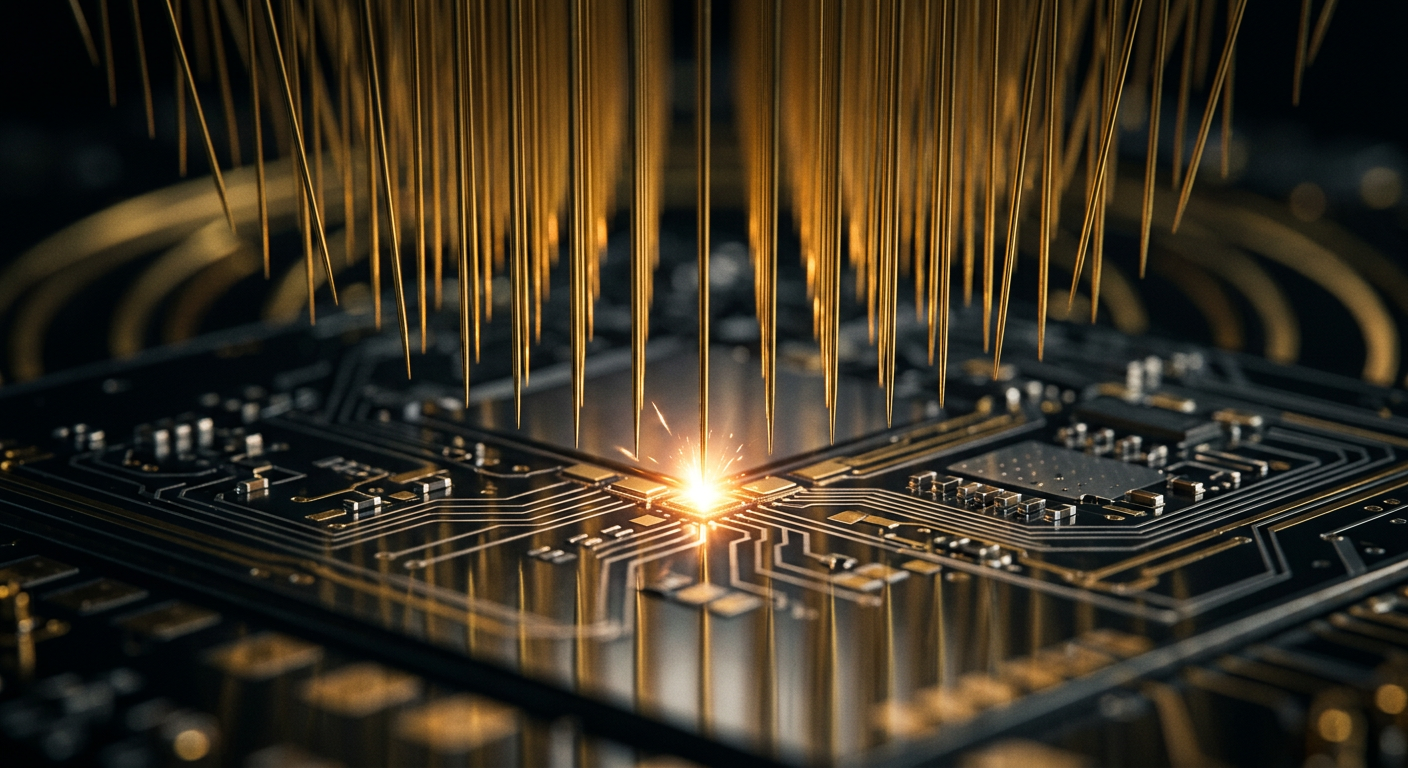
So think one step further. The memory AI chips crave is called HBM — high-bandwidth memory — and it's built like an apartment tower: a dozen chips stacked on top of one another. One bad floor condemns the whole building. Which means every stack gets tested, floor by floor, before it ships — through something called a probe card, a custom bed of microscopic needles that touches each chip and asks: are you alive?
More memory means more probe cards. Pricier, more complicated memory means pricier, more complicated probe cards.
The pairing: FormFactor (FORM) — Watch
FormFactor is the leading maker of those probe cards, with a market cap around $8.4 billion. Business is booming: a record second quarter, revenue up 14% from the prior quarter, gross margins at 53.3%, and Wall Street's average price target near $139 against a stock around $108 after Monday's tariff-driven slide.
So why Watch and not Buy? Two reasons. FormFactor costs about 31 times next year's expected earnings — the S&P 500 costs about 21 — and memory is the most famously boom-and-bust corner of the chip industry. We like the tollbooth; we don't love the ticket price. If Nvidia says anything cautious after Wednesday's close, every memory-adjacent name will take the elevator down together, deserved or not. That's the entrance — the same one we're waiting for with Fabrinet, our Watch from Tuesday. When the market schedules its own volatility event, we let the sale come to us. A genuine memory downturn, not a one-night dip, is what kills the setup.
2) The Quietest Casino in America
Bitcoin just finished its best week in three years — up 24%, touching $80,000 on Tuesday for the first time in three months. The fuel was real: spot bitcoin ETFs pulled in $1.9 billion over five sessions, with BlackRock's fund alone taking $1.3 billion, while $4.3 billion of bets against bitcoin were forcibly unwound. Crypto stocks went vertical — Coinbase jumped roughly 30% in two days after its leadership met with the White House.
That's the loud story. Here's the quiet one.
The place where professionals actually trade all of this — CME Group, the Chicago exchange giant — has been running the hottest tables in its history. A record 27 million contracts changed hands per day in July. Crypto futures volume was already up 76% from a year earlier as of June, and this year the company switched on round-the-clock crypto trading.
And the stock? Down about 1% this year, sitting near $262.
The casino has never been fuller. The market is pricing it like a slow Tuesday.
The pairing: CME Group (CME) — Buy
CME doesn't bet on bitcoin, interest rates, or anything else. It takes a small cut of every contract that crosses its tables — and the house doesn't care which gambler wins. Volatility is the product, and volatility is in a bull market.
Which brings us to Friday. New Fed Chair Kevin Warsh gives his first Jackson Hole speech, and here's the twist nobody is talking about: futures markets now price roughly a one-in-three chance that the Fed's next move is a hike, not a cut. We're not predicting which way Warsh leans. We don't have to. Hawkish or dovish, every trading desk in the world will have to reposition the moment he finishes — and repositioning happens on CME's turf, one small fee at a time.
The honest risks? If markets go quiet — inflation settles, rates stabilize, crypto calms down — volumes mean-revert and this becomes a sleepy utility again. And newer round-the-clock venues want a seat at the crypto table. But a business setting all-time volume records while its stock goes sideways is our favorite kind of boring.
3) The Sanctions That Made Oil Cheaper
On Tuesday, Treasury Secretary Scott Bessent expanded U.S. sanctions on Iran. Tehran vowed retaliation. Ordinarily that's a recipe for an oil spike.
Oil fell 3%.
West Texas crude slid to about $82 a barrel, Brent to about $89 — the market simply shrugged. And when genuinely scary news can't push a price up anymore, it usually means the fear was already in the price.
Now, who's been quietly paying that fear premium all year? Airlines. Jet fuel is one of an airline's biggest bills, and this year it has been brutal. Take Alaska Air Group: in the second quarter it grew revenue 9.7% to $4.07 billion — and still lost $76 million, because fuel devoured 32.1% of revenue at $4.43 a gallon.
An airline is a commuter with a thousand-mile commute. When gas gets cheaper, the commuter suddenly has money left over — found money, no negotiation required. Alaska already did the hard part: the planes are full and sales are growing. The oil market has been confiscating the reward.
The pairing: Alaska Air Group (ALK) — Watch
Alaska is a $4.5 billion mid-cap trading near $40, and analyst forecasts call for earnings to more than double as fuel pressure eases.
So why Watch and not Buy? Because one down day in crude is a data point, not a trend — and Tehran gets a vote on the oil price before we do. If Iran's promised retaliation sends crude back above $90, the found money disappears. Our trigger is simple: oil holding in the low $80s or lower through the Warsh speech and whatever Iran does next. If crude breaks down while planes stay full, Alaska's income statement transforms — and the crowd that left airlines for dead will have to buy them back at higher prices. Until then, we watch.
Before You Go
A memory squeeze quietly raising the price of the AI boom, a record-breaking exchange priced like a slow Tuesday, and an oil market that just yawned at sanctions.
The week's big set pieces are still ahead — Nvidia after Wednesday's close, Burlington (our Watch from Monday) reporting Thursday, and Warsh at Jackson Hole on Friday. Set pieces are exactly when the best mispricings appear, one step off-stage.
We'll see you tomorrow.
Found this helpful? Share it with others.
Written by Behind the Markets