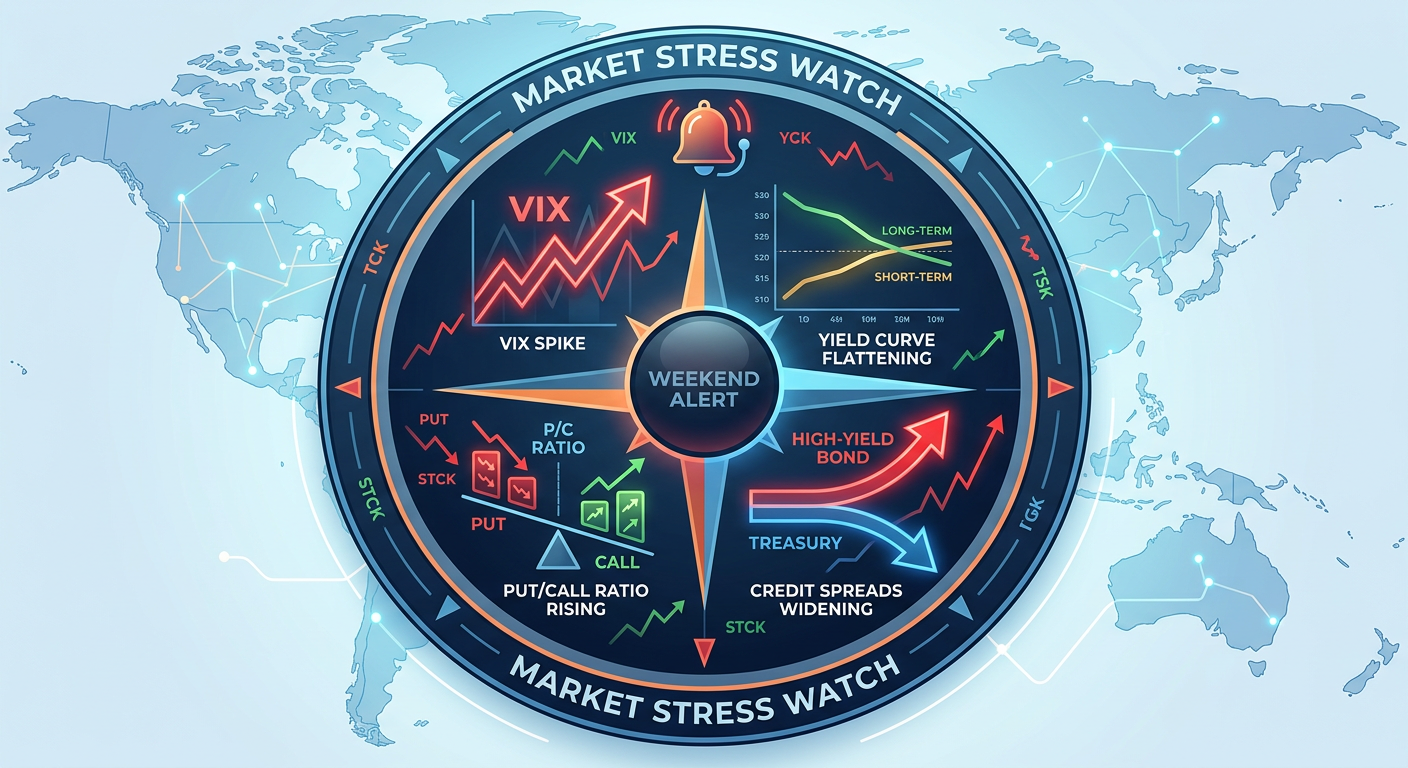
When the Market Wants You to Relax, the Plumbing Breaks: Four Stress Signals for the Weekend
A quick note from Behind the Markets
Wall Street is going to sell you a summer story. "Soft landing." "Breadth is improving." "Small caps are back."
Here's the problem: when the market wants you to relax, that's when the plumbing breaks.
Markets are closed this weekend — which makes it the perfect time to stress-test what you own before Monday, instead of reacting after the headlines. Let's talk about the signals before they become news.
1) The Small-Cap Tell: It's Not Price. It's Financing.
When small caps rally, pundits treat it like proof the economy is fine. That's backwards.
Small- and mid-caps are where financing reality hits first. And the market has been sending two quiet messages: refinancing friction is still here (companies are paying up, shortening maturities, accepting tighter covenants), and equity dilution is back as a "solution" — not because CEOs love it, but because the debt math is ugly.
The simple way to think about it: a small-cap with strong free cash flow can outlast the cycle; a small-cap that needs capital-markets access is a hostage to risk appetite. So this weekend, run every small/mid-cap you own through three questions: Does it generate real free cash flow, or burn it? When do its debts actually come due — and at what rate will it refinance? Could it fund its plan without selling new stock or new debt at all?
Don't buy "small caps" as a macro trade. Buy the survivors: the ones that don't need permission from lenders to exist. If you want a shortcut, screens and funds built around free cash flow rather than revenue growth are a reasonable starting filter — but read the balance sheets yourself.
Bottom line: Don't buy "small caps" as a macro bet on the economy. Buy survivors — the businesses that fund themselves.
2) Private Credit Is the New Shadow Banking — And It's Starting to Bite
Private credit is sold as a cleaner, smarter alternative to banks. Sometimes it is. But it carries the same old problem Wall Street always creates: yield hunger turns into leverage, and leverage turns into fragility.
The contrarian angle to watch: private lenders can keep loans "current" by renegotiating terms — which delays the visible blow-up, but often at the cost of higher rates, fees, and equity kickers. Translation: the borrower survives, but the common stockholder gets quietly mugged through dilution. This matters for public small/mid-caps because private credit is now a major funding source, and the terms are often harsher than a bank loan.
Here's the twist most retail misses: if the risk is being relocated to borrowers, then the way to be on the right side of the trade is to own the collector, not the payer.
Company: Ares Management (SYM: ARES)
One of the world's largest alternative-asset managers and a dominant force in private credit — the fee-taking "house," not the borrower
Ares is the toll collector of the private-credit boom. It manages roughly $620 billion in assets and earns management fees on a growing base of private-credit, real estate, and infrastructure capital — an asset-light model that profits from originating and managing loans rather than being the borrower who gets diluted. As banks retreat from middle-market lending, Ares fills the gap and clips a fee doing it. After the alt-manager group fell about 25% in the first half of 2026, ARES trades around $110, well off its mid-June highs near $135, with analysts clustered near $148.
But here's the whole point of this section: the stress is real, and it's touching Ares directly. Ares' own private-credit fund recently capped investor redemptions at 5% — twice — which is exactly what happens when too many investors want their money back at once. That's the fragility we're warning about, and it's showing up at the house that runs the casino. So make sure you own ARES with clear eyes: it's a high-quality, cheaper-than-usual way to be on the collecting side of private credit — but if the credit cycle genuinely turns, fee-taking managers see slower fundraising, mark-downs, and gated funds too. It's the better seat at the table, not immunity from the table.
Bottom line: Private credit doesn't eliminate risk. It relocates it — as dilution for borrowers, and as fees for the managers. Just know that when it bites, even the collectors feel teeth.
3) Defense: The Real Bull Market Is "Consumables" and Replenishment
Defense headlines focus on the primes because it's easy TV. But modern conflict burns through inventory — munitions, propellants, components, spares, secure comms, counter-drone gear — and inventory has to be replaced. Those categories aren't glamorous, but budgets are pointing at them because they're immediate, scalable, and politically defendable. The opportunity is usually a layer or two below the household-name prime.
Company: L3Harris Technologies (SYM: LHX)
The "sixth prime" — a merchant supplier of secure comms, missile propulsion, and counter-drone systems that sits below the Big Five
L3Harris is almost a perfect map of this section. Its heritage business is tactical radios and secure communications — the connective tissue every military needs. Through its Aerojet Rocketdyne unit, it's one of the key makers of solid rocket motors and propulsion — the literal consumable that missiles burn up and that has to be replenished (it's expanding propulsion capacity for PAC-3 interceptors as we speak). And it just won an Army order for VAMPIRE counter-drone systems — the exact "counter-drone gear" the draft flags. It's a supplier to the big primes as much as a competitor to them, with a growing missile and munitions backlog.
LHX trades around $290, down roughly 20% from its March high near $379 as the whole defense group pulled back — arguably a better entry into a multi-year replenishment cycle, with a modest ~1.7% dividend and a low beta. The honest caveats: defense stocks have been weak lately (LHX's 50-day moving average recently crossed below its 200-day, a bearish technical signal), revenue growth in some segments has been flattish, and Aerojet integration/execution is an ongoing show-me story. Government-budget timing and continuing-resolution drama can also delay orders. This is a "own the replenishment machine and be patient" idea, not a momentum trade.
Bottom line: Don't just follow the prime-contractor headlines. Follow the replenishment machine. Boring suppliers can compound for years.
4) The AI "Moat" Everyone Ignores: Data Rights and Provenance
Everyone wants to talk about models. The real lawsuits will be about data. As AI adoption scales, the winners will be the ones who can answer one question fast: "Show me the provenance. Show me the rights. Show me the audit trail." Companies that can't will get blocked by procurement, dragged into IP disputes, and forced into expensive remediation. So the contrarian play isn't "who has the best model" — it's "who can deploy at scale without stepping on a legal landmine."
Company: Adobe (SYM: ADBE)
The "commercially-safe" AI play — generative tools trained on licensed data, plus the provenance standard it helped create
Adobe is a direct, underappreciated bet on data rights and provenance. Its Firefly generative-AI models are trained only on licensed or rights-cleared content, which lets Adobe offer enterprises something rivals can't easily match: AI-generated content that's "commercially safe," with IP indemnification — a huge deal for a corporate buyer terrified of a copyright lawsuit. Adobe also co-created the Content Credentials provenance standard (a tamper-evident "audit trail" for digital media). And the business is real: record Q2 revenue of $6.6 billion, AI-first ARR tripling past $500 million, and a $25 billion buyback. Here's the kicker — after falling roughly 37% this year, ADBE trades at about 8x forward earnings, a deep discount to the software group.
Now the reason it's cheap, stated plainly, because this is a genuine bull-bear standoff: the market is betting that low-cost, AI-native creative tools commoditize Adobe's core products faster than Firefly can monetize — and that fear isn't crazy. Adobe is also mid-leadership-transition (its long-time CEO is retiring and the CFO is departing), and its ARR growth is deliberately "soft" right now as it chases free-tier users. If the bears are right about disruption, cheap gets cheaper. This is a contrarian value idea where the provenance moat is the bull case and AI commoditization is the bear case — buy it only if you believe the "commercially-safe" advantage is durable.
Bottom line: In the next phase of AI, compliance isn't a cost center — it's a gatekeeper. And gatekeepers get paid… if their gate holds.
Before You Go
Retail investors get told to buy what's popular. That's how you end up holding the bag.
Your edge is watching the market's plumbing: financing terms, supply chains, and replenishment cycles. Use the quiet weekend to check yours — before Monday does it for you.
Found this helpful? Share it with others.
Written by Behind the Markets