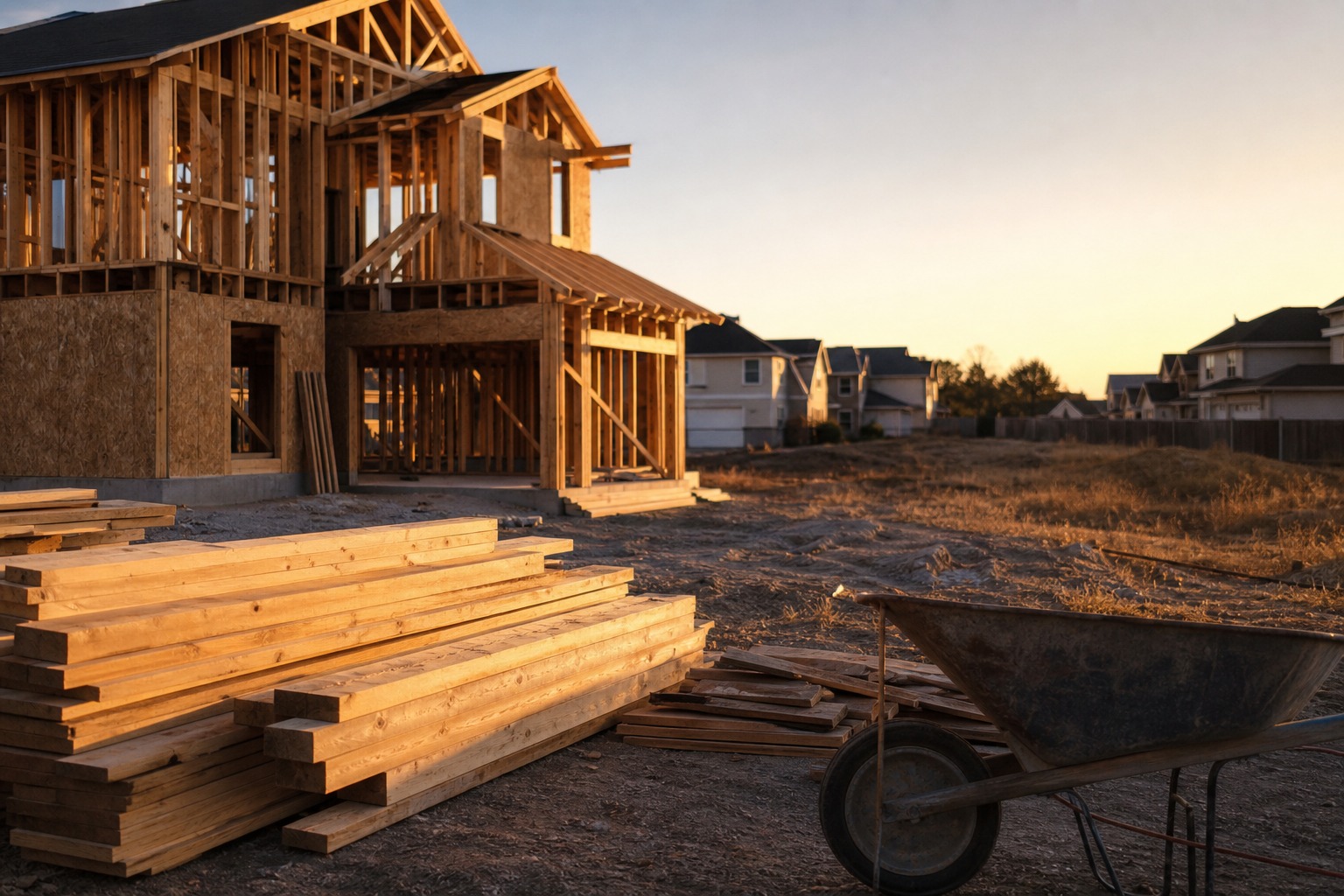
Home Depot opened the retail earnings season Tuesday morning with a set of numbers that had no business coming out of the housing market as it currently exists.
Second-quarter sales were $47.86 billion, up 5.7% from a year earlier and ahead of the $47.27 billion Wall Street expected. Comparable sales rose 1.7% against an estimate of 0.9%. Adjusted earnings came in at $4.92 a share versus $4.73 expected. The company reaffirmed full-year guidance rather than trimming it, which almost nobody on the sell side had penciled in.
Then Chief Financial Officer Richard McPhail went on television and described the environment his company is operating in as "frozen housing market conditions."
Both things are true at once. The market's answer on Tuesday was to do nothing with it: Home Depot closed at $337.77, down 11 cents on the day, after trading as high as $344.54 and as low as $330.69. A beat on every line, guidance held, and the stock finished flat.
The Quarter Itself
The line item worth staring at is the comparable sales figure. McPhail said 1.7% is the strongest comp Home Depot has posted since the third quarter of fiscal 2022 — the tail end of the pandemic renovation boom, and four years ago. U.S. comps rose 1.3%. Net earnings were $4.77 billion, or $4.79 per diluted share, against $4.55 billion and $4.58 a year ago.
The reaffirmed guidance is unchanged in every line:
Total sales growth of approximately 2.5% to 4.5%
Comparable sales growth of approximately flat to 2.0%
Gross margin of approximately 33.1%, operating margin of 12.4% to 12.6%
Adjusted diluted EPS growth of approximately flat to 4.0% from $14.69 in fiscal 2025
Roughly 15 new stores; net interest expense of about $2.3 billion
One detail inside the guidance deserves attention because it is doing real work. Home Depot said the outlook includes IEEPA tariff refunds, which are expected to partially offset unplanned fuel, energy and other input costs across the fiscal year. McPhail said the refunds are what allow the retailer to "maintain value" while those costs run above plan. That is a tariff-litigation outcome flowing through a Dow component's margin line, and it is not a permanent feature of the model.
The company ended the quarter with 2,364 retail stores, more than 1,340 SRS locations and over 470,000 employees. CEO Ted Decker remains on medical leave, with McPhail and senior executive vice president Ann-Marie Campbell running operations; Home Depot said last week it expects Decker back within a few months.
What "Frozen" Actually Looks Like
Ninety minutes before the earnings call, the Census Bureau published July new residential construction, and the split in it was severe.
Housing starts fell 12.4% from June to a seasonally adjusted annual rate of 1,239,000, down 13.5% from July 2025. Single-family starts fell 9.9% to 808,000. That is a bad number by any reading, and worse than economists expected.
Building permits went the other way, rising 5.0% to a rate of 1,443,000, up 3.1% year over year. Single-family authorizations rose 2.5% to 894,000, and permits for buildings with five or more units rose to 490,000.
Permits are the forward-looking series and starts are the current one, so July is a month in which builders slowed the work in front of them while quietly protecting the pipeline behind it. That fits Monday's builder sentiment reading, which came in at 35 — up a point, but the sixteenth consecutive month below 40, with 35% of builders cutting prices and 63% offering incentives.
Home Depot's business is not new construction. It is the existing 145 million housing units and the people who maintain them, which is precisely why the quarter worked: customers did more small projects. It is also why the ceiling is real. Large remodels follow home turnover, and turnover follows mortgage rates, and mortgage rates follow the long end of the Treasury curve — which is currently doing the opposite of what the housing market needs.
The Yield Problem Nobody Can Route Around
The 30-year Treasury yield touched 5.327% on Tuesday and closed at 5.28%, its highest level since 2007. The 10-year finished at 4.71%, the highest since January 2025 and well above the 3.97% level it held just before the war with Iran began in February.
That is the single most important number for every company reporting this week, and it explains why the equity market has now backed away from Thursday's record close of 7,798.99 for three straight sessions. Higher long rates compress the present value of distant profits, which is why the artificial intelligence complex handed back Monday's gains in a hurry. Micron closed at $940.53, down about 7% and one of the heaviest weights on the S&P 500, after rising 4.1% the day before. Nvidia fell 2.3% to $219.74 and Broadcom sank roughly 3%. The S&P 500 ended Tuesday at 7,692.10, down 0.67%, the Nasdaq Composite lost 1.31% to 26,294.46, and the Dow — cushioned by Home Depot — slipped only 0.22% to 53,343.85. The memory trade has been the most violent expression of this whole cycle in both directions.
Oil kept the pressure on. Brent settled at $91.02, up 0.17%, and West Texas Intermediate at $84.94, up 0.52% — both the highest settlements since July 24, and a third straight day of gains — after Iran's top negotiator, Mohammad Baqer Qalibaf, said the Strait of Hormuz stays closed until Washington meets the terms of the June interim deal, and Iranian officials signaled a shift to a "fully offensive" posture. President Trump said Tuesday that talks with Tehran are neither happening nor scheduled. Saudi Aramco has resumed loadings from inside the strait using ship-to-ship transfers off Fujairah, but crossings remain in the single digits.
What Lands Next
Wednesday brings two things that will settle the argument, or extend it.
Lowe's reports before the open. Consensus looks for revenue of about $26.13 billion, up roughly 9% from a year ago, on earnings of $4.22 a share, down about 3%. Analysts have spent the last two weeks trimming price targets while keeping Buy ratings — Piper Sandler's Peter Keith to $274 from $276, Bernstein's Zhihan Ma to $262 from $281 — largely on soft demand for big remodeling projects and dry weather hurting lawn and garden. If Lowe's confirms Home Depot's small-project story, the "frozen but functioning" read on the consumer holds. If it does not, Home Depot looks like a share gainer in a shrinking pond.
The July FOMC minutes land at 2:00 p.m. ET. That meeting was a 9-3 hold at 3.50%-3.75%, with Hammack, Kashkari and Logan all dissenting in favor of a quarter-point hike — the first time three dissents pointed the same direction since September 2016. Markets now put September hike odds near 31%, down from roughly two-thirds right after the meeting. Every judgment in the document was formed before the July payrolls miss, before CPI, and before the worst monthly drop in retail sales in more than a year. It is a record of a reaction function, not a forecast — and the only part that has not expired is the part describing conditions.
Then Walmart and Target on Thursday, into the densest stretch of retail reporting on the calendar.
Home Depot's answer to a frozen market was to sell more small projects to people who are not moving. The rest of the week decides whether that is a strategy or a symptom.
Found this helpful? Share it with others.