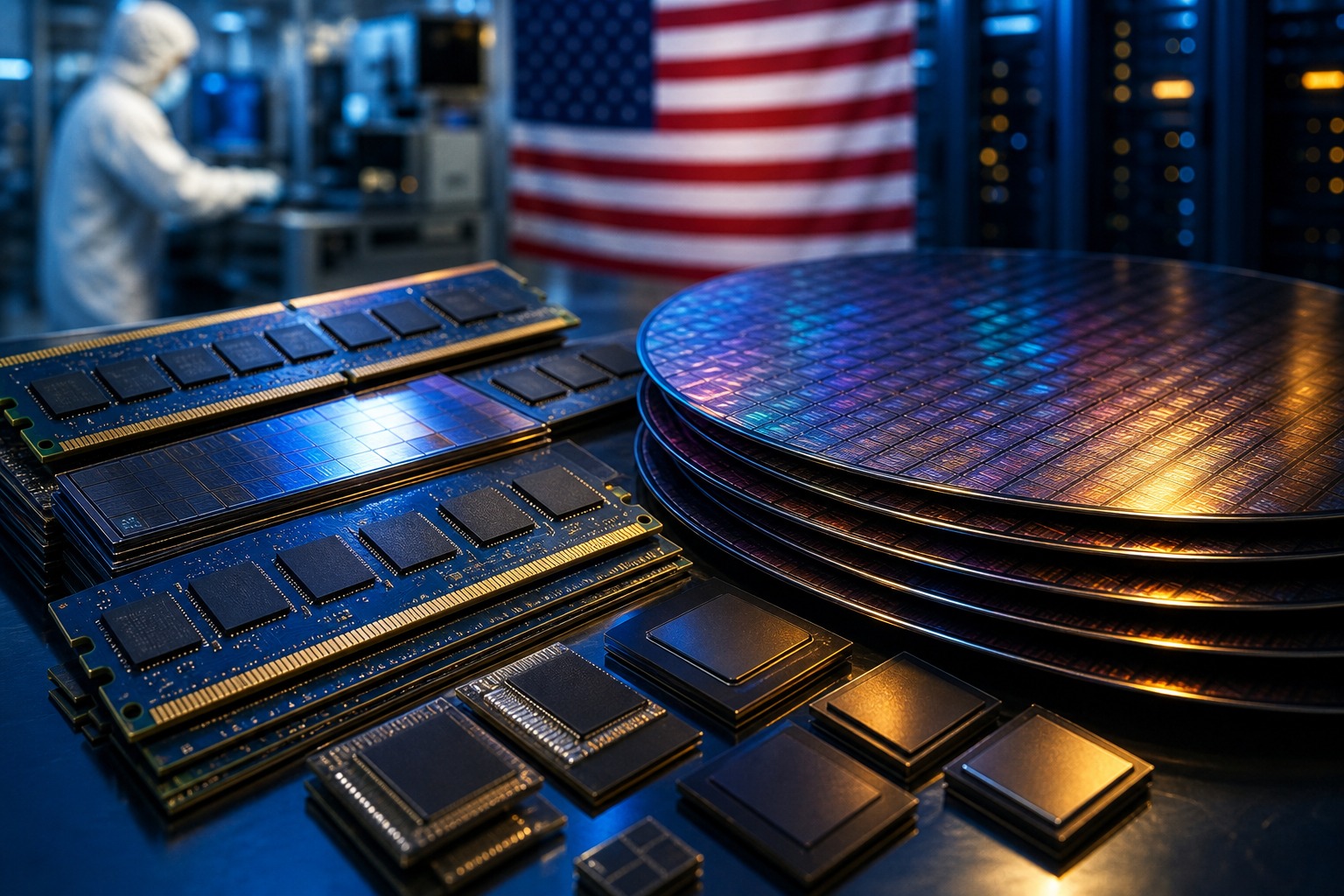
There is a version of the artificial intelligence trade that everybody already knows. Graphics processors are scarce, the companies that make them are worth trillions, and the datacenter buildout has swallowed more capital in eighteen months than most industries deploy in a decade.
Monday, the market spent the session trading a different version of it — one in which the scarce thing is not compute at all.
SanDisk closed at $1,786.85, up $145.74, or 8.9%, after trading as high as $1,827.99 on 17.4 million shares. Western Digital rose more than 5% to close near $536. Micron gained 4.1% to $1,011.75, closing back above $1,000 for the first time since July 23. South Korea's KOSPI had risen 2% overnight, which is usually the first tell that something has moved in memory, because that is where the industry actually lives.
It happened on a down day. The S&P 500 fell 0.40% to 7,754.87, the Dow dropped 0.51% to 53,459.21, the Nasdaq Composite slipped 0.32% to 26,644.91, and the Russell 2000 lost 0.44% to 3,055.01. Oil did the damage: Brent settled up $2.35, or 2.65%, at $90.87, and West Texas Intermediate settled up $2.10, or 2.55%, at $84.50, after the interim U.S.-Iran understanding expired with nothing to replace it. The 30-year Treasury yield rose five basis points to 5.31%, its highest level since June 2007.
Three separate things landed on the same group in the same forty-eight hours.
One: The Constraint Argument Went Mainstream
On Friday, Peter Diamandis posted that "memory, not compute, is the rate limiter of the Agentic Era." Elon Musk replied with three words: "Few realize this."
That is not research. It is a social media exchange. But it crystallized an argument the memory industry has been making with numbers for a year, and the numbers are more persuasive than the post.
Micron's most recent quarter is the cleanest illustration available. Fiscal third-quarter revenue was $41.46 billion, against $23.86 billion the prior quarter and $9.30 billion in the same period a year earlier. That is not growth. That is a different company. CEO Sanjay Mehrotra said on the call that "DRAM and NAND industry demand continues to significantly exceed industry supply," and that the tightness should persist beyond calendar 2027. Chief Business Officer Sumit Sadana added last week that customers are now naming DRAM as their single largest constraint — ahead of power, ahead of datacenter capacity.
For two years the binding limit on artificial intelligence was described as chips, then as electricity. The companies actually building the systems are now saying it is the memory sitting next to the chips.
Two: SanDisk Put a Number on the Decade
SanDisk held its investor day in New York on August 13 and did something unusual for a business that has historically been the most cyclical corner of semiconductors: it published a multi-year financial model.
For fiscal 2028 through fiscal 2030, the company told investors to expect:
Revenue growth of mid-to-high teens, consistent with bit growth
Non-GAAP gross margins sustained near 80%
Non-GAAP operating margins near 75%, with operating expenses around 5% of revenue
Adjusted free cash flow margin of roughly 50% after taxes, capital expenditure and working capital
A commitment to return 100% of excess cash to shareholders after investing in the business
Those are software margins attached to a company that manufactures physical flash memory. CFO Luis Visoso grounded the confidence in multi-year customer agreements rather than in the cycle — the argument being that long-term contracts have removed the volatility that defined this industry for thirty years.
Wall Street moved after it. RBC Capital Markets raised its SanDisk price target to $1,600 and Wells Fargo to $1,550, both keeping neutral ratings — a telling combination, since the stock is trading above both. New Street upgraded Micron to Buy from Neutral. Bank of America reiterated Buy on Micron and argued memory is entering a "structurally stronger phase."
The context for those moves is worth stating plainly. SanDisk closed 2025 at $275.24. It has risen roughly 591% in 2026, hit an all-time closing high of $2,335.00 on June 25, and Monday's close still sits roughly 23% below that peak. This has been a violent stock in both directions. Earnings beats have not been protecting semiconductor stocks this season, and memory is the highest-beta expression of the entire trade.
Three: Washington Decided Who Apple Can Buy From
The third catalyst has no earnings model attached, and it may matter most.
Commerce Secretary Howard Lutnick told The Wall Street Journal on August 14 that the administration opposes Apple purchasing Chinese memory chips. "The Trump administration is not in favor of that," he said. There have to be "other solutions to the memory issue, but it's not great American companies using Chinese memory." Asked whether he had said as much to Apple directly, he answered in a single word: "Plainly."
The two Chinese suppliers in question are Yangtze Memory Technologies, which sits on the Commerce Department's Entity List, and CXMT, which does not. The Pentagon has designated both as Chinese military companies. Apple had reportedly been testing chips from both, and asked Commerce earlier this summer for an assurance that CXMT would not be added to the Entity List. It did not get one.
Here is the detail that makes this a market story rather than a policy story. Apple COO Sabih Khan told the Journal the scale of the shortage means "we have to look at all options," and noted that while Apple customizes most components inside an iPhone, "there isn't a lot of customization" for memory.
Commodity parts require no shared design information, which means no export license, which means no mechanism for Commerce to block a purchase. So what Washington has issued is a preference, not a rule. HP and Acer already ship CXMT memory in products sold outside the United States.
But if the largest hardware buyer in the world takes the preference seriously, its demand lands on exactly four public companies — and it lands into a market where supply is already short. That is the trade the tape was expressing Monday.
What Lands Next
The demand side keeps getting larger. Anthropic is projecting 2028 revenue of roughly $190 billion to $200 billion, according to Reuters reporting, against a run rate the company put at $47 billion in May and about $9 billion at the end of 2025. Preliminary second-quarter revenue came in above $11.5 billion, up from $787 million a year earlier. Every dollar of that eventually requires physical memory. The datacenter footprint behind these numbers keeps expanding faster than the announcements can track it.
Meanwhile the rest of the market stayed unsettled. Negotiations with Iran are deadlocked, Foreign Minister Abbas Araqchi said over the weekend that Tehran had not decided whether to resume talks, and President Trump demanded Iran's surrender while threatening to bomb Oman. Kpler ship-tracking data showed five commodity vessels crossed the Strait of Hormuz on Saturday and none on Sunday, against 31 transits the prior weekend. The 10-year Treasury yield pushed past 4.7%.
And the week's real test of the consumer starts Tuesday morning, with Home Depot before the open, Lowe's Wednesday and Walmart Thursday — the densest cluster of retail earnings in the quarter, arriving four days after retail sales fell 0.6%.
Two markets, two different stories. One is worried the consumer is finished. The other cannot build memory fast enough to satisfy the machines.
Found this helpful? Share it with others.