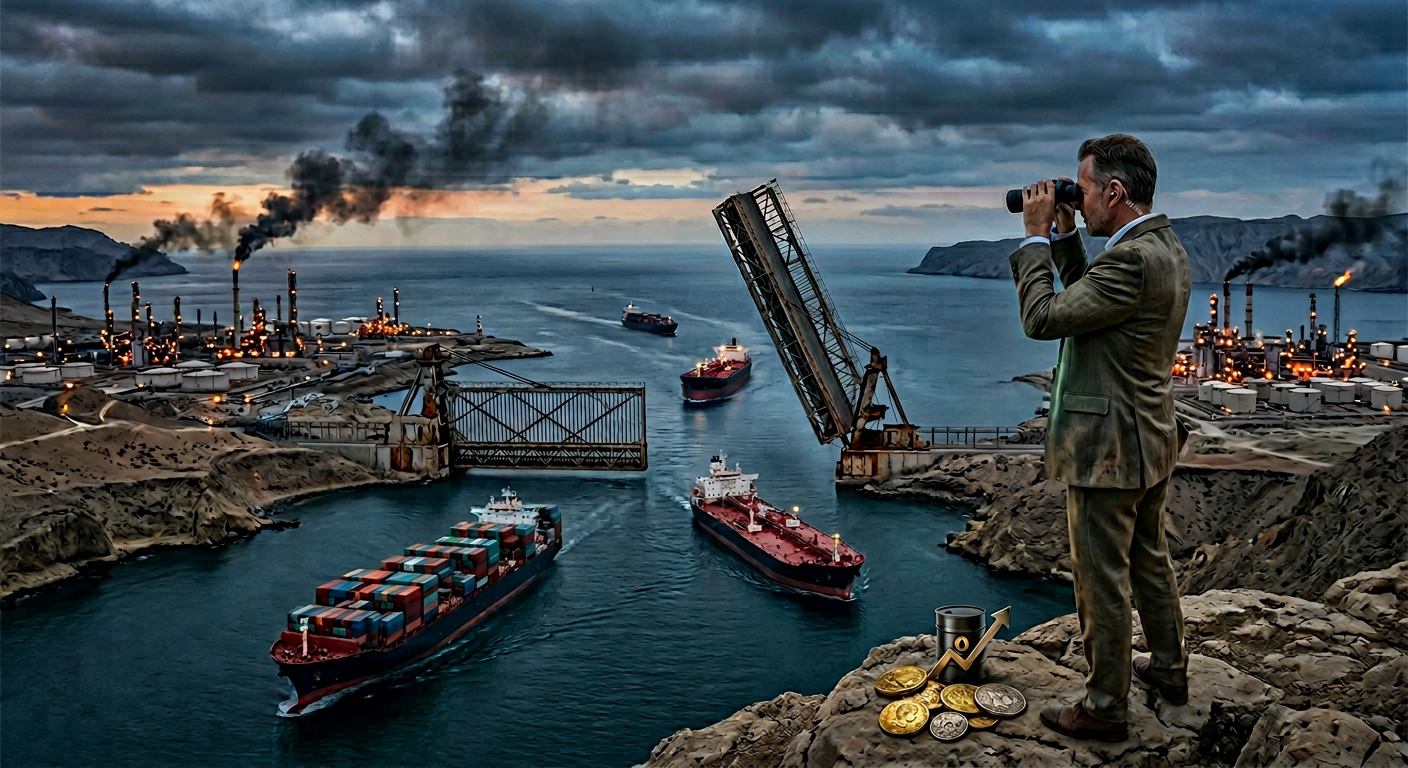
The Strait "Reopened." The Invoice Didn't. Here's Where the Money Hides.
A quick note from Behind the Markets
Markets love closure.
They see a "deal," they hit buy, and they assume the world snaps back to normal by lunch.
That's not how shipping works.
Even if the Strait of Hormuz is "open," the system has to clear mines, clear queues, clear insurance, and clear fear.
Today is about the hidden tax that survives the headline.
1) Oil isn't just oil — it's the cost of moving the world, and that cost resets slowly
InvestingLive laid out the practical reality: reopening is a process, not a switch.
A few details should change how you think about the "cheap oil" narrative.
War-risk premiums are still 1% to 4% of vessel value per transit, versus below 0.1% prewar. On a $200 million ship, that can mean up to $8 million for one crossing. And mine clearance could take 40–50 days — or as long as six months, depending on scope.
So yes, futures can drop on relief. But the "cost of moving stuff" doesn't instantly normalize.
Here's the tell most investors miss: underwriters are famously quick to raise rates and slow to lower them. That elevated premium doesn't vanish when the headline hits — it lingers on every invoice for months. And the businesses that collect those premiums get paid the whole time.
Company: W.R. Berkley (SYM: WRB)
Specialty property-casualty insurer with energy, marine, and Lloyd's-market exposure
When war-risk and marine premiums stay elevated, specialty insurers are on the receiving end of that "tax." W.R. Berkley is one of the largest commercial-lines writers in the country, with dedicated energy and marine books and a presence in the Lloyd's marketplace — exactly the lines that reprice higher when shipping risk spikes and stay firm while underwriters wait for proof the danger has passed.
The fundamentals are strong. Q1 2026 delivered record net income of $515 million with operating EPS of $1.30, beating estimates, and net investment income up 12% year-over-year. The company recently raised its regular dividend 11% and declared a special dividend, and trades around $68 with a yield near 2.7%.
Two honest caveats. First, founder and executive chairman William Berkley passed away in early June, triggering a leadership transition — and analyst sentiment has turned mixed, with a couple of recent downgrades on competitive pricing pressure. Second, a hard insurance market eventually softens. But as long as marine and energy risk stays bid, the premium flows to the underwriter, not the headline.
Bottom line: Even if crude prints a lower number, the logistics system can keep bleeding money through insurance, delays, and bottlenecks. That's inflation by another name.
2) The real signal: shipping capacity doesn't return because a politician declares it
The same InvestingLive piece notes prewar traffic was roughly 100 ships per day, while Kpler projects 40 transits per day within a month — about 40% of the old pace.
Translation: even optimistic scenarios look like partial normalization.
And that's before you factor in the backlog of stranded vessels — hundreds are still loaded and waiting — and the human factor: shipowners don't like being on the wrong end of a missile. This is the kind of "soft friction" that keeps costs elevated even after the news cycle moves on.
For tanker owners, that's not a problem. It's a windfall that lasts longer than the market expects.
Company: DHT Holdings (SYM: DHT)
Pure-play VLCC crude tanker operator; roughly 70% of its fleet exposed to spot rates
DHT owns and operates a fleet of around two dozen very large crude carriers — the workhorses that move oil from the Gulf to Asia. With roughly 70% of its fleet exposed to the spot market, DHT captures rate spikes directly, and the slow, messy normalization of Hormuz keeps those rates elevated far longer than a clean reopening would. The company's May earnings call highlighted a genuine tanker windfall, and it has been renewing its fleet with fuel-efficient newbuilds while selling older vessels at gains.
DHT trades around $18.50 with analyst targets near $20, a low double-digit P/E, and net income forecast to grow sharply this year. The two-sided risk is the same as any spot-heavy tanker: if the Strait reopens fast and the stranded-ship backlog clears in a one-time rush, spot rates can fall just as quickly. This is a cyclical bet that normalization stays slow. Size it like one.
Bottom line: Treat "reopening" headlines as market sentiment, not as an immediate return to pre-crisis economics.
3) How to invest the angle (without playing oil roulette)
Retail investors get trapped in the obvious trade: "Buy oil calls." "Short oil." "Buy airlines." That's casino thinking.
The smarter approach is second-order. Which businesses benefit from persistent logistics complexity? And which get hurt when shipping volatility stays bid?
Two practical frameworks. Volatility winners: firms that provide risk management, insurance, security, and logistics optimization. Volatility losers: low-margin companies that can't pass through freight and input costs.
The insurance side is covered above. The logistics-optimization side has its own quiet winner — the company that gets more valuable precisely when supply chains get complicated.
Company: Expeditors International (SYM: EXPD)
Asset-light global freight forwarder and logistics-optimization specialist
Expeditors doesn't own ships or planes. It books space on them, optimizes routing, and handles customs — which means it makes money solving complexity, not owning steel. When shipping lanes get tangled, rerouting becomes the norm, and tariffs and transit risk multiply, shippers lean harder on forwarders like Expeditors to navigate the mess. The company has explicitly flagged that the Iran conflict is causing prolonged spikes in fuel and freight costs, with normalization months away — exactly the environment where its expertise commands a premium.
EXPD generated over $11 billion in revenue in 2025 and trades around $160. Be clear-eyed: it's not cheap, analyst ratings cluster around "Hold," and a genuine return to calm, cheap, predictable shipping would actually reduce the complexity it profits from. But in a world where the invoice stays ugly and the routing stays hard, the asset-light optimizer keeps getting paid.
As for the volatility losers — watch low-margin manufacturers, discount retailers, and transport-heavy businesses with no pricing power. If they can't pass elevated freight and input costs to customers, the friction eats their margins. That's the short-or-avoid side of the same trade.
Bottom line: Don't overtrade the headline. Trade the friction. The friction is where the durable profits hide.
Before You Go
Wall Street wants you focused on the number on the oil chart.
I want you focused on the invoice.
If the invoice stays ugly, the inflation story stays alive — even if TV anchors are celebrating "peace."
Found this helpful? Share it with others.
Written by Behind the Markets