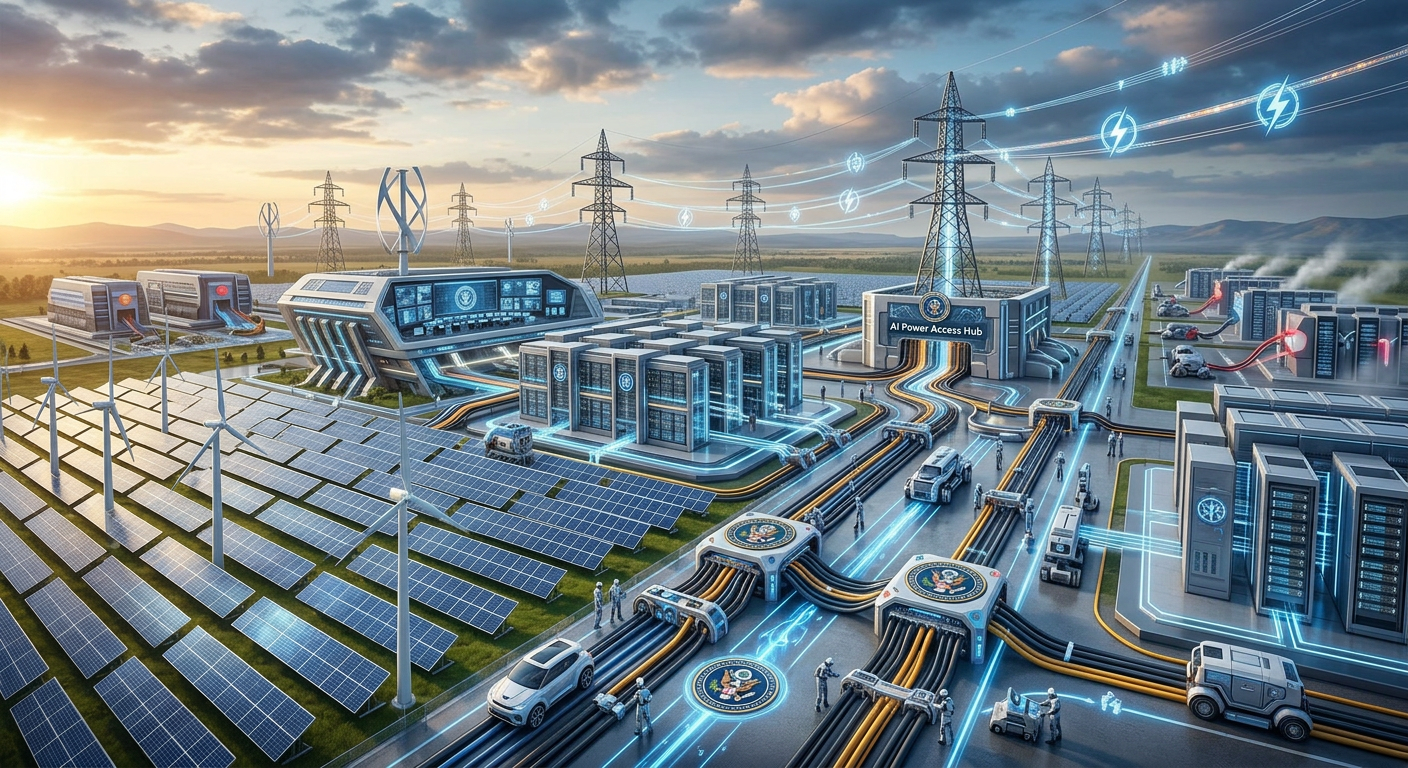
AI's Real Bottleneck Isn't a Chip. It's a Wire. And Washington Just Noticed.
A quick note from Behind the Markets
Wall Street loves stories that fit on a slide.
"AI is software." "AI is chips." "AI is cloud."
Wrong.
AI is industrial. It eats electricity. It eats land. It eats transformers. And then it forces regulators to admit the grid was built for a different century.
Today is about the real bottleneck. The one you can't fix with a new app.
1) The next AI arms race is power access — and Washington just walked onto the field
Here's what's happening under the hood.
Data centers are showing up like a mega-factory and saying, "Plug me in." But the grid isn't built for that kind of load growth, that fast. And when something breaks, everyone starts arguing about who pays.
NBC News reported that Sen. Cynthia Lummis introduced the POWER Up Act, which would establish federal guidelines for how data centers connect to the grid and give the Federal Energy Regulatory Commission (FERC) authority to approve or reject some grid connections.
This isn't happening in a vacuum. FERC is already racing to finalize a separate large-load interconnection rule — covering facilities over 20 megawatts — by the end of June. Data centers drove a 22% jump in U.S. power demand in 2025, a figure projected to triple by 2030.
This matters for investors because it's a tell. When lawmakers get involved, it means the buildout is real. It means local politics is turning into federal rules. And it means "AI growth" is about to collide with permitting, queues, and cost allocation.
If you're looking for investable angles, stop obsessing over the model names. Watch the chokepoints. Grid access is a chokepoint — and so is the power generation behind it.
Company: Constellation Energy (SYM: CEG)
Largest U.S. producer of clean, around-the-clock nuclear power; primary supplier to AI data centers
If a data center's biggest problem is getting reliable, 24/7 power, Constellation owns the scarcest version of it: nuclear. It's the largest nuclear operator in the country, and it's been signing long-term power deals directly with hyperscalers — most famously the restart of the Three Mile Island plant in Pennsylvania to serve Microsoft's data centers, which regulators just fast-tracked.
The fundamentals are solid. Q1 2026 came in strong — $2.74 adjusted EPS versus $2.53 expected, on revenue of $11.1 billion, boosted by the Calpine acquisition. The company reaffirmed full-year EPS guidance of $11–$12, authorized a $5 billion buyback, and is guiding to $8.4 billion of free cash flow across 2026–2027.
CEG currently trades around $267 — down roughly 20% year to date and about 30% off its October high near $412. Be clear about the risk: the stock isn't cheap on a P/E basis, and much of the data-center upside depends on future contracts actually getting signed at premium prices. But on the core thesis — that uninterruptible power is the real AI chokepoint and nuclear is the premium answer — Constellation sits on exactly the right asset.
Bottom line: The "AI trade" is quietly becoming a regulated infrastructure trade. The winners won't just be the best coders — they'll be the companies that sell the picks, shovels, and power hardware into a multi-year backlog.
2) The grid cost fight is the new hidden tax on AI returns
In every boom, someone is subsidizing someone else.
Tech loves to pretend its growth is "weightless." It isn't.
When a hyperscale data center wants 24/7 power, you're not just buying electrons. You're buying transmission upgrades, substations, and often new generation. And the real political fight is: who eats those costs?
If utilities push the bill onto ordinary ratepayers, expect a backlash. If regulators force the data centers to pay the true "cost to serve," expect slower buildouts, more site-selection games, and a premium placed on locations with excess capacity.
This is already the central fight at FERC. One analysis of the proposed rule notes it could require large-load customers to fund the full cost of grid network upgrades — a sharp break from the traditional model where transmission costs are socialized across everyone. Industrial customers are pushing hard on the "cost-causation principle": whoever causes the cost should pay it.
This is where retail investors can get ahead of the sell-side. The sell-side will talk about AI revenue growth. You should talk about interconnection queues, transformer lead times, who finances the upgrades, and whether the cost burden shifts into higher power prices for everyone else.
Here's the cleaner way to think about positioning: no matter who ultimately pays — ratepayers, data centers, or utilities — the money flows to whoever builds and sells the grid hardware. You don't have to win the cost-allocation argument. You just have to own the toll booth.
That's the case for the suppliers, which is where the next section — and the cleanest single vehicle for this whole theme — comes in.
Bottom line: AI's ROI isn't just chips and cloud. It's power-infrastructure economics. When that bill comes due, some "AI winners" turn into margin losers.
3) Actionable angle: "boring" grid suppliers are getting the best setup
Don't buy anything blindly. But keep your eye on where the asymmetry is.
If the world commits to a data-center buildout, the grid has to be upgraded. Period. That means transmission equipment, switchgear, transformers, grid services, and engineering plus construction.
These are the companies that tend to be under-owned in the early innings. They're also the ones that can have pricing power when lead times explode. And unlike the "AI app layer," they don't need consumers to change behavior. They just need the physical buildout to keep moving.
Rather than bet on a single equipment maker, you can own the whole supplier layer in one vehicle.
ETF: First Trust NASDAQ Clean Edge Smart Grid Infrastructure ETF (SYM: GRID)
Diversified grid-infrastructure ETF — transmission equipment, switchgear, transformers, meters, and grid software
GRID is purpose-built for exactly this thesis. It holds the companies that maintain and upgrade the electric grid — electrical equipment makers, transmission and distribution hardware, energy management systems, and the enabling software underneath it all. Instead of guessing whether the transformer maker or the switchgear maker or the E&C contractor wins, you own the basket.
GRID currently trades around $196, near the top of its 52-week range of roughly $129 to $200, with an expense ratio of 0.56%. It has been one of the better-performing infrastructure funds as the grid-upgrade story has gone mainstream. The caveat: it's already had a strong run and concentrates in industrial and electrical-equipment names, so it'll be volatile if the AI-capex narrative cools. But on the simple premise that you can't have an AI buildout without rebuilding the grid, GRID is the most direct diversified way to own the shovels.
Bottom line: The most underappreciated "AI leverage" is the electric grid. If you want exposure without paying nosebleed software multiples, follow the backlog in the physical world.
Before You Go
Wall Street will keep telling you this is a clean, frictionless AI boom.
Reality is friction.
And when friction shows up, money moves to the bottlenecks.
If you can identify those bottlenecks early, you can invest like the institutions — without paying institutional fees.
Found this helpful? Share it with others.
Written by Behind the Markets