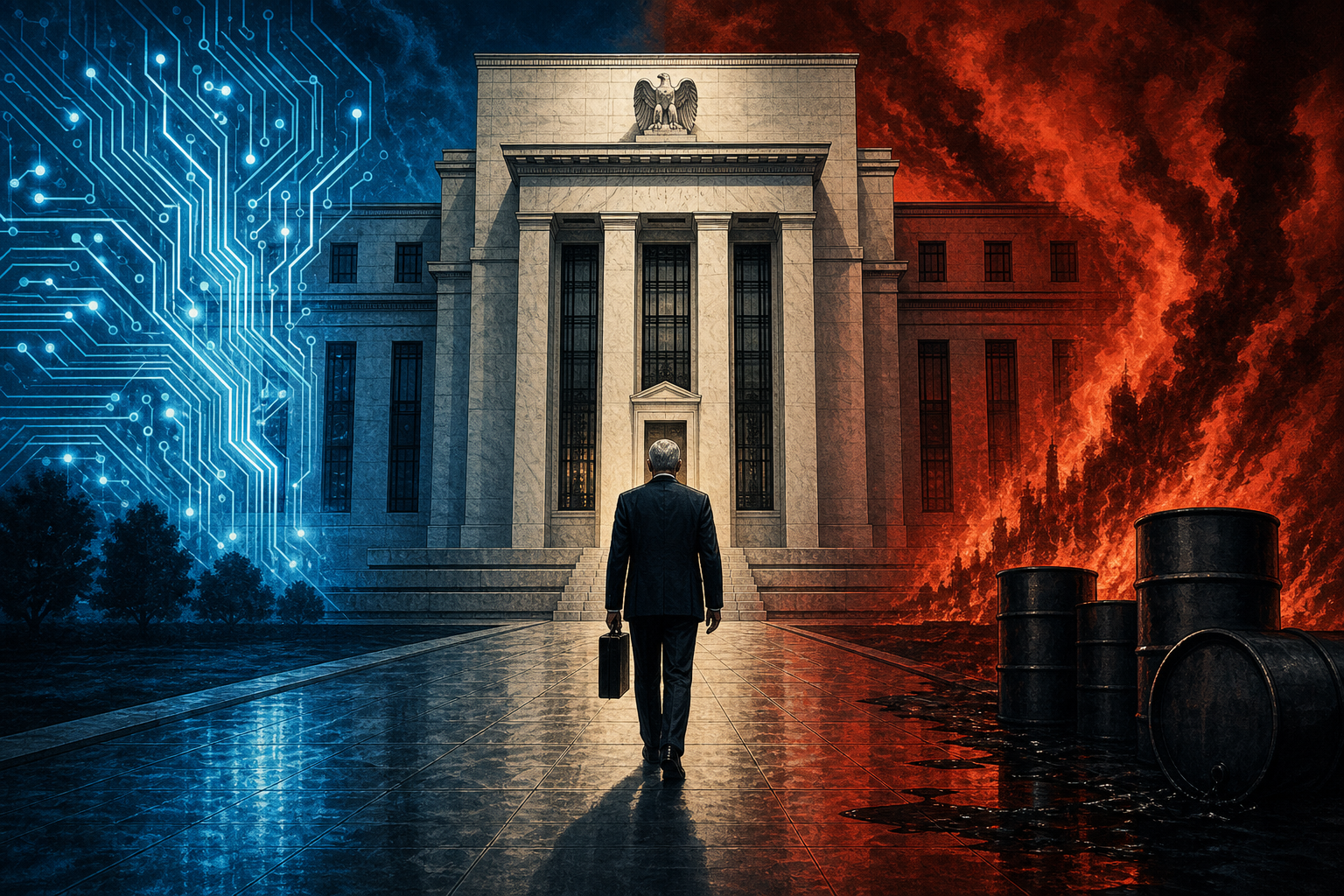
Kevin Warsh walked into the Federal Reserve building Monday morning as the new Chair. By the time he sits down at his desk, he'll be staring at the ugliest policy puzzle any Fed Chair has faced since Paul Volcker battled double-digit inflation in the early 1980s.
Inflation at 3.8% and rising. Oil above $100 with no end in sight. A global bond selloff that pushed the 10-year Treasury yield past 4.5% last week. A stock market at all-time highs, powered almost entirely by artificial intelligence stocks. And a war in the Persian Gulf that has choked the world's most critical oil shipping lane for nearly three months.
Jerome Powell left the building Friday after four years of navigating COVID, the fastest rate hike cycle in decades, and the early stages of this energy crisis. He's staying on as a governor — an unprecedented move that adds an extra layer of institutional complexity. Warsh inherits the chair, but not the kind of economy any incoming Fed leader would want.
KEY POINTS:
• 🏛️ Kevin Warsh is now Fed Chair, replacing Jerome Powell, whose term ended May 15. Powell remains on the board as a governor — a first in modern Fed history.
• 📊 The S&P 500 closed above 7,500 last week while the 10-year Treasury yield hit 4.5%. These two data points are at war with each other.
• 🛢️ Brent crude is above $107, WTI above $102. The Strait of Hormuz remains effectively closed. Global oil reserves are being depleted at a record pace.
• 💰 Bill Ackman disclosed a new position in Microsoft, saying he accumulated shares at 21x forward earnings. Azure is growing 40%. The AI investment thesis is intact.
• 📅 Nvidia reports May 28. Consensus expects $70–78 billion in revenue. This is the week the market starts positioning for the biggest earnings event of the quarter.
What Warsh Actually Inherits
The numbers tell the story.
The fed funds rate sits at 3.50–3.75%, where it's been since December. The April CPI reading came in at 3.8% — meaning the real fed funds rate (rates minus inflation) is effectively near zero. That's not restrictive monetary policy. That's barely keeping up.
Core inflation at 2.8% is moving away from the Fed's 2% target, not toward it. Producer prices surged 6.0% in April. Shelter costs are reaccelerating. Food prices are jumping. Energy is the original sin — the Strait of Hormuz disruption has been pumping inflation into every corner of the economy for three months — but the problem has metastasized well beyond oil.
The last FOMC meeting under Powell produced four dissenting votes — the most since 1992. That tells you the committee is deeply divided. Some members want to raise rates to fight inflation. Others worry that tightening further would crush an economy already dealing with an energy shock. Warsh has to unify a fractured board while making consequential decisions about the direction of policy.
Markets are currently pricing in zero rate cuts for 2026. That's a remarkable shift from January, when investors expected multiple cuts. The question now isn't whether the Fed cuts — it's whether the Fed hikes.
The AI Boom That Won't Quit
Against this backdrop, the stock market is doing something extraordinary.
Last week, the S&P 500 crossed 7,500 for the first time. The Dow reclaimed 50,000. Cisco surged 13% after reporting a "networking supercycle" driven by AI infrastructure demand — $5.3 billion in AI orders this year, on track for $9 billion. Cerebras Systems debuted and soared 75% on its first day of trading. Figma gained 12% after beating expectations and raising guidance on AI-driven revenue.
Bill Ackman's Pershing Square disclosed a new position in Microsoft, accumulated at 21x forward earnings. Ackman's thesis: Azure is growing 40%, M365 Copilot is monetizing AI at $30 per user per month in the enterprise, and Microsoft's stock has been unfairly punished — down 15% year-to-date despite 18% revenue growth and $82.89 billion in quarterly revenue.
When the most prominent activist investor in the world is betting on a $3 trillion company's AI story, it tells you the narrative has real conviction behind it.
Corporate earnings continue to deliver. With about 75% of S&P 500 companies having reported Q1 results, profits are tracking 28% higher year-over-year — the strongest growth since 2021. Profit margins hit 14.7%, the best since 2009.
The Dangerous Divergence
Here's the problem: the market is more narrow than it's been at any point in this cycle.
The AI and technology stocks are carrying the indexes. Semiconductors, cloud computing, and AI infrastructure names are responsible for the vast majority of the year's gains. Meanwhile, small caps, cyclicals, and interest-rate-sensitive sectors are struggling.
When the S&P 500 fell more than 1% on Friday, it wasn't because AI stopped working. It was because the bond market reminded everyone that monetary conditions are tightening regardless of what the Fed does. Rising bond yields are a de facto rate hike. They make it more expensive for companies to borrow, for consumers to buy homes, and for the government to service its debt.
The U.S. auctioned 30-year bonds at 5% last week — the first time since 2007. The 10-year crossed 4.5%. Japan's 30-year yield hit 4% for the first time ever. UK gilts are tumbling amid political instability. This is a synchronized global bond selloff, and it won't reverse until inflation expectations come down.
And inflation expectations won't come down until oil comes down. And oil won't come down until the Strait of Hormuz reopens. See the problem?
What to Watch This Week
Warsh's first remarks. Whatever the new Fed Chair says publicly this week will be dissected word by word. Does he signal continuity with Powell's approach? Does he hint at a hawkish shift? Does he address the oil crisis directly? Every syllable matters.
Bond yields. If the 10-year pushes meaningfully above 4.5% and toward 5%, the equity market's mood changes fast. The "stocks can ignore everything" thesis has a breakpoint, and it's somewhere in that yield range.
Nvidia positioning. The company doesn't report until May 28, but this is the week institutional investors start building or trimming their positions. Nvidia's stock price action this week will tell you how confident the market is in the AI narrative heading into the biggest earnings event of the quarter.
Oil and Hormuz. The Trump-Xi summit produced a statement that the strait "must remain open." The question is whether that translates into any actual change on the water. Every day the strait stays contested, the inflation clock keeps ticking.
The Bottom Line
Kevin Warsh's first day as Fed Chair arrives at a moment when the American economy is being pulled apart by two forces that don't know how to coexist.
On one side: the most powerful technology investment cycle since the internet, generating real revenue, real profit, and real stock gains. On the other: an energy-driven inflation shock that's spread into food, shelter, wages, and global bond markets — with no resolution in sight.
The last Fed Chair got away with waiting. This one might not have that luxury. The bond market is done being patient. Oil isn't cooperating. And the AI rally, for all its strength, can't carry an entire economy on its back forever.
Welcome to the chair, Kevin. The hard part starts now.
In January 2008, I wrote it down.
Not a hint. Not a suggestion buried in a footnote.
A clear, documented prediction: America was headed into its worst financial crash in modern history.
MarketWatch published it.
Most of Wall Street thought I was wrong.
Economists were still calling for growth. Analysts were still bullish. The consensus said: nothing to see here.
My data said otherwise.
My data was proven right when the crash came just months later.
I've been in this business for 40 years. And that's how it almost always goes.
When the mainstream view is cautious, I go back to the numbers.
Not to pundits. Not to television. Not to whoever's making the most confident prediction on cable news.
To the data.
And right now, in the spring of 2026, the data is telling a story that most investors aren't hearing.
Not a story about slowdown.
About re-acceleration.
The epicenter isn't on Wall Street.
It's in the mountains of Tennessee — behind a triple-layered security fence, at a secretive government lab.
The same lab that built the atom bomb in 1945.
40,000 of America's top scientists and engineers are finishing work on a new AI mega computer.
A device 283 trillion times more powerful than today's leading AI systems.
One Trump administration official called it "a scientific instrument for the ages."
President Trump calls it America's new Manhattan Project — but for AI.
I call it Golden Dawn.
And when it goes live, I believe it will trigger a $100 trillion reset of the AI markets.
Nearly 25 times bigger than everything we've seen from the AI boom up to now.
The investors positioned ahead of that reset — in the right name — won't care what the market's mood was in 2026.
I believe I've identified that stock.
I'm revealing it, ticker and all, in a new free presentation.
Found this helpful? Share it with others.