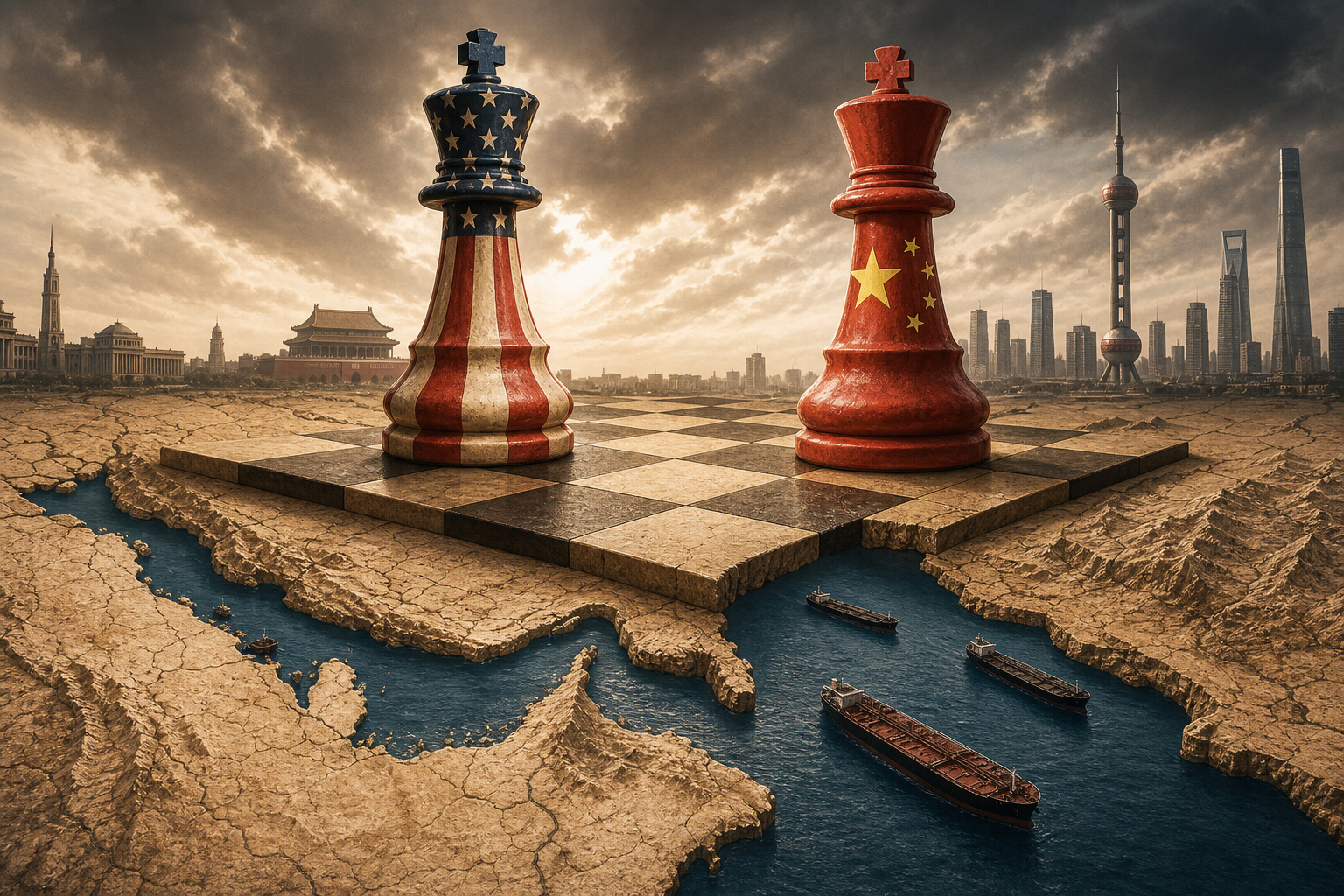
President Trump flew out of Beijing Friday calling his two-day summit with President Xi Jinping a success. He touted "fantastic" trade deals, a historic agreement that the Strait of Hormuz must remain open, and a pledge from China to buy at least 200 Boeing jets.
Then the market opened and sold off more than 1%.
If you're confused, you shouldn't be. This is exactly what happens when political theater meets economic reality — and right now, reality is winning.
KEY POINTS:
• ✈️ China committed to buying 200 Boeing jets with an option for up to 750 — a headline-grabbing number that masks the lack of structural trade agreements.
• 🤝 Trump and Xi agreed the Strait of Hormuz "must remain open" — the first joint U.S.-China position on the Iran conflict. But no enforcement mechanism was announced.
• 🔧 The U.S. cleared 10 Chinese firms for Nvidia H200 chips — a significant step in semiconductor diplomacy, with AI "guardrails" discussions ongoing.
• 📉 Markets sold off Friday despite the summit optimism. S&P futures fell over 1%. Brent crude climbed above $107. The 10-year yield topped 4.5%.
• 🇨🇳 Chinese markets slipped too. Mainland benchmarks fell as investors locked in profits, with analysts noting the lack of specific deal terms suggests a "deterioration freeze" rather than a thaw.
The Headlines vs. the Fine Print
Let's separate what actually happened from what was marketed.
The biggest deliverable was the Hormuz statement. Trump and Xi agreed that the Strait of Hormuz "should remain a free waterway" and that "Iran should not be able to impose payments on shipping traffic." That's the first time the U.S. and China have been on the same page about the Iran situation since the war began.
It sounds great — until you realize there's no enforcement mechanism, no timeline, and no Iranian buy-in. Tehran wasn't at the table and has shown zero interest in reopening the strait on anyone else's terms. The day the statement was released, ship attacks near Hormuz continued. Oil went up, not down.
The Boeing deal is real but conditional. China committed to 200 planes with an option to buy up to 750 "under certain conditions." Those conditions weren't specified. For context, China had effectively frozen Boeing orders since the original trade war. Reopening that pipeline matters for Boeing's order book — but 200 planes isn't a trade revolution. It's a gesture.
The semiconductor move is more interesting. The U.S. approved 10 Chinese firms to purchase Nvidia's H200 chips — a meaningful shift in the chip export policy that has been one of the sharpest tools in America's economic arsenal against China. Trump and Xi also discussed AI "guardrails," which is diplomatic speak for trying to figure out the rules of AI competition before it spirals into something neither side can control.
Why the Market Wasn't Impressed
Markets had already priced in optimism heading into the summit. The S&P 500 set records three days in a row leading up to Friday. The Dow crossed 50,000. The AI trade was firing on all cylinders.
When Trump emerged with broad promises but few binding commitments, the "buy the rumor, sell the news" instinct kicked in immediately. S&P futures pointed to an open down over 1%. The Nasdaq fell harder. And the bond market, which had already been selling off all week on inflation data, accelerated its slide.
Chinese markets had the same reaction. Mainland benchmarks slipped as investors took profits, and analysts at several major banks described the summit outcome as a "deterioration freeze" — meaning the two sides agreed to stop making things worse, not to actually make things better.
The missing piece is Iran. Trump told Fox News that Xi "offered help" on mediating with Tehran. China is Iran's largest oil customer and has significant economic leverage. But there's a vast distance between offering help and delivering results, especially when Iran's leadership has shown no willingness to negotiate under pressure.
Taiwan Remains the Elephant in the Room
The detail most investors overlooked was Xi's message on Taiwan. According to multiple reports, Xi made clear that interference in Taiwan is the "red line" that could generate actual conflict between the two superpowers.
This matters because the semiconductor supply chain runs through Taiwan. TSMC manufactures the world's most advanced chips on an island that China considers its territory and the U.S. has pledged to defend. Any escalation around Taiwan doesn't just create a geopolitical crisis — it creates a global technology crisis.
The fact that Xi raised this directly, in person, at a summit designed to project cooperation, is a reminder that the U.S.-China relationship operates on multiple levels simultaneously. You can sign Boeing deals on Monday and face off over Taiwan on Tuesday.
The Week Ahead Is Loaded
This summit was supposed to provide clarity heading into a crucial stretch. Instead, it generated more questions.
Kevin Warsh starts his first full week as Fed Chair. His initial public remarks will set the tone for monetary policy under new leadership — and he inherits an economy with 3.8% inflation, oil above $100, a global bond selloff, and a stock market at record highs powered almost entirely by AI.
The University of Michigan Consumer Sentiment data released Friday showed inflation expectations are climbing. Consumers are feeling the squeeze from energy and food costs, even as their 401(k) balances look great. That disconnect can't last forever.
Nvidia reports earnings on May 28 — the single most important data point for the AI narrative. Consensus expectations are for $70–78 billion in revenue. If Nvidia delivers, the rally has fuel. If it disappoints, the narrow market leadership that's carried everything this year gets called into question.
The Bottom Line
The Trump-Xi summit produced nice headlines — Boeing jets, Hormuz statements, chip diplomacy, and an invitation for Xi to visit the White House in September. But it didn't produce the one thing the market actually needed: a credible path to lower oil prices.
Until the Hormuz situation gets resolved — truly resolved, with shipping flowing freely — oil stays elevated, inflation stays sticky, bonds keep selling off, and the Fed stays frozen. No amount of political pageantry changes that equation.
The summit wasn't a failure. It was a start. But starts don't move markets. Results do.
Editor's Choice: Trump Issues Emergency Order That Supports Elon Musk's Next Venture
Without most people noticing, Elon Musk has started a new venture that has nothing to do with rockets, EVs, Neuralink, or tunnels.
Trump has personally issued emergency support to roll this underlying tech out as fast as possible.
It's already live in multiple states.
Behind the scenes, demand for this is already spiking...
The Financial Times says Sam Altman is begging people on the phone to build this for him and OpenAI.
And the best part for you and your wealth is:
A few little-known companies control the supply chain.
Anyone who wants this tech - be it Sam Altman or even Elon himself - must go through these companies to get it.
You can simply buy their stocks right now... before this news becomes common knowledge.
But you ought to move fast. Because leaked satellite images are already showing up online...
Click here to see how you could back Elon Musk's next venture from your regular brokerage account.
Found this helpful? Share it with others.