Key Bullet Points:
- South Korea's KOSPI surged a record 17.9% on Friday to close at 6,695.45 — the largest single-day gain in the index's history and the sharpest reversal on record
- Three sessions earlier, the same index fell as much as 12.6% intraday and erased roughly $2.18 trillion in value — the largest destruction of market value in Korean history
- SK Hynix posted a record one-day rebound and Samsung Electronics soared, days after falling 14.7% and 13.4% respectively
- Samsung reported a record $62 billion annual profit — which investors initially sold — and warned the global memory shortage could persist into 2028
- Micron fell more than 25% across four sessions, then rallied 13%. SanDisk rose 21%. Lam Research jumped 20% after September revenue guidance beat consensus by 14.2%, implying a 45% incremental operating margin
The Round Trip
On Wednesday, South Korea's stock market had the worst day in its history. On Friday, it had the best.
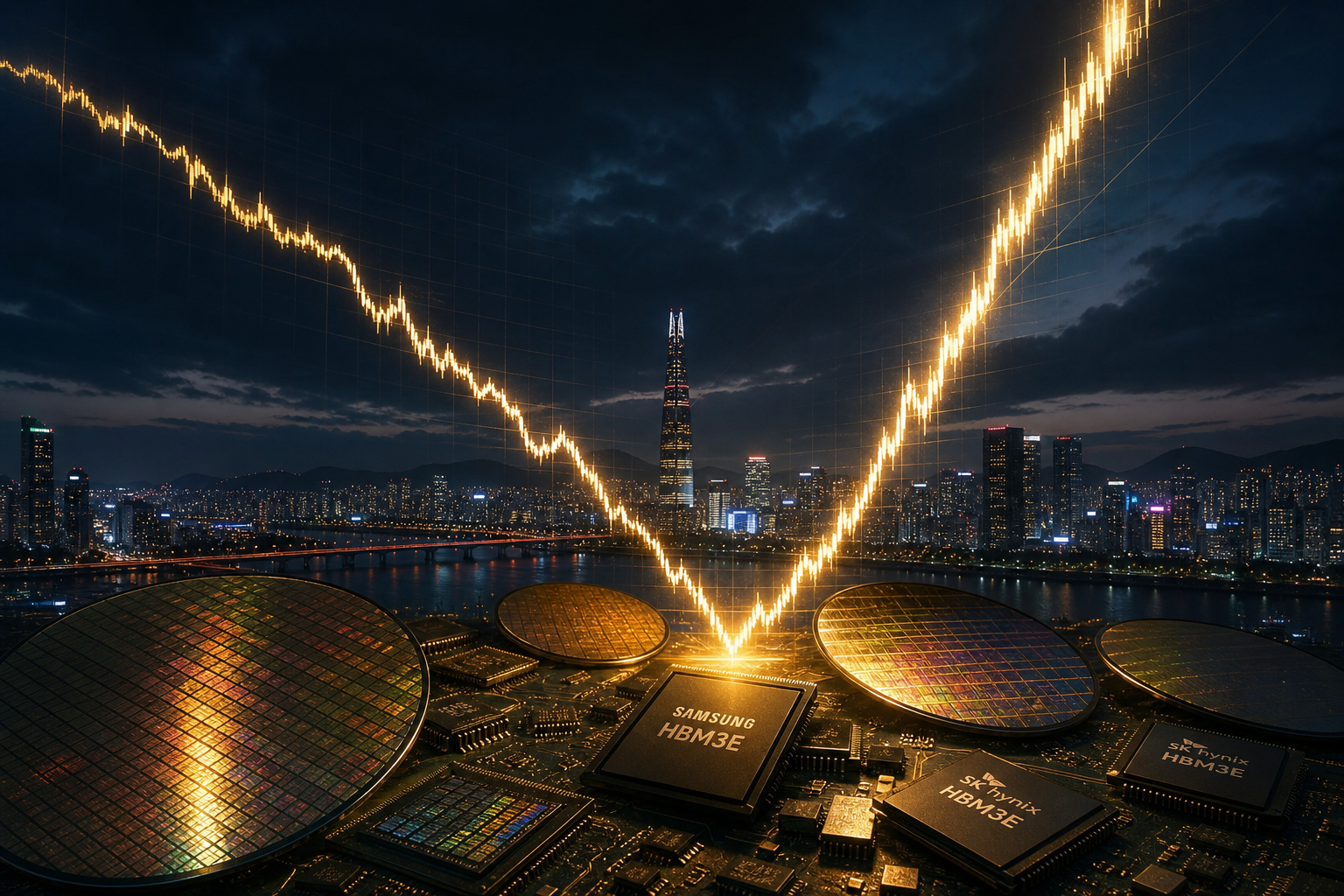
The KOSPI closed Friday at 6,695.45, up a record 17.9% — the largest single-session gain ever recorded by the index, and according to LSEG data, the sharpest reversal on record. Seventy-two hours earlier the same market had fallen 12.6% intraday and wiped out approximately $2.18 trillion in value.
Nothing about the underlying businesses changed in three days. Samsung did not build new fabs. SK Hynix did not sign new contracts. What changed was the market's belief about whether anyone would buy what they make.
That is worth sitting with, because it is the single clearest illustration available of how much of the current market is sentiment rather than arithmetic.
Why It Broke
The selloff began with SK Hynix. The company reported second-quarter operating profit up 557% year over year — a genuinely extraordinary number — and the stock fell 14.7%.
The reason was the same one that has been punishing AI-linked names for two weeks: investors decided the memory boom was a cyclical peak rather than a structural shift. If hyperscalers were about to slow their data center spending, then record memory profits were the top, not the beginning. Samsung fell 13.4%. SanDisk dropped 14%. Micron lost more than 25% over four sessions.
The fear was coherent. It was also, as it turned out, wrong on the facts.
Why It Snapped Back
Two things arrived from the United States and demolished the deceleration thesis.
Microsoft reported Azure growth accelerating to 43% against expectations of 40%, and crossed $100 billion in annual cloud revenue for the first time. Amazon reported AWS growth of 37% — the fastest in 18 quarters — against expectations near 31%, and raised 2026 capital spending guidance from $200 billion to $220 billion.
The two largest buyers of data center hardware on the planet both told the market, on consecutive evenings, that demand was accelerating and they intended to spend more, not less. The entire premise of the memory selloff evaporated in about thirty-six hours.
Then Samsung added the supply side of the argument, warning that the memory crunch could last into 2028. Producers are not able to add capacity fast enough to meet AI-driven demand, which means pricing power sits with the sellers for years, not quarters. The unglamorous industrial layer of this build-out keeps turning out to be where the leverage actually sits.
What Samsung's Record Profit Actually Revealed
Samsung's earnings deserve their own note, because the initial reaction was so strange.
The company posted a record $62 billion annual profit — the best in its history — and the shares fell anyway. The stated concern was Chinese competition: the worry that domestic Chinese memory manufacturers, heavily subsidized and increasingly capable, will eventually commoditize the high-margin products Samsung and SK Hynix currently dominate.
That risk is real but it is a multi-year risk, and the market applied it to a quarter in which Samsung earned more money than it ever has. China's structural position is considerably weaker than the reflexive fear suggests.
By Friday, investors had reconsidered. Samsung soared and SK Hynix set a rebound record.
The American Read-Through
For US investors, the memory complex is where this story is tradeable, and Micron is the most direct exposure.
Micron fell more than 25% in four trading sessions on the deceleration fear, then rose 13% on Thursday once Microsoft's numbers landed. SanDisk gained 21%. Western Digital moved with them.
The most informative print came from Lam Research, which makes the equipment that memory manufacturers buy when they intend to expand. Lam jumped 20% after guiding September revenue 14.2% above consensus, with an EPS midpoint 17.5% higher and guidance implying roughly a 45% incremental operating margin. Equipment orders are a forward signal — manufacturers do not order fab tools for demand they expect to disappear.
And Apple, in the same week, guided its September quarter below consensus and blamed component shortages, memory chief among them. When the most powerful buyer in consumer electronics says it cannot get enough of something, that is a supply statement, not a sentiment one.
What Lands Next
The week ahead brings the rest of the memory chain and a bond market that has stopped cooperating. Long-dated Treasury yields hit fresh multi-year highs on Friday even as equities rallied — the 30-year near a 19-year peak, the 10-year at its highest since January 2025 — while Brent crude settled at $90.12 and closed out a July gain north of 20%.
Korea's round trip is the lesson worth carrying into August. In three days, the same set of facts justified the worst day in the index's history and then the best. The businesses were identical on both days.
When positioning is this crowded and this leveraged, price stops describing value and starts describing who was forced to sell. That works in both directions, and it is now working in both directions within the same week.
Found this helpful? Share it with others.