Key Bullet Points:
- The 30-year Treasury yield reached roughly 5.23% — its highest level in 19 years — while the 10-year climbed to its highest since January 2025, even as equities staged their best day in a month
- June PCE inflation fell 0.1% month over month, the first monthly decline since April 2020, and cooled to 3.7% year over year from 4.1% in May. Yet the index still rose at a 4.4% annualized rate over the last six months
- Brent crude settled at $90.12 and finished July up more than 20% — its largest monthly gain since March — after Iran stopped two vessels attempting to exit the Strait of Hormuz on Friday
- Commodity transits through Hormuz collapsed from roughly 33 per day to as few as 4 per day after renewed Iranian strikes on commercial vessels began July 7
- Real inflation-adjusted wages for private-sector workers fell 0.4% year over year in Q2 — the first decline since 2022 — with private wage growth slowing to 3.1% from 3.5%
Two Markets, Two Answers
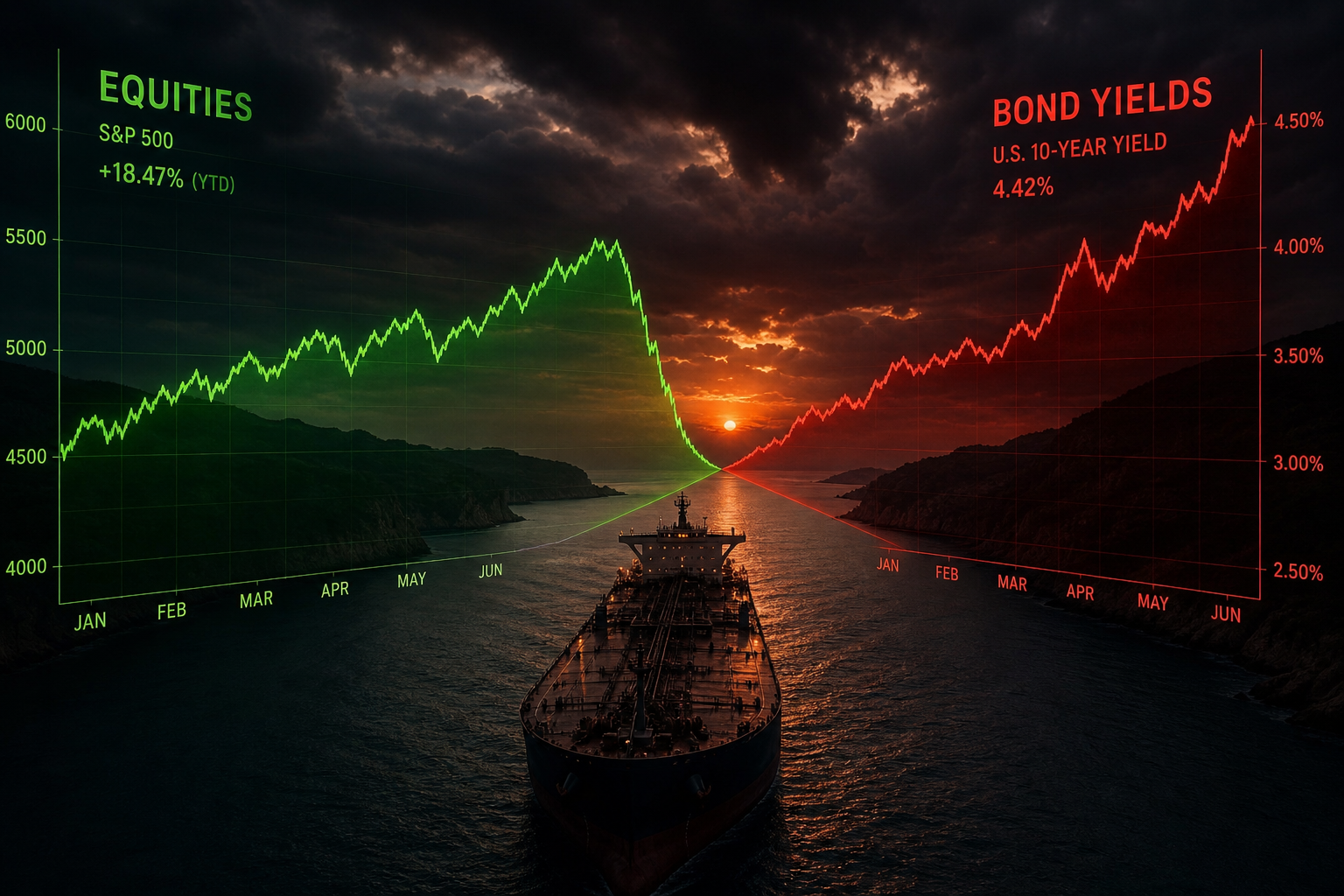
Last week ended with equity investors and bond investors looking at the same information and reaching opposite conclusions.
Stocks had their best session in a month on Thursday. The Dow rose 613.92 points to 52,208.06, the S&P 500 added 121.48 to 7,437.63, and the Nasdaq jumped 2.78% to 25,122.18, snapping a six-day losing streak. Microsoft posted the largest single-day market value gain of any company in history. Amazon followed with the fastest AWS growth in 18 quarters.
The bond market spent that same stretch pushing long-term borrowing costs to levels not seen since 2007.
Only one of those two markets can be right, and the disagreement is not about artificial intelligence. It is about inflation, oil, and how much the US government has to pay to borrow for thirty years.
The Inflation Print Was Good. The Trend Isn't.
June's PCE data was genuinely encouraging on the surface. The Federal Reserve's preferred inflation gauge fell 0.1% on the month — the first monthly decline since April 2020 — driven largely by a 5.9% drop in the energy component. The annual rate cooled to 3.7% from 4.1%.
Two problems sit underneath it.
First, over the trailing six months the index has still risen at a 4.4% annualized pace, and it sits well above the 2.9% readings recorded in January and February, before the Iran conflict became a factor. One month of decline does not establish a trend.
Second, the improvement came from energy — in a month that preceded Brent crude's 20%-plus July surge. The disinflation the market cheered was produced by the one input that has since reversed hard. The risk the market keeps declining to price is the one sitting in the oil complex.
That is why the 30-year sold off into good inflation news. Bond investors read June's report as a lagging snapshot rather than a forecast.
Oil Is the Variable That Decides August
Brent settled Friday at $90.12, up more than 1%, and closed July with a gain north of 20% — the biggest monthly advance since March.
The supply picture explains the persistence. Before renewed Iranian strikes on commercial vessels began on July 7, roughly 33 commodity-related transits per day moved through the Strait of Hormuz. That figure fell to as low as four per day. The strait historically carries about a fifth of global crude. On Friday, Iran said it had stopped two vessels attempting to exit, following an uncorroborated similar report earlier in the week and a drone attack on shipping in the Mediterranean.
US crude inventories are simultaneously sitting at multi-year lows, which removes the buffer that would normally absorb this kind of disruption.
Energy has quietly become the most important macro variable in the market, and it is being priced by a small number of vessel movements in a single waterway. The trade Wall Street keeps under-owning is the one furthest upstream.
Why This Is Meta's Specific Problem
Rising long-term yields are not an abstraction for AI capital spending. They are a direct input cost, and Meta is the most exposed name in Big Tech.
Meta guided full-year capital expenditure to $125–145 billion. Last quarter it generated $784 million in free cash flow — not billion — because $31.1 billion of quarterly capex consumed essentially all of it. Total costs rose 55%. Operating margin fell from 43% to 31%.
A company funding a $145 billion investment program out of $784 million of quarterly free cash flow has to raise the difference. When the 30-year yield moves from 4% to 5.23%, the cost of raising that difference changes materially — and the returns on the spending remain, by management's own framing, years away.
Microsoft and Amazon can absorb higher rates because their AI spending is already producing accelerating revenue. Meta's is producing depreciation. That distinction was an opinion a month ago. With long yields at 19-year highs, it becomes arithmetic.
The Consumer Signal Nobody Mentioned
Friday brought one data point that received almost no attention and probably deserved the most.
Real, inflation-adjusted wages and salaries for private-sector workers fell 0.4% year over year in the second quarter — the first decline since 2022. Nominal private-sector wage growth slowed to 3.1% from 3.5%.
Workers are losing ground to inflation again. That is disinflationary for the Fed in the narrow sense that labor is not driving prices higher. It is also a warning about consumer spending in the back half of the year, arriving precisely as gasoline prices follow $90 crude higher.
Elsewhere, Japanese authorities intervened to buy yen and sell dollars for the first time in three months, after the currency slumped to four-decade lows. Sovereign behavior around the dollar has become one of the more revealing signals in the market.
What Lands Next
July was one of the strangest months in recent memory: a Nasdaq correction, a record wipeout and a record rally in Korea within one week, the Fed holding rates with three officials dissenting in favor of a hike, oil up more than 20%, and the largest single-day value gain by any company in history.
Equities exited it near where they entered. Long bond yields exited it at a 19-year high.
August will resolve that disagreement one way or the other. The mechanism to watch is not earnings — those largely came in strong. It is whether oil stays above $90 long enough to push the next inflation print back up, because that is the number that decides whether the bond market or the stock market spent last week reading the situation correctly.
Found this helpful? Share it with others.