Key Bullet Points:
- Microsoft (MSFT) surged 16.8% to $456.06 on Thursday — its largest single-day gain in years — after reporting $90 billion in quarterly revenue (up 18%), EPS of $4.81 against $4.24 expected, and Azure growth that accelerated to 43% when Wall Street had modeled 40%
- Azure crossed $100 billion in annual revenue for the first time in company history, while Microsoft's commercial remaining performance obligation — contracted revenue not yet recognized — jumped 84% to $678 billion
- Meta (META) fell roughly 9% the same day: revenue beat at $60.80 billion (up 28%), but EPS came in at $6.18 versus $7.14 a year ago, costs rose 55%, operating margin collapsed from 43% to 31%, and free cash flow fell to just $784 million as capex hit $31.1 billion in a single quarter
- Wednesday's session was the worst in seven weeks: the Dow shed 1,153.18 points (-2.19%) to 51,594.14, its lowest close since June 18, while the 30-year Treasury yield touched 5.23% — a 19-year high
- Chip stocks staged a violent reversal Thursday: Lam Research jumped 20%, SanDisk 21%, Micron 13%, and AMD surged, after Samsung warned the global memory shortage could persist into 2028
The Same Bet, Two Verdicts
For three years, investors treated artificial intelligence spending as a single trade. If a company was pouring billions into data centers and GPUs, you bought it. The details did not matter much, because the story did all the work.
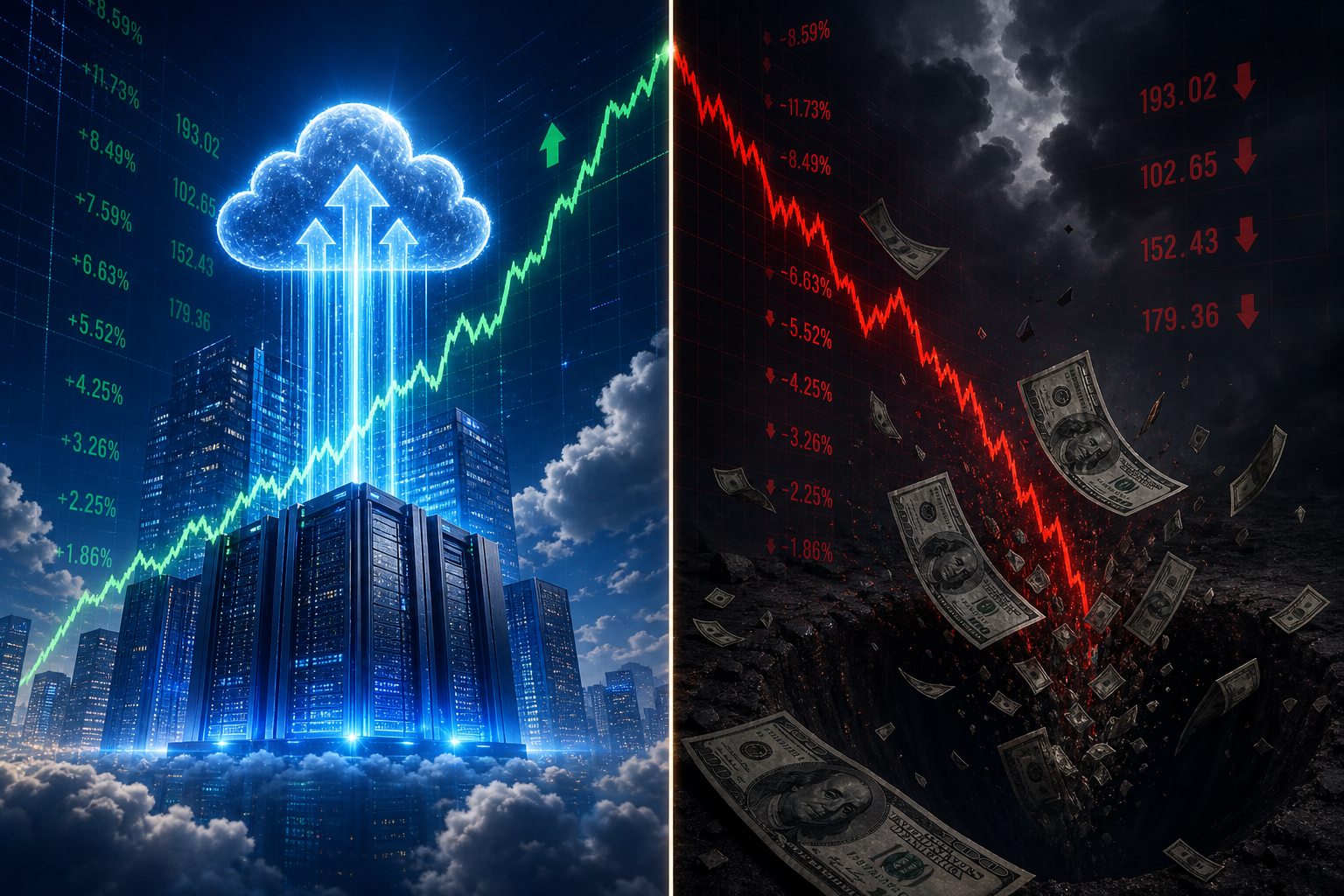
On Wednesday evening, Microsoft and Meta reported within minutes of each other. By Thursday's close, Microsoft was up 16.8% and Meta was down about 9%.
That 26-point spread in a single session is the market drawing a line it has refused to draw since 2023. AI spending is no longer a virtue by itself. Investors now want to see the revenue on the other side of it, and the Magnificent Seven is no longer trading as one organism.
Microsoft Showed the Other Side
Microsoft's quarter was the cleanest answer the AI trade has received.
Revenue came in at $90 billion, up 18% year over year, against a consensus near $87.7 billion. Earnings per share hit $4.81 versus the $4.24 analysts modeled — a 13% beat. Full fiscal-year revenue topped $331 billion.
But the number that moved the stock was Azure. Analysts expected 40% constant-currency growth, matching the prior quarter. Microsoft delivered 43%. Cloud growth accelerated at a $100 billion-plus run rate, which is not supposed to be arithmetically possible at that scale. Azure crossed $100 billion in annual revenue for the first time. Microsoft Cloud as a whole surpassed $214 billion, up 27%.
Then there is the backlog. Commercial remaining performance obligation — contracted revenue Microsoft has signed but not yet booked — rose 84% to $678 billion. That figure is larger than the annual GDP of most countries, and it is money customers have already committed to spend.
Microsoft spent $41 billion on capital expenditure in the quarter and brought 88 data centers online during the fiscal year. Investors did not flinch, because the revenue arrived alongside the spending.
Meta Showed What Happens When It Doesn't
Meta's revenue was fine. That was never the argument.
Revenue reached $60.80 billion, up 28% year over year, ahead of the roughly $60.2 billion consensus. Under almost any other circumstances, 28% growth from a company this size would be celebrated.
Everything beneath the top line deteriorated. Earnings per share fell to $6.18 from $7.14 a year earlier — a 13% decline and a roughly 14% miss against estimates. Net income dropped 14% to $15.85 billion. Total costs rose 55%. Operating margin fell from 43% to 31% in twelve months.
And then the number that genuinely alarmed people: free cash flow of $784 million. Not billion. Meta generated less than a billion dollars of free cash in a quarter where it produced $60.8 billion of revenue, because capital expenditure reached $31.1 billion and legal and severance charges piled on top. Management raised full-year capex guidance again, having already lifted it to $125–145 billion.
Meta entered the report on the longest losing streak in its history — nine straight down days. It exited on the tenth. When a company's entire cash generation is consumed by an investment program whose returns remain theoretical, the risk stops being an equity story and becomes a balance-sheet story.
Wednesday Was Genuinely Ugly
It is worth remembering what these earnings landed on top of.
Wednesday was the worst session in seven weeks. The Dow fell 1,153.18 points, or 2.19%, closing at 51,594.14 — its lowest level since June 18. The S&P 500 dropped 1.52% to 7,316.15, its lowest since June 10. The Nasdaq Composite lost 1.74% to 24,442.94, its weakest close since April 23, and the Nasdaq-100 slid into technical correction territory, roughly 10.3% below its record.
The driver was rates. After the Fed held at 3.5%–3.75% with three regional presidents dissenting in favor of a hike, the 30-year Treasury yield climbed to 5.23% — its highest level in 19 years. Oil above $90 did the rest.
Thursday reversed a good chunk of it. The S&P rose about 0.9%, the Nasdaq climbed 1.8%, and the Dow added roughly 250 points.
Memory Chips Ripped
The most violent moves Thursday were in semiconductors, and they had nothing to do with Microsoft.
Samsung reported a record $62 billion annual profit — and, in a pattern now familiar, its shares sold off anyway on Chinese competition fears. But Samsung also warned that the global memory shortage could last into 2028. That single forecast reversed a four-day collapse.
Lam Research jumped 20% after September revenue guidance beat consensus by 14.2%. SanDisk rallied 21%. Micron rose 13% after falling more than 25% in four sessions. AMD and Intel both climbed. Nvidia added 2% to $193.89.
Oil, meanwhile, drifted lower despite escalating U.S.–Iran fighting, with Brent slipping about 2% to $88.93 as tanker traffic through the Strait of Hormuz steadied — even as U.S. crude stockpiles hit a multi-year low. The disconnect between energy fundamentals and energy prices remains one of the most stubborn in the market.
What Lands Next
Amazon and Apple both reported after Thursday's close. Amazon was expected near $197 billion in revenue with EPS around $1.82 and AWS near $40.5 billion, with analysts anticipating full-year capex guidance to rise above the current $200 billion. Apple's consensus sat near $108.9 billion in revenue and $1.89 EPS, with iPhone revenue projected around $53.6 billion.
Apple's report carries an additional weight: it is Tim Cook's final earnings call as chief executive. Apple briefly touched a $5 trillion market capitalization on Tuesday, becoming only the second company in history to do so.
Microsoft has now proven that AI capital expenditure can produce visible, accelerating returns. Meta has proven it doesn't have to. From here, every AI company will be sorted into one of those two categories — and the market has demonstrated it will do the sorting in a single trading session.
Found this helpful? Share it with others.