Key Bullet Points:
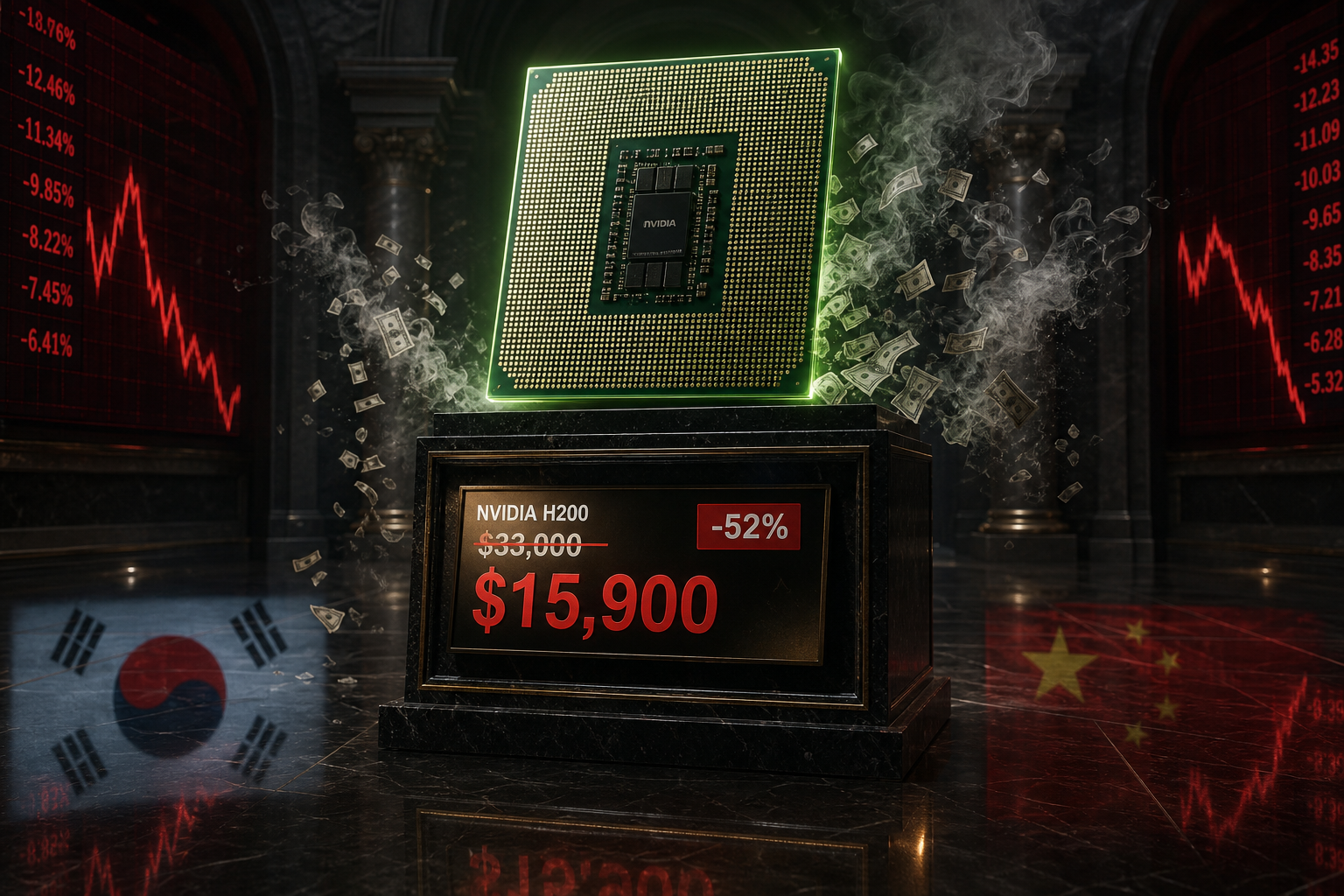
- Nvidia (NVDA) fell 1.9% to $193.26 on Wednesday, touching $190.68 intraday — and according to Barron's, the most important stock in the world now trades at its cheapest valuation since 2015, before the AI boom even began
- The global AI chip selloff has now erased more than $1 trillion in market value, and Nvidia's credit default swap spreads just posted their largest single-day widening on record — a signal from the bond market that has nothing to do with equity sentiment
- South Korea's stock market suffered a historic collapse: the KOSPI plunged as much as 12.6% and roughly $2.18 trillion was wiped from Seoul equities, with SK Hynix crashing 14.7% and Samsung falling 13.4% — despite SK Hynix reporting a 557% surge in Q2 operating profit
- The Federal Reserve held its benchmark rate at 3.5%–3.75% for the seventh consecutive month, but three regional Fed presidents — Cleveland, Dallas, and Minneapolis — dissented in favor of a rate hike, the clearest hawkish signal of Chair Kevin Warsh's tenure
- Oil violently reversed its three-day collapse, with Brent crude surging 7.2% to $90.12 after President Trump said the U.S. would "hit Iran hard" and American forces intercepted an Iranian surprise attack — sending the Dow down as much as 850 points intraday
The Cheapest Nvidia in Eleven Years
There is a number circulating on Wall Street this morning that stops conversations.
Nvidia — the company that defined the AI era, that became the first $5 trillion business in history, that single-handedly carried the S&P 500 for three straight years — is now trading at its lowest valuation multiple since 2015. That's not since last year. Not since the 2022 bear market. Since 2015, when Nvidia was a $10 billion gaming-graphics company and nobody outside a handful of research labs had heard the phrase "large language model."
The stock closed Wednesday at $193.26, down 1.9%, after dipping to $190.68 during the session. Barron's flagged the valuation. Bank of America told clients to buy. Cathie Wood's ARK funds have been accumulating shares. Profit estimates for Nvidia keep rising, not falling.
And the stock keeps going down.
The Bond Market Is Saying Something Different
Here is the detail that should give every investor pause, and it has nothing to do with the equity price.
Nvidia's credit default swap spreads — essentially the cost of insuring against a Nvidia debt default — widened by the largest single-day amount on record. Credit markets are not driven by retail sentiment or momentum traders. They are driven by institutions doing arithmetic on cash flows and counterparty risk.
The specific concern is what analysts have started calling circular financing: Nvidia invests in AI companies, those companies use the money to buy Nvidia chips, and Nvidia books the revenue. The $250 billion OpenAI arrangement sits at the center of that debate. If the customers buying your product are funded in part by you, credit analysts want to know what happens when outside capital stops arriving.
Most analysts believe these fears are overblown. The credit market is not so sure. When equity and credit disagree this violently, it is usually worth asking who has more to lose by being wrong.
Seoul's $2.18 Trillion Reckoning
The scale of what happened in South Korea overnight is difficult to overstate.
The KOSPI index dived as much as 12.6% before recovering to close down roughly 6%. As much as $2.18 trillion in market value evaporated from Seoul equities in a single session — the largest destruction of wealth in the history of the Korean market. Leveraged retail investors, who had piled into the AI trade at record margin levels, were annihilated.
SK Hynix fell 14.7%. Samsung Electronics dropped 13.4%. SanDisk plunged over 14% in U.S. trading and is now down more than 55% from its record high.
The extraordinary part: SK Hynix reported a 557% year-over-year surge in second-quarter operating profit. Record results. Historic numbers. The stock was destroyed anyway.
That is the defining pattern of this selloff. Intel beat every metric and fell 8%. Netflix posted record revenue and dropped 9%. SK Hynix grew profits sixfold and lost a seventh of its value in one day. Good news has stopped working, and crowded trades are breaking in exactly the way they always do — all at once.
The catalyst was China. ChangXin Memory Technologies (CXMT) launched a blockbuster Shanghai IPO that briefly peaked above a $500 billion valuation, resurrecting fears of memory oversupply. Combined with reports that Chinese firms have begun producing domestic DUV lithography equipment, the market is now pricing a future where China competes rather than depends.
Three Dissents and a Hawkish Warning
The Federal Reserve held its benchmark rate at 3.5%–3.75% on Wednesday, the seventh consecutive month without a change. That was expected. What wasn't expected was the scale of internal opposition.
Three members of the FOMC — the presidents of the Cleveland, Dallas, and Minneapolis Federal Reserve Banks — dissented in favor of an immediate quarter-point hike. All three had also dissented at Jerome Powell's final meeting as chair in late April, though in the opposite direction that time.
Chair Kevin Warsh, who has deliberately abandoned forward guidance since taking over, offered little clarity in his press conference. But markets are now pricing roughly an 80% probability of a hike at the September 15–16 meeting. With oil back above $90 and tariffs now touching nearly everything Americans buy, the labor market data that would justify holding is looking increasingly unreliable.
Oil Snapped Back Instantly
The three-day, 12% collapse in crude prices reversed in a single session.
Brent crude surged 7.2% to $90.12 a barrel. West Texas Intermediate jumped 6.6% to $84.46. The trigger: President Trump declared the U.S. would "hit Iran hard," American forces intercepted what officials described as an Iranian surprise attack, and fresh strikes hit targets in Iraq. The American Petroleum Institute also reported a crude inventory draw.
The Dow fell as much as 850 points intraday on the inflation implications, with two high-priced components — Caterpillar chief among them — accounting for roughly 72% of the index's decline.
Ceasefire optimism lasted exactly three nights.
What Lands Next
Microsoft and Meta reported fiscal results after Wednesday's close, and the numbers that matter aren't revenue or earnings — they're capital expenditure guidance. Microsoft was expected to post roughly $87.7 billion in revenue with Azure growth near 40%, and FY2027 capex guidance in the $255–260 billion range. Options markets priced a $190 billion swing in Microsoft's market value.
Meta entered the report following its longest losing streak on record — nine consecutive down days — with 2026 capex already guided to $125–145 billion.
Tonight, Amazon reports (consensus EPS $1.81) and Apple follows roughly 30 minutes later (consensus EPS $1.88). Apple briefly touched a $5 trillion market capitalization on Tuesday, becoming only the second company ever to do so, on the strength of record iPhone revenue and a China rebound.
Nvidia is now cheaper than it has been since 2015. Whether that is the buying opportunity of the decade or the first honest price in three years depends entirely on numbers being read on earnings calls this week.
Found this helpful? Share it with others.