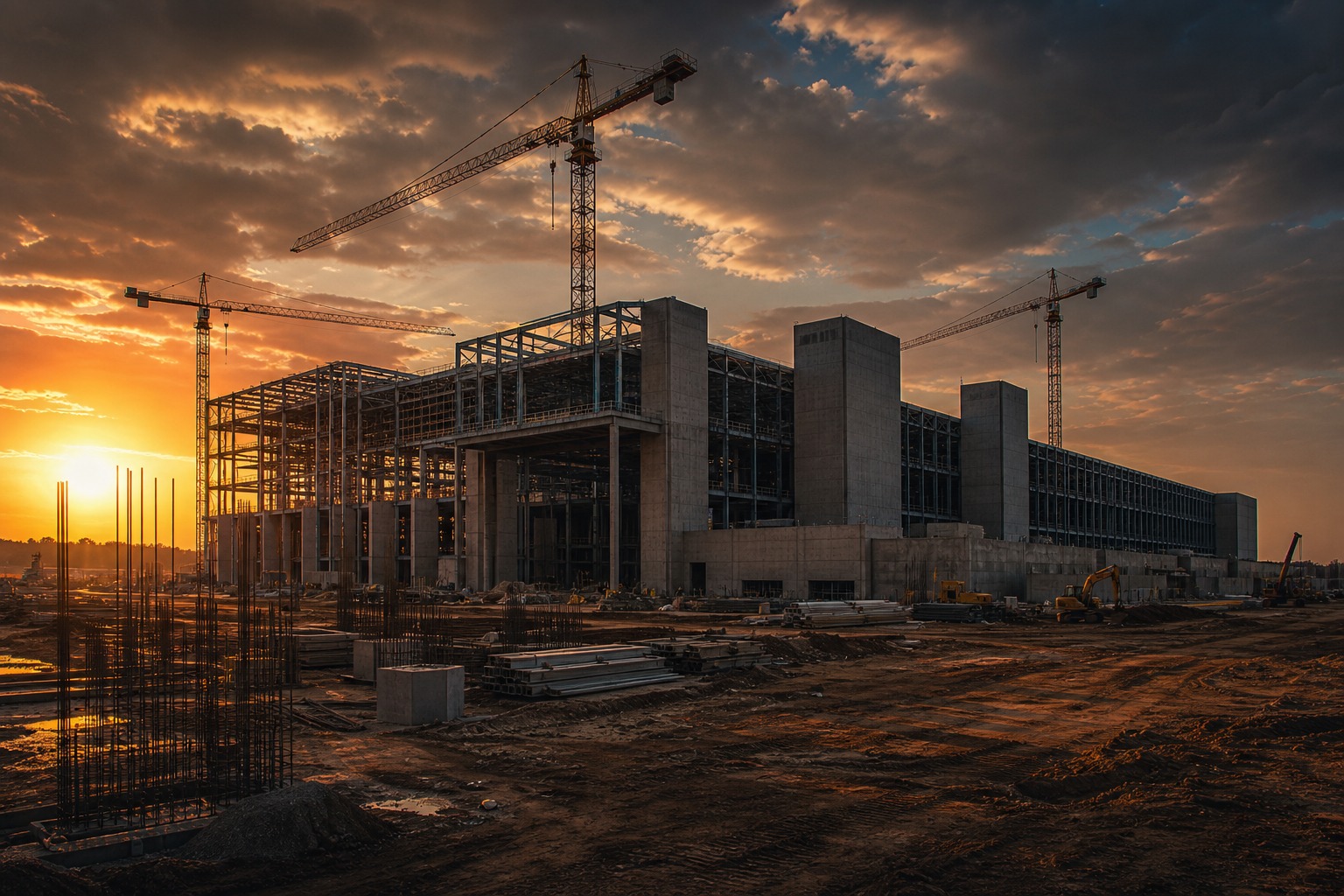
Oracle is carrying the largest order book in the history of enterprise software. Remaining performance obligations reached $638 billion in the fourth quarter of fiscal 2026 — a number with no precedent in the industry.
The stock is down roughly 40% over the past year and 24% year to date. It closed Friday at $146.49, up 3.11% on the session — still some 28% below its 52-week high of $341.82.
Friday was a broad rebound. The S&P 500 finished at 7,674.30 (+0.43%), the Dow added 517.80 points to 53,277.01 (+0.98%), the Nasdaq Composite rose 0.43% to 26,180.46, and the Russell 2000 gained 0.89% to about 3,018.9. It did not rescue the week: all three major indexes closed lower over five sessions, with the S&P and Nasdaq breaking a three-week winning streak and the Dow suffering its worst week since mid-March. The 10-year Treasury yield ended at 4.74% and the 30-year at 5.27%. Brent crude settled at $93.90.
Backlogs are supposed to be the thing that fixes a stock. This one is the thing breaking it, and the reason is on the funding side of the ledger.
The Business Is Working
Nobody serious disputes the demand.
Fourth-quarter revenue: $19.18 billion, EPS of $2.11.
Oracle Cloud Infrastructure revenue: $5.79 billion, up 93%.
AI infrastructure contracts signed in a single quarter: $67 billion, primarily bring-your-own-hardware or prepaid.
Global GPU utilization: 97.5%.
Data center capacity brought online across 2026: 1.2 gigawatts, with another 1 gigawatt expected in the first quarter of fiscal 2027 alone.
FY2027 guidance: $90 billion in revenue, non-GAAP EPS of $8.05.
Of the $638 billion backlog, 12% converts to revenue within twelve months and 34% within twenty-four. CFO Hilary Maxson, hired from Schneider Electric in April, called it "exceptional visibility into our future revenue growth." She is not wrong about the visibility.
The Cash Does Not Work
Here is the other column.
Free cash flow in fiscal 2026: negative $23.69 billion.
Capital expenditure in fiscal 2026: $55.66 billion, guided to $90–95 billion in fiscal 2027.
Non-current debt: $124.7 billion.
New debt and equity planned for fiscal 2027: roughly $40 billion, including an already-announced $20 billion at-the-market equity issuance.
Oracle also changed how it reports the spending. Beginning this quarter it emphasizes "project net cash outlay," guided to $70 billion for fiscal 2027, with customer prepayments and timing effects broken out separately. Actual capital expenditure is likely $20 to $25 billion above that headline figure. Maxson's stated reason: "We think this measure is important to better understand our funding needs."
That is a candid sentence. A company introduces a funding-needs metric when funding needs are the story.
The Lenders Noticed First
TD Cowen's latest data center channel checks describe something more concrete than a valuation debate.
Oracle has raised roughly $58 billion in debt to build out OpenAI-linked projects — $38 billion for campuses in Texas and Wisconsin, $20 billion for a campus in New Mexico. To service its existing agreements the firm calculates Oracle needs to procure around three million GPUs and associated equipment.
According to the report, a number of U.S. banks have retreated from Oracle-linked data center projects specifically because of the OpenAI exposure. Where American lenders remain willing, borrowing costs have risen. Asian banks looking for AI exposure are still lending against Oracle leases, but the drop in U.S. financing has slowed the pipeline materially — several leases under negotiation have been unable to secure financing at all. Oracle is now requiring 40% deposits upfront to offset the incremental capital requirement.
The credit market is saying it out loud: Oracle's credit default swap spreads have widened, with pressure on both the stock and the bonds.
The counterparty math is the reason. TD Cowen puts OpenAI's implied capital requirement at roughly $156 billion, assuming a conservative $30 million per megawatt of IT fit-out — against $1.4 trillion in outstanding multi-year commitments across the industry. Oracle's backlog is only as good as the ability of the entities behind it to pay.
Everyone Is Building This Way Now
Oracle is not an outlier. It is the most levered example of a structure that has quietly become standard: build enormous physical capacity, keep as much of it as possible off your own balance sheet, and let someone else carry the financing risk.
Uber added 2,000 robotaxis to its network without owning a single one. Nvidia is guaranteeing $105 billion of leases for power infrastructure it will not operate. Oracle is borrowing against contracts signed by a customer that is itself pre-revenue on the scale required.
Each arrangement works while credit is available and rates are stable. Neither condition described this week. Thirty-year Treasury yields touched their highest level since 2007 on Tuesday before the Treasury Department stepped in Wednesday with a doubling of its long-end buyback operations — and the relief lasted exactly one session. The market has already shown what happens to a richly-priced asset when the supply of capital shifts even slightly.
The Bull Case Is Real
It should be stated fairly. Roughly $75 billion of the backlog is structured as customer-prepaid or bring-your-own-hardware, with no margin degradation. Maxson expects steady-state return on invested capital "in the high 20s." Safra Catz has projected OCI reaching $144 billion by fiscal 2030. Oracle is up 16% over the past month as the backlog narrative regains ground.
If the financing holds, the backlog converts and this is one of the great re-ratings of the decade. If the financing does not hold, the backlog is a liability schedule with a revenue label on it.
What Lands Next
The week is dense. Wednesday, August 26 brings the July PCE report at 8:30 a.m. — the Fed's preferred inflation gauge, running 3.7% year over year in June against a 2% target — followed by Nvidia's fiscal second-quarter results after the close. Thursday through Saturday, August 27–29, is the Jackson Hole symposium, with Chair Kevin Warsh delivering his first keynote as chair on Friday.
For Oracle specifically, none of those events matter as much as the long end of the Treasury curve. Every additional basis point on thirty-year money is a direct tax on a $90 billion capital program funded by borrowing. The backlog is not the variable. The cost of the money behind it is.
Found this helpful? Share it with others.