Key Bullet Points:
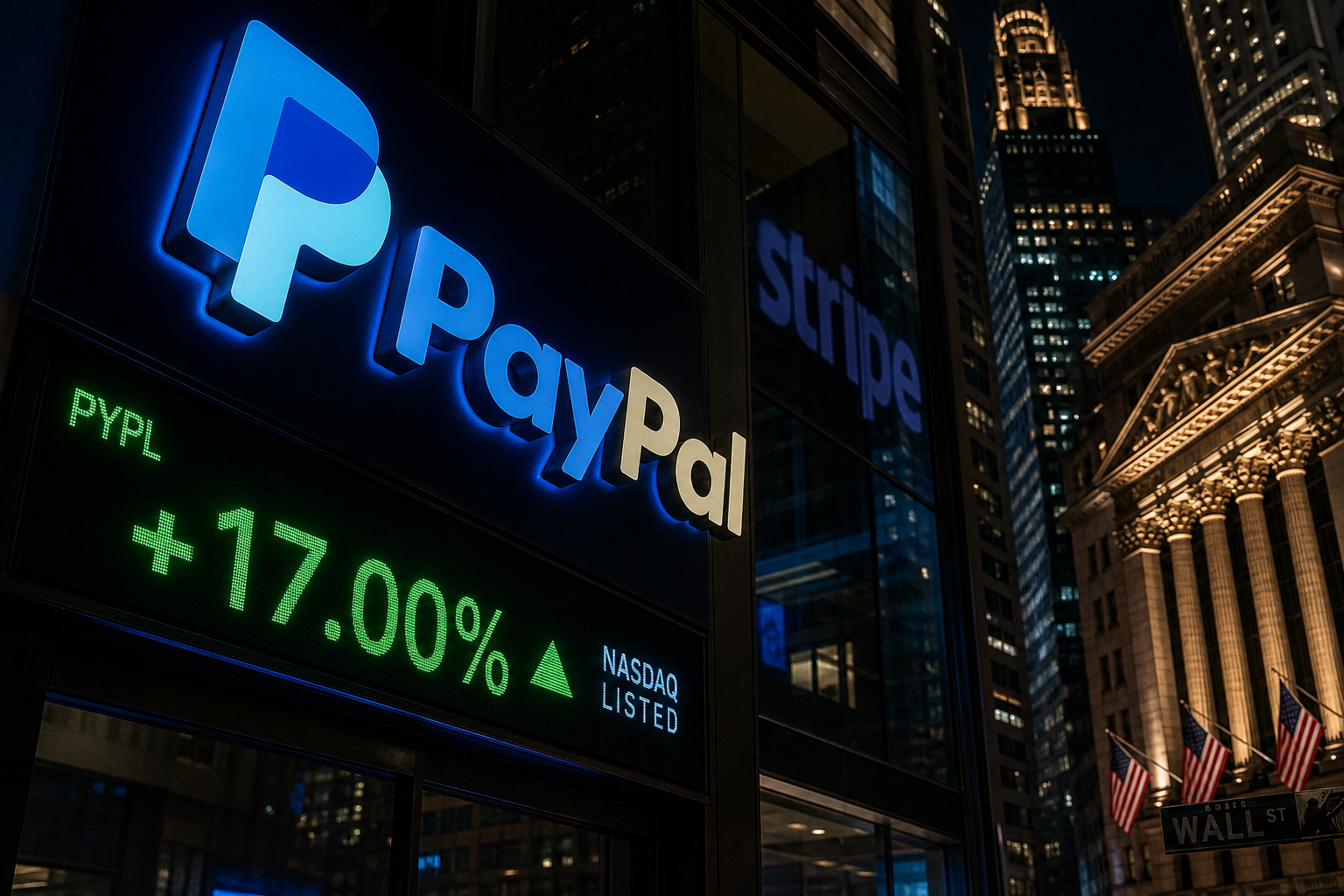
- PayPal (PYPL) surged as much as 17% after Stripe and private equity giant Advent International made a joint $53.4 billion takeover offer — $60.50 per share in cash, a 28% premium to Tuesday's close, backed by $50 billion in committed bank financing — in what would be the largest fintech acquisition in history
- Morgan Stanley (MS) posted record Q2 revenue of $21.35 billion (vs. $19.64 billion expected), with EPS of $3.46 versus the $2.94 consensus estimate — making it the sixth major bank in two days to crush earnings, and capping a first half with $42 billion in revenue, $6.90 EPS, and a 27% return on equity
- SpaceX (SPCX) crashed below its $135 IPO debut price for the first time, hitting an intraday low of $132.15 — down over 41% from its all-time high of $225.64 reached just weeks after its June listing — as post-IPO liquidation deepened
- The June PPI fell 0.3% month-over-month (expected: flat), with the annual rate decelerating to 5.5% from 6.0%, delivering a second straight day of cooler-than-expected inflation data and pushing December rate hike odds down to 74%
- The United States reimposed a full naval blockade on all Iranian ports and launched daylight airstrikes for the first time — a dramatic escalation — as Trump held an emergency Situation Room meeting to discuss a "massive offensive" to reopen the Strait of Hormuz, with Brent crude holding above $86
The Biggest Fintech Takeover Bid in History
PayPal stock exploded Wednesday morning after reports confirmed what nobody in Silicon Valley saw coming.
Stripe — PayPal's fiercest rival — teamed up with private equity giant Advent International to make a joint offer to acquire PayPal for $60.50 per share in cash, valuing the payments company at $53.4 billion. The bid represents a 28% premium to PayPal's Tuesday close, and is backed by approximately $50 billion in committed bank financing.
Shares of PayPal surged as much as 17% on the news.
The offer, submitted earlier this month according to sources, would create an undisputed fintech colossus. Stripe, already valued at over $90 billion privately, has long competed with PayPal for online payment dominance. Acquiring its biggest rival would consolidate the digital payments industry in a way regulators are certain to scrutinize.
PayPal has not publicly responded to the offer. But the market's reaction tells its own story: investors are betting this deal — or something like it — happens. PayPal has struggled to regain its pandemic-era dominance, and a 28% premium might be exactly the lifeline shareholders have been waiting for.
For Advent, the deal represents classic private equity logic: buy an undervalued franchise with massive cash flows, strip costs, and re-list at a premium. For Stripe, it's empire-building — the kind of audacious consolidation move that defines an era.
Morgan Stanley Completes the Bank Earnings Sweep
While PayPal dominated the headlines, Morgan Stanley quietly delivered the final act of the most dominant bank earnings season in recent memory.
The firm reported record Q2 revenue of $21.35 billion, crushing the $19.64 billion consensus estimate. Earnings per share came in at $3.46 versus $2.94 expected — an 18% beat. For the first half of 2026, Morgan Stanley generated $42 billion in revenue, $6.90 in EPS, and a 27% return on equity.
That makes it six for six. Every major bank that reported this week — Goldman Sachs, JPMorgan, Wells Fargo, Bank of America, Citigroup, and now Morgan Stanley — beat estimates. Goldman's record-smashing 45% EPS beat on Tuesday set the tone, and Morgan Stanley confirmed the pattern.
The common thread? Trading revenue. The geopolitical chaos of Q2 — the Iran conflict, the SpaceX and SK Hynix IPOs, the oil swings, the tariff uncertainty — created the exact type of volatile, high-volume environment where Wall Street's trading desks print money. The banks didn't dodge the storm. They built a business model that feeds on it.
SpaceX Falls Below Its IPO Price
If there was a single chart on Wall Street that told the story of this market, it might be SpaceX.
Shares of the space and satellite company crashed below their $135 IPO debut price on Wednesday for the first time, hitting an intraday low of $132.15 before closing near $135.66. It has been barely five weeks since SpaceX listed on the Nasdaq at $135 per share, briefly soared to an all-time high of $225.64, and became the most talked-about IPO in a decade.
Now, it is trading below where it started.
The decline — more than 41% from peak to Wednesday's low — has wiped out every dollar of gains for anyone who bought after the opening bell on day one. Post-IPO liquidation has deepened as early investors, freed from lockup restrictions, unload shares into a market that is running out of buyers at these levels.
The Motley Fool ran a headline Wednesday asking what a $10,000 investment today would be worth in a year. The question itself captures the mood: SpaceX, which was supposed to be the defining IPO of the decade, has become a cautionary tale about what happens when hype meets reality at $1.8 trillion valuations.
Inflation Keeps Cooling — and Nobody Trusts It
The June Producer Price Index fell 0.3% month-over-month, surprising economists who expected a flat reading. The annual PPI rate decelerated to 5.5% from 6.0%. Core PPI, excluding food and energy, rose just 0.2%.
Combined with Tuesday's CPI report — which showed consumer prices falling 0.4%, the biggest monthly decline since April 2020 — the data painted a picture of an economy where inflation was genuinely cooling in June. Traders pushed December rate hike odds down to 74% from roughly 80%, and New York Fed President John Williams said publicly that inflation has "peaked" and rates are "well positioned."
But the fine print matters. Both reports capture June — when oil prices briefly collapsed during the US-Iran memorandum of understanding. That window has slammed shut. And the reason it slammed shut was playing out in real time, 7,000 miles away.
Trump Goes All In
The United States reimposed a full naval blockade on all Iranian ports Wednesday — the same blockade it had lifted last month as a goodwill gesture during the failed negotiations. Within 17 hours, U.S. Central Command launched daylight airstrikes on Iranian targets, an unusual and significant escalation from the overnight raids that had characterized previous rounds.
President Trump held an emergency meeting in the White House Situation Room to discuss what three sources described to Axios as a "massive offensive" to forcibly reopen the Strait of Hormuz. He scrapped the 20% shipping toll he had announced just Monday, replacing it with trade deals with Gulf allies. And he threatened to bomb Iranian bridges and power plants unless Tehran returns to negotiations.
Iran responded by claiming fresh strikes against U.S. bases in the region and threatening to halt all Middle East energy exports.
Brent crude held above $86 per barrel. WTI hovered near $79. The conflict, now in its fourth consecutive day of active hostilities since the ceasefire collapsed, showed no signs of resolution — and oil traders are pricing in the possibility that it won't for weeks.
Tuesday's session closed with the Nasdaq up 0.90% to 26,107, the S&P 500 up 0.38% to 7,544, and the Dow barely positive at 52,508. Wednesday futures edged higher on the PPI relief. But with SpaceX crumbling, oil elevated, and a president discussing a "massive offensive" from the Situation Room, the question for Thursday isn't whether the market can rally — it's whether it can hold.
Found this helpful? Share it with others.