Key Bullet Points:
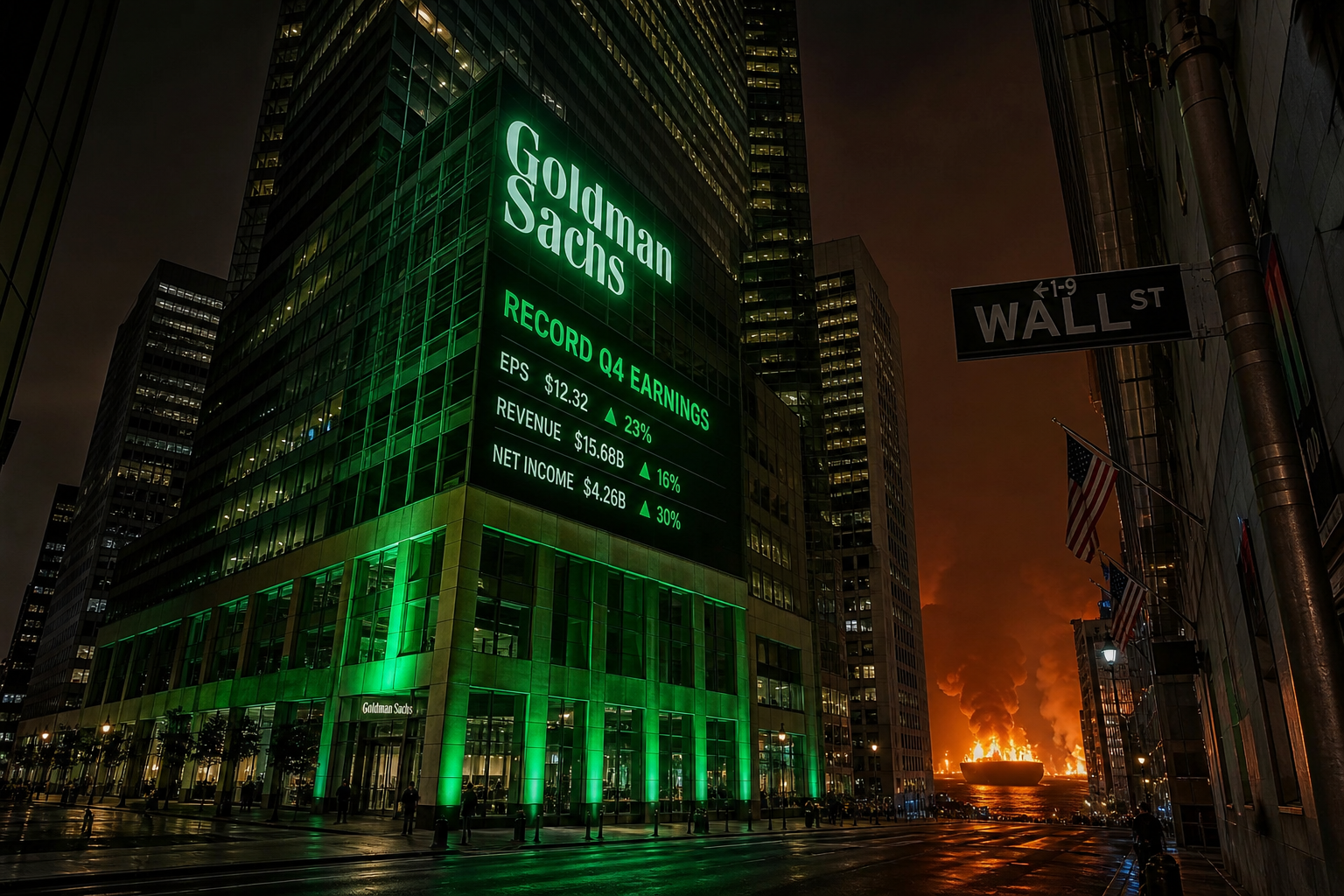
- Goldman Sachs (GS) posted record Q2 earnings — EPS of $20.98 vs. the $14.48 consensus estimate, a 45% beat, on revenue of $20.34 billion (+39.5% year-over-year), with Global Banking & Markets generating a record $15.5 billion in revenue and the firm delivering a 23.5% return on equity
- All five major banks crushed estimates: JPMorgan posted net income of $21.2 billion with EPS of $6.14 vs. $5.74 expected (+7%) on $58 billion in revenue (+27% YoY); Wells Fargo earned $2.00 per share vs. $1.72 expected; Bank of America posted $9.1 billion in profit; and Citigroup delivered $5.8 billion in net income (+45% YoY) on $24.8 billion in revenue
- The June CPI report showed prices fell 0.4% month-over-month — the largest monthly decline since April 2020 — dragging the annual inflation rate from 4.2% to 3.5%, well below the 3.8% Wall Street expected, as the energy index plunged 5.7% during the brief US-Iran ceasefire window
- IBM crashed approximately 25% in its biggest single-day loss since Black Monday in 1987, vaporizing roughly $70 billion in market value after CEO Arvind Krishna admitted "we faltered" as clients redirected AI spending from software to hardware ahead of expected price hikes
- Iran struck two UAE oil tankers — the Mombasa and Al Bahiyah — with missiles in the Strait of Hormuz, killing one Indian crew member and wounding eight, sending Brent crude surging to $87 per barrel and WTI above $81 as fighting entered its third consecutive day
The Best Quarter Goldman Sachs Has Ever Had
When five of America's largest banks reported Q2 earnings Tuesday morning, the results told two different stories — both of them extraordinary.
Goldman Sachs delivered the best quarter in the firm's history. Earnings per share came in at $20.98, obliterating the $14.48 consensus estimate by 45%. Revenue hit $20.34 billion, beating estimates by nearly $4 billion and surging 39.5% year-over-year. The firm's return on equity was 23.5%.
Chief Financial Officer Denis Coleman confirmed that Global Banking & Markets — Goldman's trading and investment banking powerhouse — generated a record $15.5 billion in revenue. Asset and Wealth Management rose 20% year-over-year.
The numbers tell a story the market already suspected: every crisis of the past quarter — SpaceX's $25.7 billion IPO, SK Hynix's $26.5 billion Nasdaq debut, the oil volatility from the Iran conflict, the wild swings in Treasuries — translated directly into record trading revenue. Goldman Sachs didn't just survive the chaos. It monetized it.
JPMorgan told a similar story. The bank posted $21.2 billion in net income, with earnings per share of $6.14 versus $5.74 expected — a 7% beat. Revenue surged 27% year-over-year to $58 billion. Jamie Dimon's equities trading division, as it did in Q1, took full advantage of the market's volatility.
Wells Fargo beat by $0.28, posting $2.00 EPS versus $1.72 expected on $22.62 billion in revenue and $6.4 billion in net income. Bank of America delivered $9.1 billion in profit. And Citigroup's net income surged 45% year-over-year to $5.8 billion on $24.8 billion in revenue.
Five banks. Five beats. Not a single miss.
IBM: The Worst Day in 115 Years
Then there was IBM.
Shares crashed approximately 25% Tuesday in the company's worst single-day loss since Black Monday in October 1987 — and possibly the worst ever. The plunge vaporized roughly $70 billion from IBM's $272.78 billion market capitalization.
CEO Arvind Krishna was blunt: "We faltered."
The problem? Clients redirected their capital expenditure away from IBM's software products and toward "servers, storage, and memory purchases" in anticipation of price hikes from tariffs and trade disruptions. In other words, the AI infrastructure boom is cannibalizing the AI software side. Companies are panic-buying hardware before costs rise, and that spending is coming directly out of the budgets IBM depends on.
The implications rattled the entire software sector. If IBM's clients — some of the largest enterprises in the world — are cutting software spending to stockpile hardware, what does that mean for every other enterprise software company?
The Dow fell 0.1% Tuesday, dragged almost entirely by IBM. Without it, the index would have been solidly green.
Deflation — for One Brief, Beautiful Moment
The June CPI report, released at 8:30 a.m. Tuesday, delivered a shock of its own — in the opposite direction.
Consumer prices fell 0.4% month-over-month, the largest monthly decline since April 2020. The annual inflation rate dropped from 4.2% to 3.5%, well below the 3.8% Wall Street had expected. Core CPI — stripping out food and energy — was flat.
The culprit was energy. The energy index plunged 5.7% in June, driven by gasoline prices that briefly collapsed after the United States and Iran signed their memorandum of understanding in late May. For a few weeks, it appeared the conflict might de-escalate. Oil dropped. Gas prices followed. And the CPI captured that fleeting moment of hope.
But the data is already stale. June's energy decline occurred before Iran's Revolutionary Guard Navy closed the Strait of Hormuz, before Trump declared the US "guardian" of the waterway, before the 20% toll announcement, and before Brent crude surged to $87 per barrel. The relief in inflation was real — and it is already over.
Tankers Burn in the Strait
If there was any doubt about inflation's trajectory, Iran provided the answer Tuesday.
Iranian missiles struck two UAE oil tankers — the ADNOC-operated very large crude carriers Mombasa and Al Bahiyah — while they transited the Strait of Hormuz. One Indian crew member was killed. Eight were wounded. Both vessels sustained "significant damage."
Iran's Revolutionary Guard claimed the ships had "ignored repeated warnings" by using a route near Oman's territorial waters, outside Iran's approved corridor. The UAE condemned what it called a "brazen" attack and demanded Iran halt its "unprovoked" aggression.
The strikes sent oil prices surging for the second consecutive day. Brent crude hit $87 per barrel — its highest level in over a month — while WTI broke above $81. The fighting between U.S. and Iranian forces has now continued for three straight days with no sign of de-escalation. Trump, who had announced the 20% shipping toll just hours earlier, began walking back the proposal as the attacks intensified.
The Scoreboard
When the dust settled Tuesday afternoon, the market was split.
The Nasdaq rose approximately 1%, led by semiconductor and cybersecurity stocks that rallied on the cooler inflation data. The S&P 500 gained about 0.4%. But the Dow slipped 0.1%, with IBM's $70 billion collapse more than offsetting the bank earnings euphoria.
SpaceX (SPCX) continued its relentless decline, hitting a new all-time low of $136.78 before closing around $139.14. The stock is now barely above its $135 IPO price from just five weeks ago, having lost roughly 39% from its peak.
And this morning, the earnings parade continues: Morgan Stanley reports Q2 results before the bell, with analysts expecting IB income to jump 40% year-over-year. If Goldman's record quarter is any indication, Morgan Stanley's trading desk likely delivered its own blockbuster.
But the real question isn't whether Morgan Stanley will beat. It's whether the market can hold onto its gains as $87 oil, a burning Strait of Hormuz, and a $70 billion IBM collapse compete for investors' attention — on a day when the inflation report showed prices falling, and nobody believes it will last.
Found this helpful? Share it with others.