Key Bullet Points:
- Tesla reported record Q2 deliveries of 480,126 vehicles — crushing Wall Street's consensus estimate of 406,600 by 18% — marking a 25% surge year-over-year and 34% jump from Q1, the company's biggest quarterly beat in years
- Despite the blowout numbers, Tesla stock fell roughly 7% to $398 in a classic "sell the news" reaction, erasing most of the 12% two-day rally from earlier in the week
- Europe drove the recovery as soaring gas prices from the Iran conflict pushed buyers toward EVs, while FSD rolled out in European markets for the first time and the cheaper Model 3/Y variants gained traction
- The June jobs report came in shockingly weak at just 57,000 nonfarm payrolls — half what economists expected — as leisure and hospitality shed 61,000 jobs, raising fresh questions about whether the economy is finally slowing
- Markets shrugged off the weak data as a reason for the Fed to eventually cut rates: the Dow rose 0.5% and the S&P 500 gained 0.3%, heading into the July 4th holiday weekend
480,000 Cars. And the Stock Went Down.
This is the Tesla paradox in a single number.
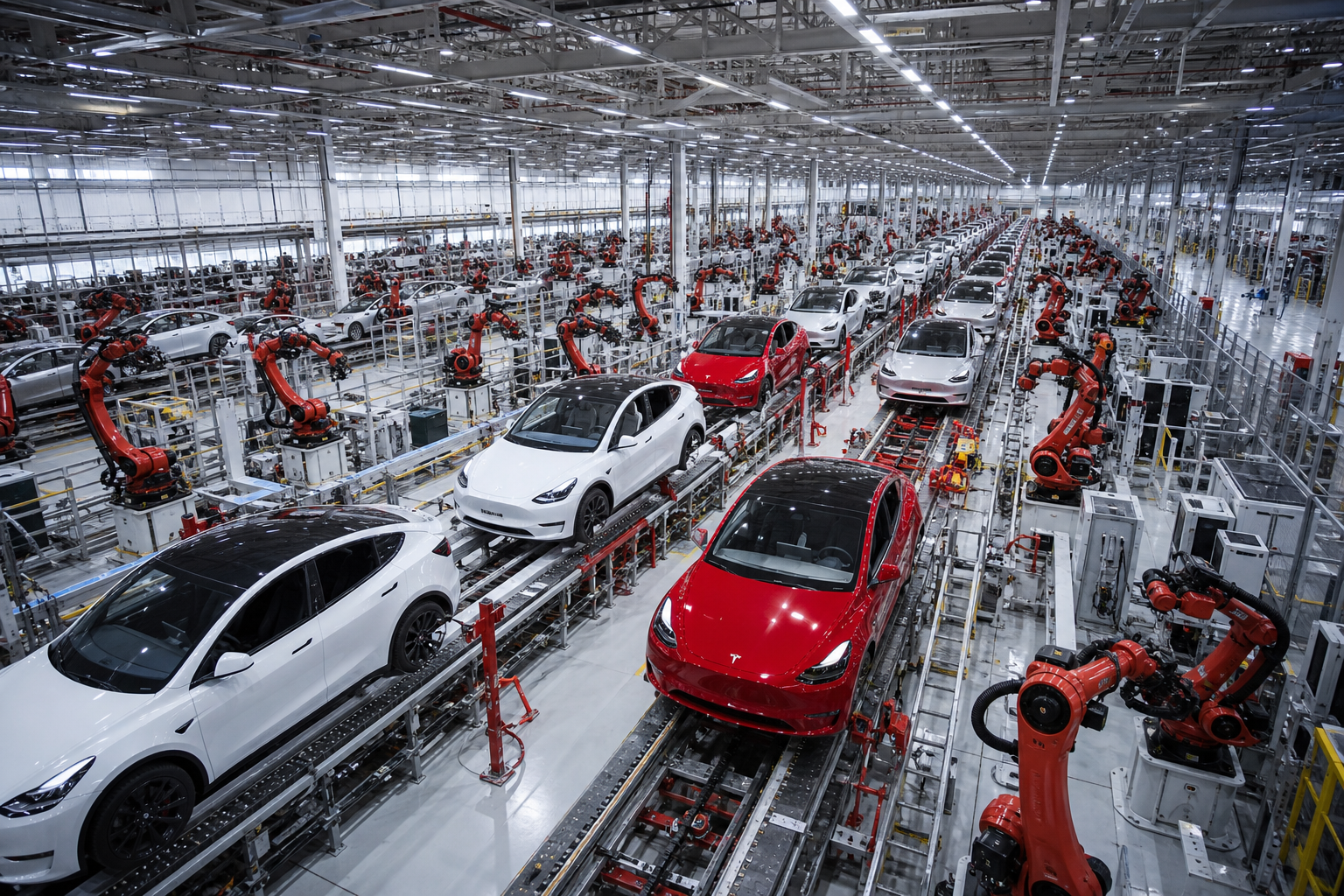
On Thursday, Tesla reported that it delivered 480,126 vehicles in the second quarter — an all-time Q2 record that blew past Wall Street's consensus estimate of 406,600 by a staggering 18%. It was a 25% surge from the 384,000 vehicles delivered a year ago and a 34% jump from the 358,023 delivered in Q1.
And the stock dropped 7%.
Welcome to the most confusing stock in the market.
The Numbers Are Undeniable
Let's start with what should have been the headline: Tesla just delivered more cars in a single quarter than at any point in its second-quarter history, and it wasn't even close.
The company produced 451,758 vehicles and delivered 480,126 — meaning Tesla actually drew down its inventory by more than 28,000 units. When a car company is shipping faster than it can build, demand isn't the problem.
The Model 3 sedan and Model Y SUV accounted for 467,762 deliveries — 97% of the total. These are Tesla's bread-and-butter vehicles, and they're selling at a pace that makes the "demand cliff" narrative look absurd.
Tesla's energy business also posted a monster quarter, deploying 13.5 gigawatt-hours of battery storage — a business that's becoming increasingly material to the company's bottom line.
Why Europe Changed Everything
The biggest driver of Tesla's blowout quarter was a region that had been its weakest link: Europe.
Soaring gasoline prices during the Iran conflict pushed European consumers toward electric vehicles at an accelerating rate. When you're paying the equivalent of $8 or $9 a gallon, a Model 3 starts looking less like a luxury purchase and more like a financial necessity.
Tesla capitalized on this shift by rolling out cheaper versions of the Model 3 and Model Y across European markets and, critically, making its Full Self-Driving system available to European customers for the first time. The combination of lower prices, better technology, and painful fuel costs created a perfect storm of demand.
But here's the catch: oil prices have since retreated to near pre-conflict levels following the fragile U.S.-Iran truce. If gasoline prices continue to fall, that European tailwind could become a headwind in the second half.
So Why Did the Stock Drop?
The 7% decline on a record-smashing quarter reveals everything you need to know about how Wall Street thinks about Tesla.
First, the stock had already ripped higher in anticipation. Tesla surged 8.46% on Monday — its biggest single-day gain in a year — and added another 3.6% on Tuesday. By the time deliveries hit, much of the good news was priced in.
Second, the "what's next" questions are getting harder. CEO Elon Musk has directed the company to focus on the driverless Cybercab and the Optimus humanoid robot — futuristic bets that excite believers but make traditional auto analysts nervous. Production of the Semi electric truck is ramping, but Tesla hasn't provided specific unit targets.
Third, Tesla remains down roughly 8% for the year despite Thursday's numbers. Even after a 480,000-vehicle quarter, the stock is flat for Q2. In a market where the S&P 500 gained 14.9% and the Nasdaq surged 21.4% last quarter, Tesla has been left behind.
But here's the contrarian case: if Tesla can deliver 480,000 vehicles in a quarter where analysts expected 406,000, what happens when the real growth catalysts — Cybercab, Semi, Optimus — start hitting production? The sell-the-news crowd may be selling into what turns out to be an inflection point.
The Jobs Report Nobody Expected
Away from Tesla, the other major story Thursday was a jobs report that made economists do a double-take.
The U.S. economy added just 57,000 nonfarm payrolls in June — roughly half the 115,000 that economists expected and a dramatic slowdown from the 172,000 jobs added in May. Leisure and hospitality shed 61,000 jobs, reflecting weaker-than-usual seasonal hiring.
The unemployment rate held steady at 4.2%, but the headline number was the weakest since the post-pandemic recovery began. Average hourly earnings rose 0.3% month-over-month, or 3.5% year-over-year — enough to support consumer spending but not enough to reignite inflation fears.
Paradoxically, Wall Street loved it.
The logic: weaker jobs data means the economy is cooling, which means Fed Chairman Kevin Warsh — who just told the world at Sintra that "prices are too high" — may eventually have cover to cut rates. Bad news became good news, and the Dow rose 0.5% while the S&P 500 gained 0.3%.
The Nasdaq, still nursing wounds from Wednesday's brutal 6.3% semiconductor selloff, managed a modest 0.2% gain as markets headed into the July 4th holiday weekend.
What Comes Next
Markets are closed Friday in observance of Independence Day, giving investors a long weekend to digest one of the most eventful weeks of the year.
In just five trading days, Wall Street closed out its best quarter since 2020, watched $200 billion evaporate from chip stocks in a single session, processed a record-breaking Tesla delivery report, and absorbed the weakest jobs number in years — all while Fed Chairman Warsh stood at a podium in Portugal and refused to tell anyone what he planned to do next.
When the market reopens Monday, the question won't be whether the rally can continue. It will be whether 480,000 Teslas, 57,000 jobs, and one very hawkish Fed chairman can coexist in the same bull market.
So far, the answer is yes.
Found this helpful? Share it with others.