Key Bullet Points:
- AMD surged 7.7% on Tuesday as chip stocks rallied to close out the best quarter for the S&P 500 and Nasdaq since 2020 — the stock is now up 275% over the past year and 152% year to date, making it one of the most explosive runs in semiconductor history
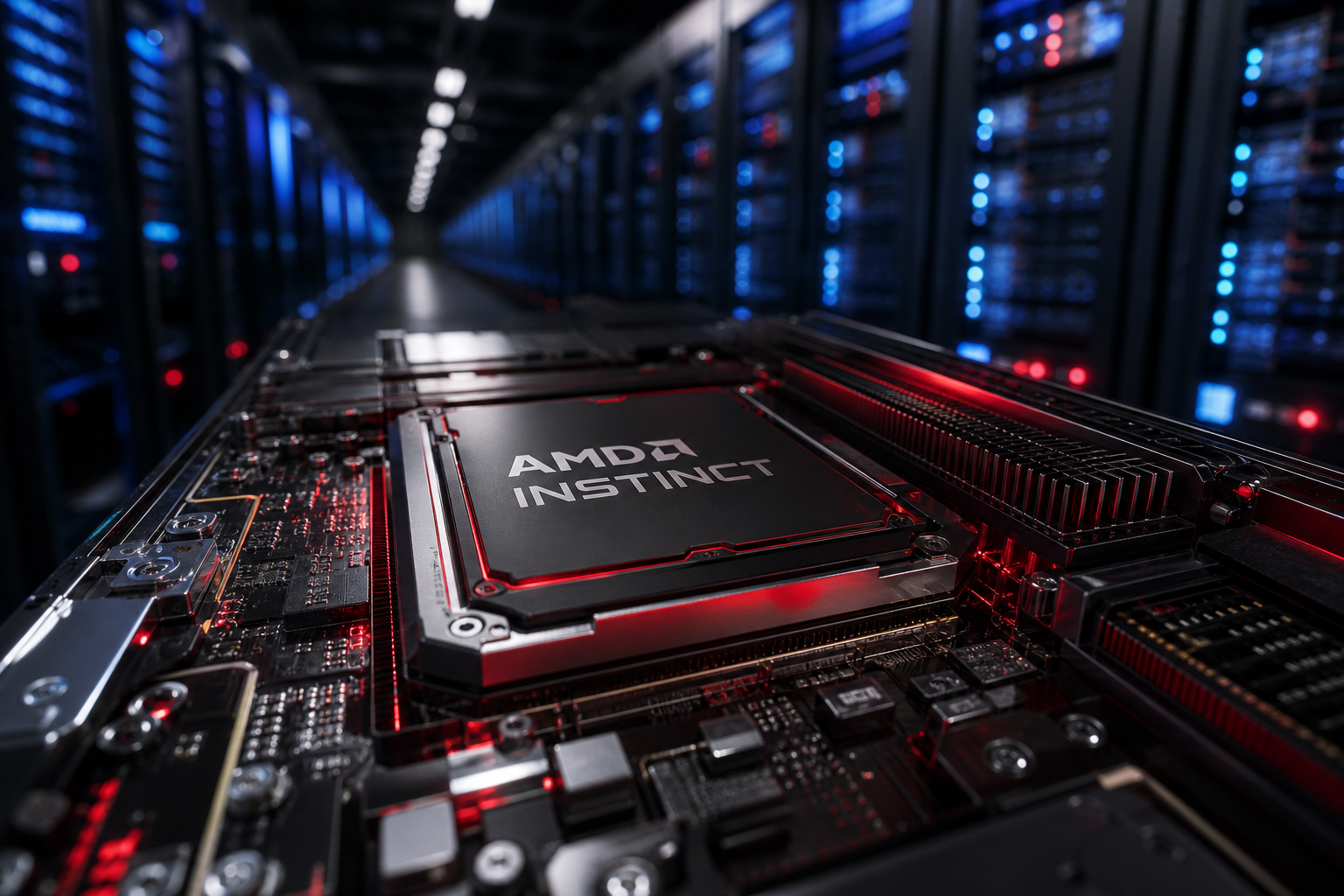
- AMD and Meta signed a 6-gigawatt agreement — one of the largest AI infrastructure deals ever — to deploy AMD Instinct GPUs across Meta's next-generation data centers, with shipments of a custom MI450-based chip beginning in the second half of 2026
- AMD's MI450 GPU and Helios rack-scale platform are set to launch in H2 2026, and analysts estimate the MI400 series could generate $7.2 billion in revenue this year alone — data center GPU revenue is forecast to surge 114% year-over-year to $15 billion
- The S&P 500 gained 14.9% in Q2 — its best quarter since 2020 — while the Nasdaq surged 21.4% and the Russell 2000 jumped 21%, with tech leading at +31% for the quarter
- The Dow closed at a second straight all-time high of 52,319 as Fed Chairman Kevin Warsh prepared to take the stage at the ECB Forum in Sintra, Portugal, where investors are watching for signals on inflation and rate policy
The AI Chip War Has a New Contender
For three years, Nvidia has been the undisputed king of AI chips. It owns roughly 80% of the accelerator market. Its data center revenue hit $193.7 billion in fiscal 2026. Jensen Huang is a rock star. The stock is a religion.
But on Tuesday, a different chip stock caught Wall Street's attention.
Advanced Micro Devices — AMD — surged 7.7% in a single session, leading a broad chip rally that closed out the best quarter for the S&P 500 and Nasdaq since 2020. The move capped an extraordinary run: AMD is now up 275% over the past 12 months and 152% year to date, making it one of the most explosive performers in the entire market.
And the stock may just be getting started.
The Meta Deal That Changed the Math
In February, AMD and Meta announced something that stopped Wall Street in its tracks: a 6-gigawatt agreement to deploy AMD Instinct GPUs across Meta's next-generation AI infrastructure.
Six gigawatts. To put that in perspective, that's roughly the electricity output of six nuclear power plants — all dedicated to running AMD chips inside Meta's data centers.
The deal is built around a custom AMD Instinct GPU based on the MI450 architecture, optimized specifically for Meta's AI workloads. Shipments are expected to begin in the second half of 2026. It's the kind of deal that doesn't just validate a chip — it validates an entire company's reason to exist.
For years, the knock on AMD was that it couldn't compete with Nvidia's CUDA software ecosystem. Cloud providers loved AMD's EPYC server CPUs, but when it came to AI training and inference, Nvidia was the only game in town. AMD's GPU market share hovered around 5-7% — barely a rounding error compared to Nvidia's dominance.
The Meta deal changes that narrative. When the company building one of the largest AI training clusters on Earth decides to bet billions on your silicon, the credibility gap narrows fast.
MI450: AMD's Biggest Product Launch in Years
The MI450 GPU and Helios rack-scale platform represent AMD's most ambitious product launch since CEO Lisa Su transformed the company from a perpetual underdog into a semiconductor powerhouse.
Analysts at S&P Global estimate the MI400 series could generate approximately $7.2 billion in revenue in 2026, accounting for roughly 25% of AMD's data center sales. But the bigger number is the trajectory: data center GPU revenue is forecast to surge 114% year-over-year to $15 billion.
That growth rate is staggering, even by AI industry standards.
On AMD's Q1 2026 earnings call, Su told investors that customer engagement around MI450 and Helios is "exceeding our initial expectations," with leading customer forecasts running ahead of AMD's own projections. The company is seeing strong momentum as "inferencing and agentic AI drive increasing demand for high-performance CPUs and accelerators."
Translation: the AI workloads are getting more complex, and the market needs more than one chip supplier. AMD is positioning itself as that critical second source.
The Numbers Behind the Rally
AMD's Q1 2026 results tell the story of a company hitting on all cylinders.
Revenue came in at $10.3 billion, up 38% year-over-year. Non-GAAP earnings per share of $1.37 beat estimates by nearly 6%. Data Center revenue — now the company's primary growth engine — hit $5.8 billion, up 57% year-over-year and accounting for more than 60% of total revenue.
CEO Lisa Su also dropped a number that should terrify AMD's competitors and excite its investors: she expects the server CPU market to grow at "greater than 35% annually, reaching over $120 billion by 2030." That's the total addressable market expanding rapidly — and AMD is positioned to grab a bigger slice of it every year.
The client and gaming segment added another $3.6 billion in revenue, up 23%, driven by strong demand for Ryzen processors and continued market share gains against Intel.
This isn't a company riding one product cycle. It's a company firing across every business line simultaneously.
The Best Quarter Since 2020
AMD's surge came on the final trading day of a quarter that will go down in market history.
The S&P 500 gained 14.9% in Q2 — its best quarterly performance since the pandemic recovery rally in 2020. The Nasdaq surged 21.4%. The Dow rose 13%, its best quarter since 2022. Even the Russell 2000, the small-cap index that had been left for dead during the AI mega-cap rally, jumped 21%.
Tech led everything, gaining 31% for the quarter. The semiconductor ETF (SMH) posted its best first half ever, surging 75.5% since January. Micron is up 301% year to date. Intel has gained 257%. Marvell Technology has rallied 227%.
These are numbers that would be impressive over a decade. They happened in six months.
The Dow closed at 52,319.20 — its second consecutive all-time high — while the S&P 500 finished at 7,499.36 and the Nasdaq ended at 26,213.72.
What Hangs Over the Rally
The biggest risk to this market isn't valuation or AI spending — it's the man standing at a podium in Sintra, Portugal.
Federal Reserve Chairman Kevin Warsh is scheduled to speak Wednesday at the European Central Bank's annual forum alongside ECB President Christine Lagarde and Bank of England Governor Andrew Bailey. At his debut press conference on June 17, Warsh held rates steady but took a notably hawkish tone, pledging to hit the Fed's 2% inflation target and stripping forward guidance from the policy statement entirely.
Translation: Warsh isn't telling anyone where rates are going. And that uncertainty has kept the bond market on edge — the 10-year yield ended the quarter at around 4.17%, with gold hovering just below $4,000 an ounce.
The semiconductor sector itself showed cracks last week when SMH dropped 7.3% — its worst weekly decline since April 2025. South Korea's KOSPI crashed 10%. The chip trade may be running hot.
But none of that stopped AMD from surging 7.7% on Tuesday, or prevented Wall Street from posting its best quarter in six years. When Lisa Su has a 6-gigawatt deal with Meta, a $15 billion GPU revenue forecast, and a stock up 275% in a year, the bears don't just have to fight the tape.
They have to fight the math.
Found this helpful? Share it with others.