Key Bullet Points:
- Tesla surged 8.46% Monday to close at $411.84 — its biggest single-day gain in months — as Morgan Stanley raised its Q2 delivery estimate to 413,000 vehicles, Barclays to 418,000, and Goldman Sachs to 420,000, all above Tesla's company-compiled consensus of 406,024 deliveries
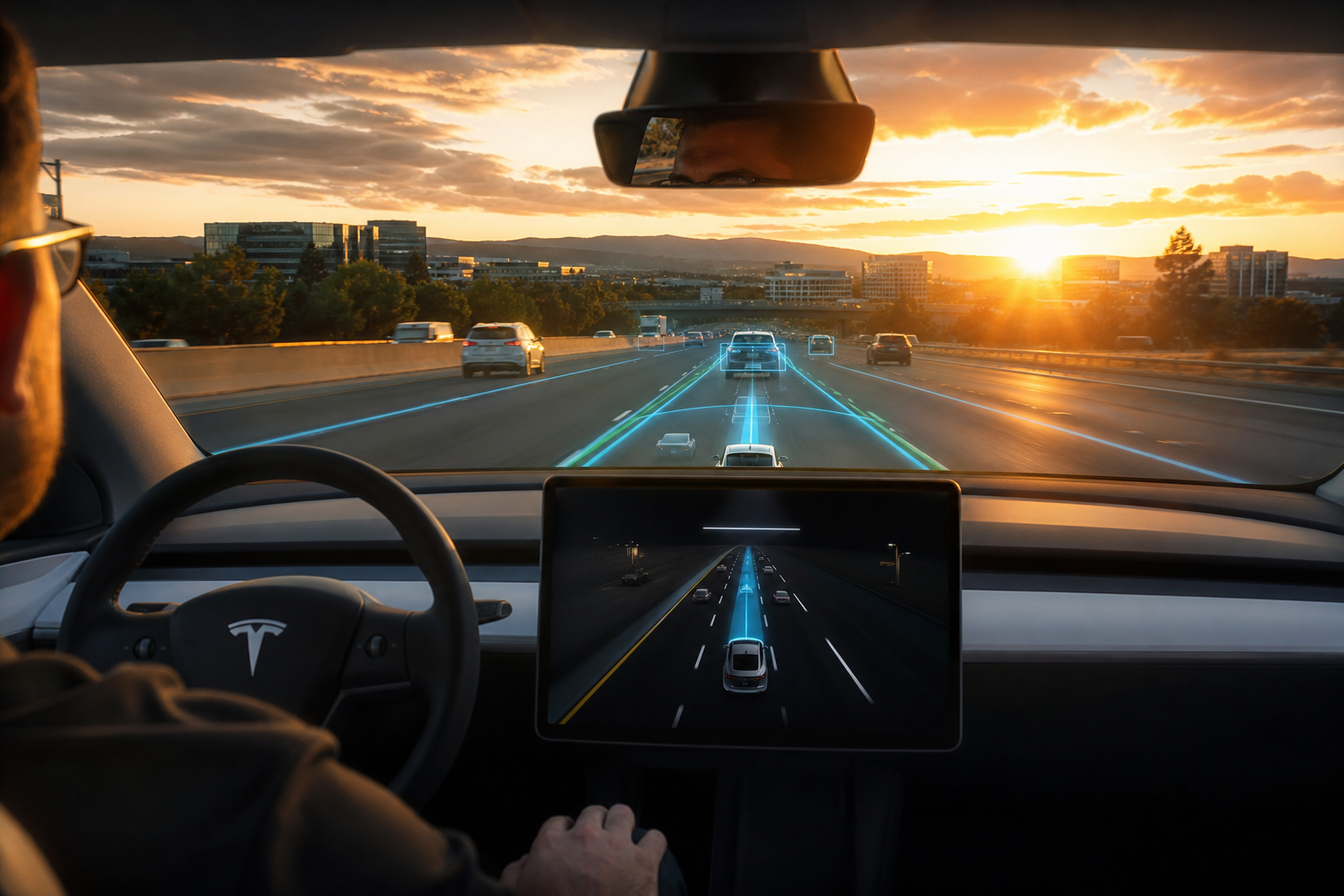
- Tesla's AI chief Ashok Elluswamy confirmed Sunday that FSD V14 Lite has started rolling out to Hardware 3 vehicles — the first major Full Self-Driving update for roughly 4 million cars that had been frozen on FSD v12.6 since early 2025, in what could become the largest software monetization event in automotive history
- The company now has 1.3 million paid FSD customers globally, and CFO Vaibhav Taneja dropped a bombshell on the Q1 earnings call: "We have evolved our vehicle sales strategy where we now emphasize FSD as a product and vehicle as only the delivery mechanism" — signaling Tesla is no longer a car company, it's a software company that happens to sell cars
- The Dow Jones Industrial Average closed above 52,000 for the first time in history as Alphabet surged 3.7% on its first day replacing Verizon in the blue-chip index — putting five of the Magnificent Seven (Nvidia, Amazon, Apple, Microsoft, and now Alphabet) inside the Dow
- Semiconductor stocks closed out their best first half on record — the VanEck Semiconductor ETF (SMH) surged 75.5% in H1 2026, with Micron up 301%, Intel up 257%, and Marvell up 227% year to date — but last week's 7.3% selloff in SMH, its worst since April 2025, has investors debating whether the chip trade is running out of steam
The Most Important Software Update You've Never Heard Of
On Sunday evening, Tesla's Head of AI Ashok Elluswamy confirmed what 4 million Tesla owners had been waiting over a year to hear: FSD V14 Lite has started rolling out to Hardware 3 vehicles.
If you don't own a Tesla, that sentence probably means nothing to you. But for Wall Street, it might be the most important software update in automotive history.
Here's why: roughly 4 million Tesla vehicles on the road today are equipped with Hardware 3 — the older computer chip that had been left behind as Tesla pushed its Full Self-Driving software to newer Hardware 4 vehicles. These HW3 cars had been stuck on FSD version 12.6 since early 2025, unable to access the dramatic improvements Tesla had made to its autonomous driving system. Owners who had paid up to $15,000 for FSD were watching newer Teslas get the good stuff while their cars sat frozen in time.
Now that changes. FSD V14 Lite — firmware version 2026.20.5.1 — is going out to early-access drivers first, with a broader rollout expected through July. It won't deliver the full capabilities of V14 on Hardware 4, but it represents a massive leap from where HW3 owners have been stranded.
And that's why Tesla surged 8.46% on Monday.
Wall Street Smells Blood
The FSD rollout wasn't the only catalyst. Wall Street's top analysts are quietly raising their Q2 delivery estimates above consensus, and the revisions tell a story of strengthening demand that the market hadn't priced in.
Morgan Stanley now expects Tesla to deliver approximately 413,000 vehicles in Q2. Barclays raised its estimate to 418,000. Goldman Sachs went even higher at 420,000. All three are above Tesla's company-compiled consensus of 406,024 vehicles from 22 sell-side analysts — meaning the smart money thinks Tesla will beat expectations.
The delivery revisions matter because Tesla is fighting a two-front war: BYD in China and legacy automakers like Ford and General Motors in the U.S. If Tesla can post deliveries above 410,000, it would signal that demand is stabilizing without the deep price cuts that had been crushing margins throughout 2025.
And the Q1 2026 numbers already hinted at exactly that. Tesla reported its highest order backlog in over two years, Giga Berlin hit a record output of more than 61,000 units, and automotive margins excluding credits improved from 17.9% to 19.2%.
"The Vehicle Is Only the Delivery Mechanism"
But the real bombshell came from Tesla CFO Vaibhav Taneja on the Q1 earnings call — a single sentence that may have redefined how Wall Street values this company.
"We have evolved our vehicle sales strategy," Taneja said, "where we now emphasize FSD as a product and vehicle as only the delivery mechanism."
Read that again. The CFO of a car company just told Wall Street that cars aren't the product. Software is. The vehicle is just the box it comes in.
This is the shift Tesla bulls have been arguing for years: the transition from a hardware-margin business (selling cars at 19% margins) to a software-margin business (selling FSD subscriptions at 80%+ margins). With 1.3 million paid FSD customers globally and 4 million HW3 vehicles about to get their first major update in over a year, the addressable market for FSD revenue just expanded dramatically.
If even a fraction of those 4 million HW3 owners convert to paid FSD subscribers — at $99 per month or $15,000 upfront — the revenue impact would be staggering.
The Dow Hits 52,000
Tesla wasn't the only story on a historic Monday.
The Dow Jones Industrial Average closed above 52,000 for the first time in its 130-year history, finishing at 52,182.74. The milestone was fueled in part by Alphabet, which surged 3.7% to $350.24 on its first trading day as a Dow component after replacing Verizon Communications.
The swap carries symbolic weight: Verizon, a telecommunications giant, was among the least influential stocks in the price-weighted index. Alphabet — the parent of Google, YouTube, and DeepMind — now joins Nvidia, Amazon, Apple, and Microsoft to give the Magnificent Seven five seats in the Dow's 30-stock club. The blue-chip index is no longer your grandfather's portfolio of industrial titans. It's a tech fund wearing a bowler hat.
Semiconductor stocks also closed out a quarter for the record books. The VanEck Semiconductor ETF surged 75.5% in the first half of 2026 — its best performance since the fund's inception in 2000. Micron is up 301% year to date. Intel has gained 257%. Marvell Technology has rallied 227%. These are numbers that belong in a fever dream, not a stock chart.
What Could Go Wrong
Tesla's stock is still 17% below its 52-week high of $498.83, and there are real reasons for caution. BYD is eating Tesla's lunch in China. The EV price war shows no signs of ending. FSD V14 Lite on Hardware 3 still can't support unsupervised driving — a limitation that could frustrate owners expecting a bigger upgrade.
And the broader market faces its own headwinds. The semiconductor rally, despite its historic run, showed cracks last week when SMH dropped 7.3% — its worst weekly performance since April 2025. South Korea's KOSPI crashed 10% earlier in the week with Samsung and SK Hynix both plummeting 12%+. The chip trade may be getting overheated.
But on Monday, none of that mattered. Tesla's stock surged 8.46% on volume of nearly 58 million shares, the Dow crossed 52,000 for the first time, and the Nasdaq jumped 2.07%.
Wall Street isn't betting on what Tesla is today. It's betting on what 4 million software updates could turn it into tomorrow.
Found this helpful? Share it with others.