Your Electric Bill Just Became an AI Tax. Residential Rates Are Up 36%. And 27 States Are About to Fight Back.
A quick note from Behind the Markets
Wall Street loves defense… as long as it's a headline. A contract drops. The stock pops. Everyone moves on.
But the real money is made in the boring middle: manufacturing capacity.
1) Raytheon's $1.02B NASAMS Deal Is a Reminder: Air Defense Isn't "News" — It's a Multi-Year Industrial Cycle
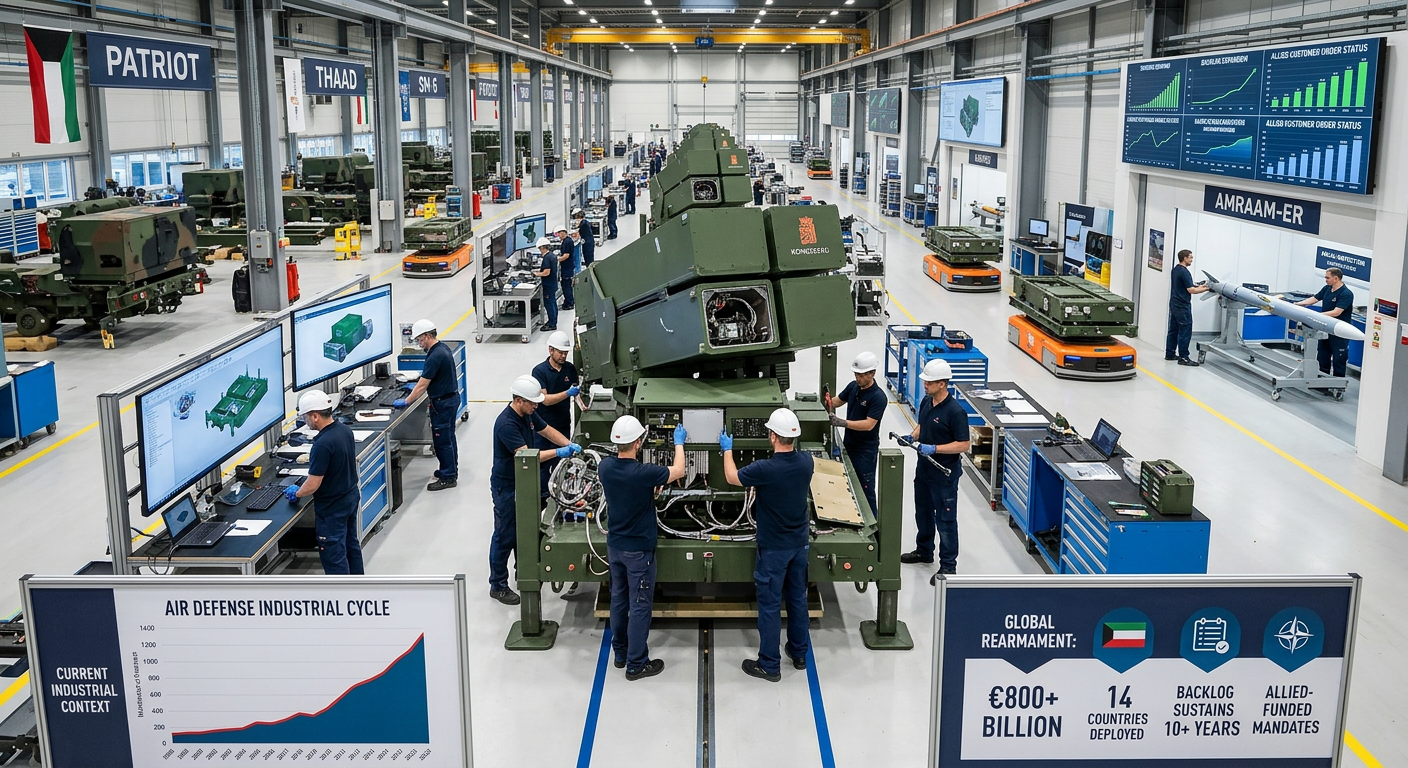
The Pentagon awarded Raytheon a $1,020,659,819 firm-fixed-price contract to deliver NASAMS air defense fire units to Kuwait. Work runs through May 2031. The entire amount — every dollar — was obligated at award, not phased or conditional. And it's 100% funded through Foreign Military Sales.
Kuwait is writing the check. Not the U.S. taxpayer.
Raytheon was the sole bidder. No competition. When a billion-dollar defense system attracts one bid, it tells you the barriers to entry are structural — qualification, integration, and production capacity that can't be replicated.
Raytheon's president of Land and Air Defense Systems, Tom Laliberty, said it directly: "Sustained combat success has driven surging international demand for NASAMS, proving its ability to neutralize aircraft, drones, and advanced cruise missiles." He added that RTX is "investing heavily across the company to accelerate the production of critical air defense capabilities like NASAMS."
NASAMS is now deployed in 14 countries. And the demand pipeline is accelerating. In April 2026, the Pentagon awarded a separate $235 million contract for AMRAAM-ER full-rate production — the interceptor missile that arms NASAMS — naming Kuwait, Hungary, Lithuania, the Netherlands, Norway, and Taiwan as customers. That's six allied nations ordering the same missile for the same system simultaneously.
This sits inside the broader air defense buildout we've tracked all month: PAC-3 ramping from 600 to 2,000 interceptors per year ($4.7 billion, 94% allied-funded). THAAD quadrupling capacity. SM-6 ramping from 125 to 500+. The GPI hypersonic interceptor pulled forward to 2029. And the U.S. burned through 1,800 Patriot interceptors in 16 days of the Iran conflict — proving the demand isn't theoretical.
The company at the center of the air defense industrial ramp:
Company: RTX Corporation (SYM: RTX)
The parent of Raytheon — manufacturer of NASAMS, AMRAAM, AMRAAM-ER, Tomahawk, SM-6, PAC-3, and the DARPA Burn n' Go composable motor program. Now carrying the largest air defense backlog in the company's history.
RTX is currently trading around $180.37. The NASAMS deal alone provides revenue visibility through 2031. Layer on the seven-year munitions framework (Tomahawk from 60 to 1,000/year, AMRAAM to 1,900, SM-6 to 500+), the PAC-3 production ramp, the AMRAAM-ER full-rate production with six allied customers, and the DARPA propulsion program — and you're looking at a company whose backlog could sustain production growth for a decade regardless of which headlines dominate the news cycle. RTX's Advanced Technology president just admitted propulsion is "a critical bottleneck." The company is both naming the constraint and developing the technology to solve it.
Bottom line: A multi-year air defense contract isn't a "one-day catalyst." It's the visible part of a longer industrial buildout — and Raytheon just told you the demand is "surging."
2) The Smarter Angle: The Primes Are the Billboard — the Underfollowed Suppliers Are the Cash Register
When Wall Street sees "Raytheon," it thinks the story ends there. It doesn't.
NASAMS — and modern air defense broadly — pulls demand through a web of components. The system integrates Raytheon's Sentinel radar with interceptors (AMRAAM, AMRAAM-ER, AIM-9X Sidewinder), a command-and-control center, and the launch platforms. Kongsberg Defence & Aerospace of Norway developed the fire distribution center and canister launcher. The system can integrate with third-party radars and interceptors — making it a "plug-and-play" air defense architecture.
That modularity is the investment thesis. Every NASAMS unit sold to one of 14 countries creates demand for radars, interceptors, command software, secure communications, specialty electronics, and propulsion — across multiple suppliers. And the AMRAAM-ER transition to full-rate production means the interceptor pipeline is now running at industrial scale, not development pace.
The catch: the primes can't ship what the supply chain can't produce. Raytheon's own president acknowledged the company is "investing heavily" to accelerate production. When the prime contractor says it needs to invest to keep up with demand, the constraint is downstream — in the components, the castings, the energetics, the specialty electronics with long qualification cycles.
On the same day as the NASAMS contract, the Pentagon also awarded $100+ million in F-35 brake assembly heat sinks and MLRS engineering services — the unglamorous sustainment work that keeps existing fleets flying and firing. Every one of these contracts has a supplier pyramid underneath it.
One company positioned in the defense electronics and sensor layer that feeds every air defense system:
Company: L3Harris Technologies (SYM: LHX)
Top-tier defense electronics — sensors, communications, electronic warfare, and ISR systems. The components that sit inside NASAMS, Patriot, THAAD, Aegis, and every other air defense architecture.
L3Harris is currently trading around $313.54. When 14 countries deploy NASAMS, when PAC-3 is ramping across 17 nations, when 158 HBTSS tracking satellites are being built, and when the AMRAAM-ER is entering full-rate production — the electronics inside those systems come from a small number of qualified suppliers. L3Harris is one of them. The company's sensor, EW, and communications portfolio generates demand pull across every air defense program simultaneously. That's the compounding dynamic Wall Street misses: it's not one contract. It's the intersection of a dozen contracts, all pulling through the same electronics layer.
Bottom line: The best defense upside is often one layer down from the headlines — in the bottlenecks. When the prime admits it's investing to keep up with demand, the supply chain underneath is where the pricing power lives.
3) Geopolitics Isn't Background Noise Anymore — It's the Demand Engine
Kuwait doesn't buy NASAMS because it's trendy. It buys because the neighborhood is dangerous.
The Strait of Hormuz crisis is now in its 14th week. Iran struck Fujairah — Kuwait's neighbor, the UAE's critical export terminal — with loitering munitions during the Project Freedom debacle. Saudi Arabia and the UAE were reportedly "moving closer to joining the conflict" earlier in the war. Gulf states that spent decades relying on U.S. naval presence as their primary shield are now writing billion-dollar checks for their own integrated air defense.
That's the hard truth: the demand curve for air defense is being pulled by real-world threats, not Washington's talking points. When a country commits to integrated air defense, it doesn't stop at one purchase. It expands. It trains. It maintains. It upgrades. It buys interceptor reloads. It integrates command software. It builds maintenance facilities.
That's recurring revenue dressed up as national security.
And it's happening everywhere simultaneously. Europe is mobilizing €800+ billion through ReArm Europe. Taiwan just signed $6.6 billion in arms (including NASAMS via the AMRAAM-ER connection). Global defense spending hit $3 trillion — up 50% over five years. The World Nuclear Association projects installed nuclear capacity doubling by 2040 — and nuclear facilities need air defense too.
One ETF that captures the full allied air defense industrial buildout:
ETF: iShares U.S. Aerospace & Defense ETF (SYM: ITA)
Broad exposure to RTX, L3Harris, Lockheed, Northrop, General Dynamics, and the rest of the defense industrial base — the companies supplying 14 NASAMS nations, 17 PAC-3 nations, and the broader global rearmament.
ITA owns the pyramid. RTX at the top (NASAMS, AMRAAM, Tomahawk, PAC-3). L3Harris in the electronics layer (sensors, EW, satellites). Northrop in space and hypersonics (GPI, HBTSS, B-21). Lockheed in platforms and missiles (HIMARS, F-35, THAAD). General Dynamics in ammunition and vehicles. When 14 countries standardize on NASAMS and 17 on PAC-3, the fleet economics benefit every name in the ETF.
Bottom line: Defense is shifting from discretionary spending to baseline spending. Investors should treat it like an industrial category, not a political headline.
Before You Go
If the world is entering a decade where drones and missiles are cheap, what does that make air defense?
A luxury? Or a utility?
Found this helpful? Share it with others.
Written by Behind the Markets