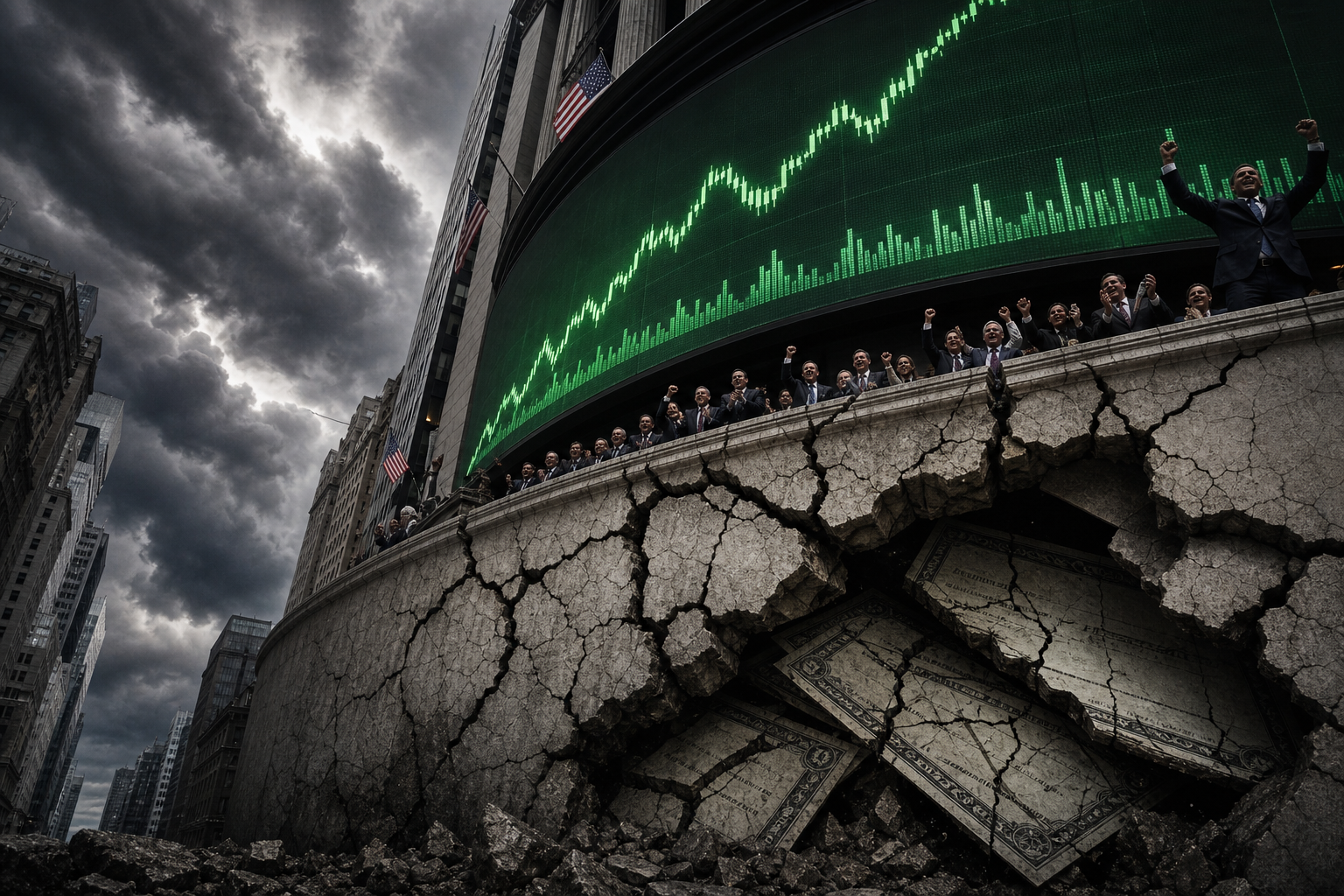
The S&P 500 crossed 7,500 for the first time on Thursday. The Dow reclaimed 50,000. Champagne corks were popping across every trading floor in Manhattan.
And then the bond market showed up Friday morning like a parent turning on the lights at a house party.
Global government bonds sold off in a wave that stretched from Tokyo to London to New York. The U.S. 10-year Treasury yield blew past 4.5% — its highest in about a year. Japan's 30-year bond yield hit 4% for the first time since its debut in 1999. The U.K. 30-year gilt yield climbed to levels not seen since 2007. And the U.S. sold 30-year bonds at a 5% yield — the first time that's happened since George W. Bush was in the White House.
Record stock highs and a historic bond selloff happening in the same week isn't normal. It's a signal — and not a comfortable one.
KEY POINTS:

Global bonds sold off hard Friday. U.S. 10-year yields hit 4.5%, Japan's 30-year hit 4% (a first), and the U.S. auctioned 30-year bonds at 5% — the highest since 2007.

Stocks hit records the day before. S&P 500 closed above 7,500 for the first time at 7,501.24. The Dow reclaimed 50,000 at 50,063.46. The Nasdaq hit 26,635.

Oil won't back down. Brent crude climbed back above $107 Friday. WTI pushed past $102. Ship attacks near the Strait of Hormuz continued.

Inflation is broadening. April CPI came in at 3.8% — above expectations. PPI hit 6.0%. India's wholesale prices exploded to 8.3%. This is now a global problem.

The British pound had its worst week since 2024as political turmoil around PM Starmer added fuel to the gilt selloff.
What the Bond Market Is Really Saying
Bond traders have a reputation for being the adults in the room. While stock investors chase momentum and narratives, bond investors price in cold math — inflation expectations, default risk, the actual cost of money over time.
And right now, the math is ugly.
The April Consumer Price Index came in at 3.8% year-over-year — above the 3.7% forecast and sharply higher than March's 3.3%. Core CPI, which strips out food and energy, ran at 2.8% — also above expectations. Then the Producer Price Index landed at 6.0%, confirming that the cost pressures hitting businesses are only getting worse.
This isn't just an American problem anymore. India's wholesale price index exploded to 8.3% year-over-year in April — nearly double the 4.4% consensus. Japan's producer prices surged 2.3% month-over-month, triple what economists expected. U.S. export prices jumped 3.3% versus a 1.1% forecast.
The energy shock from the Strait of Hormuz closure, now approaching its third month, has metastasized. What started as an oil story has spread into food systems, manufacturing costs, shipping rates, and currency markets. The worst-performing currencies since the Iran conflict began are almost all energy importers — the Egyptian pound, the Philippine peso, the South Korean won, the Thai baht.
Oil Is the Engine Behind Everything
Brent crude climbed back above $107 a barrel Friday, with WTI pushing past $102. The Strait of Hormuz — through which roughly 20% of the world's oil flows daily — remains contested despite the joint Trump-Xi statement that it "must remain open."
The Wall Street Journal reported that the world has burned through its strategic oil reserves at a record pace. An underappreciated surplus of crude that had been sitting in storage tanks and aboard ships is now dwindling fast. Oil executives and analysts are warning that a harsh reckoning is coming — even if diplomacy works.
Refinery attacks tied to the wars in Iran and Ukraine have knocked out nearly 9% of global oil refining capacity. That's not a number that gets fixed with a ceasefire announcement. Physical infrastructure takes months to rebuild.
The United Arab Emirates announced plans to double its crude export capacity by 2027, bypassing the Strait of Hormuz entirely. That's a smart long-term play — but it doesn't help in 2026.
Stocks Don't Care — Yet
Here's the strange part: the stock market keeps going up.
The S&P 500 has gained 22.3% year-to-date and 37% from the March war-era lows. Cisco surged 13% Thursday after reporting a "networking supercycle" driven by AI demand — with $5.3 billion in AI infrastructure orders this year and a target of $9 billion. Cerebras Systems, the AI chip company, debuted Thursday and soared 75% on its first day of trading. Nvidia tacked on another 4.4%.
The AI story is so powerful it's overriding everything else. Corporate earnings for Q1 are tracking 28% higher year-over-year — the biggest jump since 2021. Profit margins are sitting at 14.7%, the best since 2009.
But the stock market and the bond market are telling two very different stories. Stocks are saying "growth is unstoppable." Bonds are saying "inflation is uncontrollable." When these two signals diverge this sharply, one of them is wrong — and historically, it's usually stocks that have to adjust.
Why This Matters for Next Week
Kevin Warsh officially takes over as Federal Reserve Chair when markets open Monday, replacing Jerome Powell, whose term as chair expired Friday. Powell is staying on as a governor — an unusual move that creates an awkward dynamic at the most critical moment for monetary policy in years.
Warsh inherits a mess. The fed funds rate is parked at 3.50–3.75%. Inflation is running at 3.8% and accelerating. The bond market is demanding higher yields. Oil is above $100 with no resolution in sight. And markets are pricing in roughly zero rate cuts for 2026.
His first public remarks will be scrutinized for any signal about the Fed's framework going forward. Does Warsh lean into inflation fighting? Does he try to calm bond markets? Does he address the oil crisis directly?
Whatever he says, he can't change the math. And right now, the math says bonds are in trouble — and eventually, stocks will have to listen.
The Bottom Line
Thursday was a celebration. Friday was a warning. The S&P 500 above 7,500 and the 10-year yield above 4.5% can't coexist forever.
The bond market is telling you that inflation is not under control, that oil is not coming down soon, and that the Fed is out of room to help. The stock market is telling you that AI earnings are so strong they can overpower all of it.
One of these narratives breaks first. If you're sitting on gains from this AI-fueled rally, this is the week to think about what happens when the bond vigilantes finally get the stock market's attention.
Enjoy the weekend. The volatility isn't going anywhere.
Read Next: This is the worst news for stocks in 50 years
Wall Street’s declared what could be the worst news for the U.S. stock market in 50 years.
If Goldman Sachs and Morgan Stanley are right... this won't be like the crashes we're used to. What's about to hit America next could keep your portfolio in the red for 10 years or longer - unless you make a big change now.
To hear about this decade-long crisis now being predicted by multiple Wall Street banks...
And to see what you can do to prepare your wealth before this hits...
Found this helpful? Share it with others.