Key Bullet Points:
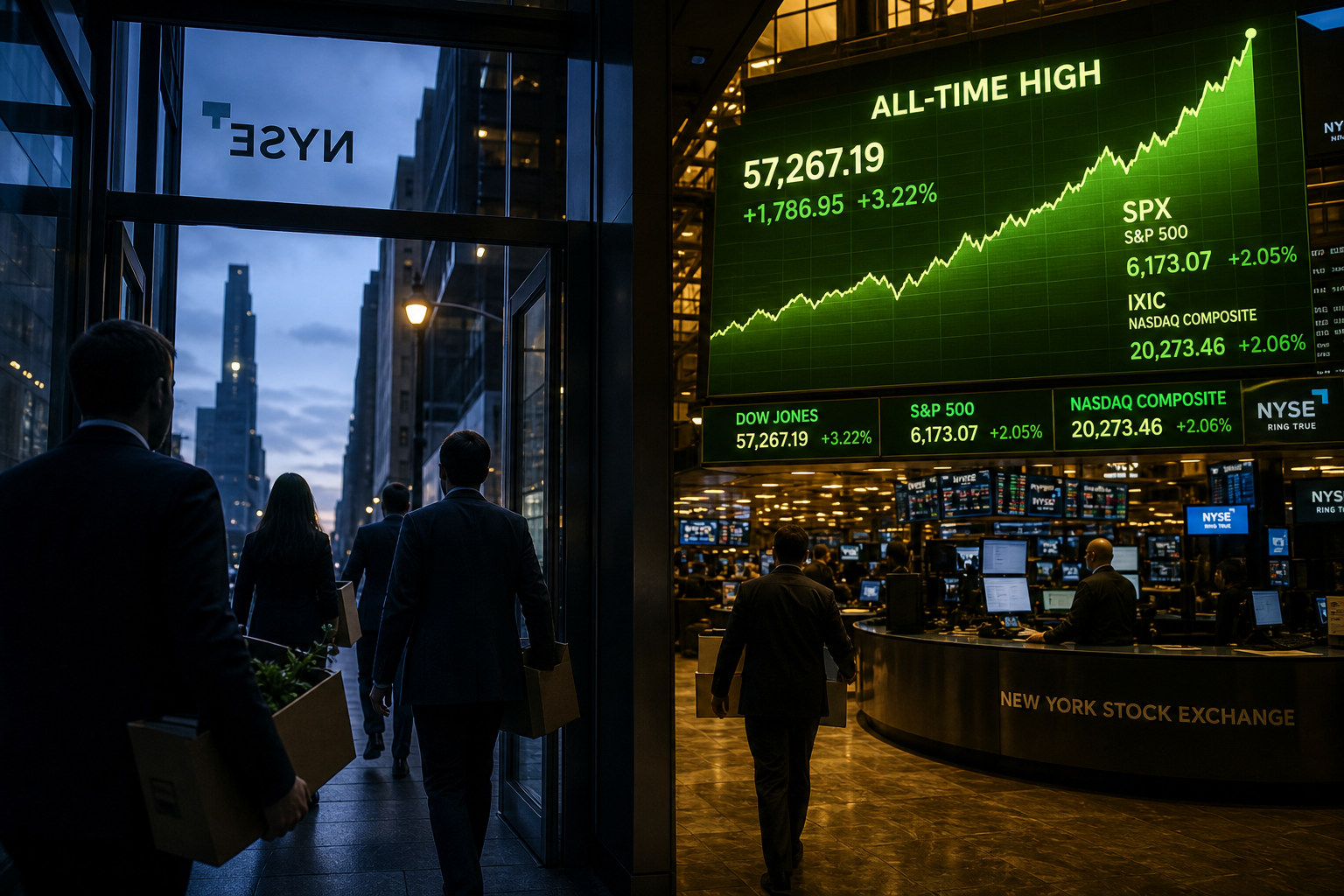
- July nonfarm payrolls fell by 23,000 — the first outright decline in months — against forecasts of a 95,000 gain. The S&P 500 responded by closing Friday at a record 7,757.51, up 47.55 points (+0.62%)
- The unemployment rate dropped to 4.1% from 4.2%, but not for a good reason: participation fell to 61.4%, a five-year low, as 381,000 people left the labor force
- Revisions erased more than 100,000 jobs Wall Street thought existed. June was cut to +20,000 from +57,000; May to +63,000 from +129,000
- The Nasdaq closed up 342.26 points (+1.30%) to 26,690.62 — a 5.19% weekly gain. The Dow added 151.42 to 54,036.52, up 2.96% on the week. Nvidia rose 1.6%, Broadcom 1%
- SpaceX rose more than 6% Thursday — the day 911.5 million shares worth roughly $101 billion unlocked, more than doubling its public float. The selloff everyone braced for never came
- SK Hynix committed 54 trillion won ($38.1 billion) Friday to two new memory plants, one week after SanDisk posted 84.6% gross margins - Brent closed up more than 1% at $83.55 and WTI settled at $78.18, yet both fell more than 7% for the week. Hormuz ship traffic was down 33% Friday from the prior day
- Gold and silver posted their biggest weekly gains in months, with gold up 2.28% Friday alone
The Number That Went the Wrong Way
The July employment report was supposed to show a modest rebound. Economists surveyed by Dow Jones expected 95,000 new jobs. The Wall Street Journal's consensus was 83,000. Instead, the Bureau of Labor Statistics reported Friday morning that the American economy lost 23,000 jobs.
The S&P 500 closed at an all-time high.
Those two facts belong to the same trading day. The index finished at 7,757.51, up 47.55 points, or 0.62% — above the record it set Tuesday. The Nasdaq Composite gained 342.26 points, or 1.30%, to 26,690.62, capping a 5.19% week. The Dow Jones Industrial Average rose 151.42 points to 54,036.52, up 2.96% over five sessions. Nvidia climbed 1.6%, Broadcom 1%, and Treasury yields fell across the curve.
The unemployment rate improved too, falling to 4.1% from 4.2% against expectations that it would hold. One Wall Street economist called the report "pretty horrendous." Both descriptions are accurate.
The reconciliation sits in the participation rate, which dropped to 61.4% — a level not seen in more than five years. Some 381,000 people left the labor force in July. The unemployment rate counts only people actively looking for work, so when enough of them stop looking, the rate falls even as employment shrinks. The number of unemployed Americans fell by 178,000. The number of employed Americans fell too.
The revisions were arguably worse than the headline. June's gain was cut to 20,000 from 57,000. May's was cut to 63,000 from 129,000. Between them, more than 100,000 jobs that Wall Street believed existed in the spring turned out not to. Average hourly earnings rose 3.2% year over year against 3.5% expected. Local government education shed 50,000 positions. Health care was, once again, most of what was left standing.
Bad News Is Good News Again
The market's logic is straightforward, if uncomfortable.
Investors have spent months worrying that the Fed's next move is up. Officials held at 3.5%–3.75% in July with three dissents arguing for a hike — the most fractured decision the committee has produced in years. A negative payroll print does not fit inside a rate-hike case. September odds collapsed within minutes of the release, falling yields lifted long-duration growth stocks, and semiconductors led the tape.
So a report describing a labor market that has stopped creating jobs became the catalyst for a record close. That is not irrationality — it is discounting. But it means the index level is now telling you something about the Fed rather than something about the economy. It is worth remembering how little a headline number reveals about what is happening underneath it.
The Catastrophe That Didn't Happen
Thursday delivered the same lesson in a single stock.
For weeks investors had been warned about August 6. SpaceX's first and largest post-IPO lockup tranche was set to release up to 911.5 million shares — roughly $101 billion worth — lifting the tradable float from about 639 million shares to as many as 1.55 billion, and the public float from 4.9% of shares outstanding to 11.8%. The setup could hardly have looked worse. The stock had fallen almost 14% Wednesday, its second-worst day on record, closing at an all-time low of $108.27 after its first public earnings call revealed heavier AI capital spending than expected. It was down more than 50% from its June 16 peak of $225.64. Short sellers held 35% of the available float.
The stock rose more than 6%.
Two structural details explain it. SpaceX deliberately built its lockup as nine staggered tranches rather than one 180-day cliff, and a further 455.8 million shares stayed frozen precisely because the stock trades below its $135 IPO price. More important, the put/call ratio on options expiring into the event had already climbed to 1.42. Everyone had hedged. The risk was transferred long before the bell rang.
Events you can see coming are rarely the ones that damage portfolios, because prices adjust in advance. Nobody had positioned for a negative payroll number.
$38 Billion Says the Shortage Is Real
One number this week meant exactly what it appeared to mean.
SK Hynix announced Friday that it will spend 54 trillion Korean won — about $38.1 billion — building two new memory fabs: a DRAM plant called Y2 in Yongin and a NAND facility called M17 in Cheongju. Groundbreaking is 2027, with first cleanrooms in 2028 and 2029. "In the AI era, technological competitiveness alone is not enough," the company said. "The ability to supply the required volume at the exact moment customers need it is the ultimate competitive advantage."
That lands one day after Tesla and SpaceX committed $16.8 billion to their Terafab project in Texas, and one week after SanDisk reported 84.6% gross margins on what used to be a commodity. Extraordinary margins summon capital, and capital eventually becomes capacity. The memory complex is now racing to build the supply that ends its own pricing power — and the buildout carries a power problem with it, since the electricity required to run these facilities is quietly becoming its own investment story.
Oil Rises, Hormuz Waits
Crude gained Friday on anticipation alone. Brent rose more than 1% to close at $83.55 and WTI settled at $78.18. Both still finished the week down more than 7%.
Treasury Secretary Scott Bessent said Tuesday that an agreement to reopen the Strait of Hormuz with freedom of navigation could come "as soon as Wednesday." It is now Saturday. Iranian state media published a draft plan Thursday under which inbound traffic would transit Iranian waters and outbound traffic Omani waters. Nothing has been signed. Kpler data showed Hormuz ship traffic down 33% Friday from the day before, with most vessels using the Iranian route.
Gold and silver, meanwhile, posted their largest weekly gains in months, with gold rising 2.28% Friday. There is a structural case building underneath that metal that has nothing to do with this week's data.
What Lands Next
CPI and PPI arrive next week, into a market that just decided the Fed is finished hiking. If inflation disagrees, Friday's record becomes a problem rather than a repricing.
Thursday's session is the tell worth carrying into Monday. The Dow fell 464.02 points to 53,885.10, ending a record streak, while the S&P slipped just 0.18% and the Nasdaq 0.06%. Those calm index numbers concealed HubSpot down 24%, Datadog down 16%, Fiserv down 12% and Western Digital down 13%, with only two of eleven sectors closing green and 59% of NYSE listings falling.
A market where the averages set records while the components come apart is not a calm market. It is a concentrated one.
Found this helpful? Share it with others.