Key Bullet Points:
- SanDisk reported fiscal fourth-quarter revenue of $8.97 billion, up 51% sequentially and 372% year over year. Non-GAAP diluted earnings came in at $39.25 per share against $0.29 a year earlier. Gross margin reached 84.6%
- Full fiscal-year revenue was $20.25 billion, up 175%. GAAP net income for the quarter alone was $6.90 billion, and the company added a $14 billion share buyback
- The stock closed Wednesday's regular session down 5.4% at $1,350.50, fell roughly another 8% after hours, and traded down 4.84% Thursday to $1,285.20. Next-quarter revenue guidance of $10.3–10.8 billion came in slightly under what Wall Street wanted
- Tesla and SpaceX announced Thursday that "Terafab," their jointly developed chip plant, will be built in Grimes County, Texas, with an initial investment of $16.8 billion
- The Dow closed Wednesday at a record 54,349.12, up 263.24 points — its fifth straight positive session — while the S&P 500 slipped 12.97 to 7,723.55 and the Nasdaq fell 221.55, or 0.83%, to 26,363.44. Three stocks accounted for 79% of the Dow's advance
- Jobless claims rose 1,000 to 199,000, below forecasts, with the four-week average falling to 198,750. July nonfarm payrolls land at 8:30 a.m. this morning, with consensus clustered around 80,000–100,000 against June's 57,000
- The US, Iran and Oman are converging on a 60-day interim deal to reopen the Strait of Hormuz. Brent held near $79.38, WTI near $75 — more than 15% below the roughly $100 Brent touched on July 23
The Numbers Do Not Look Real
Every so often a company reports a quarter so far outside normal experience that the figures require a second reading. SanDisk did that Wednesday night.
Revenue of $8.97 billion, up 51% from the prior quarter and 372% from a year ago. Full-year revenue of $20.25 billion against $7.4 billion the year before — up 175%. GAAP net income of $6.90 billion in a single three-month stretch, translating to $43.97 per diluted share. On a non-GAAP basis, $39.25 per share. The same line one year earlier read twenty-nine cents.
Management guided the September quarter to $10.3–10.8 billion in revenue and $44–46 per share, and announced an additional $14 billion buyback. They also disclosed that their contracted "New Business Models" now provide more than four years of visibility, with over half of fiscal 2027 bit supply and roughly two-thirds of fiscal 2028 already committed.
Every headline number exceeded the high end of the company's own guidance. Revenue beat consensus by about 8%, earnings by nearly 15%.
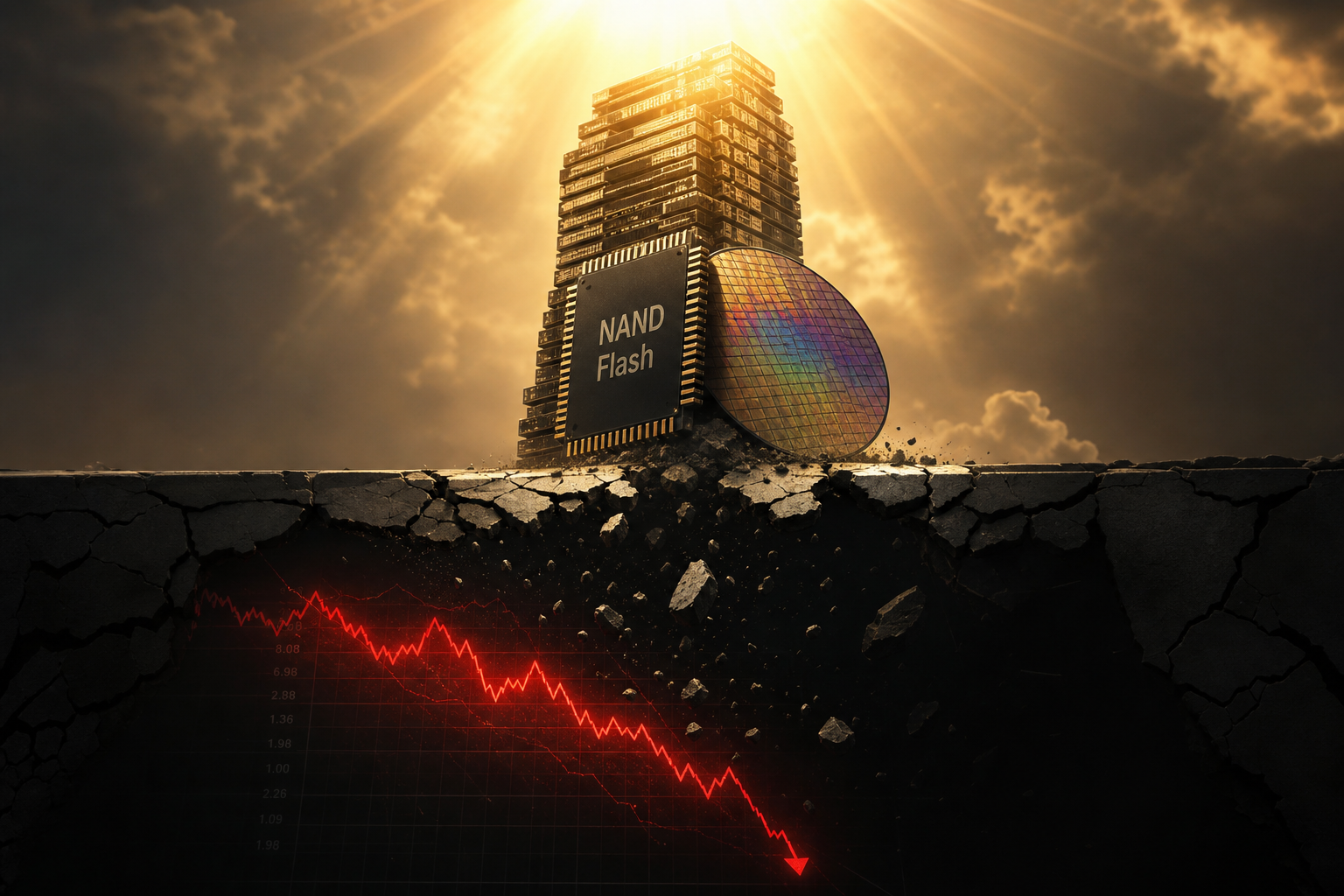
The stock closed down 5.4% Wednesday at $1,350.50, dropped another 8% in after-hours trading, and finished Thursday down 4.84% at $1,285.20.
84.6%
The reflex is to blame the guidance, and the stated reason was indeed that the $10.3–10.8 billion revenue range sat slightly below the most optimistic estimates. But that explanation is too small for the reaction, and it misses the number that actually matters.
Gross margin was 84.6%.
SanDisk sells NAND flash memory. Historically that has been a commodity — a business where you build enormous fabs, flood the market, watch prices collapse, and take losses through the trough. This is a company that lost money in this same quarter a year ago. It is now earning software-company margins on a physical product.
Margins like that are not evidence of a durable competitive moat. They are evidence of a shortage. When AI infrastructure demand outruns memory supply, pricing power lands in the seller's lap, and for a stretch the economics look almost fictional. The question every professional investor asked Wednesday night was not "was this a good quarter." It was "how long can 84.6% possibly last." Korea's memory complex has been living inside that exact question all summer, with the violence in both directions to prove it.
It is worth remembering that the stock fell roughly 47% during July — before SanDisk reported a single soft data point. The market had already begun answering the question on its own.
Musk Answered It on Thursday
Here is what happens next when margins get that fat, and it arrived on schedule.
Tesla and SpaceX confirmed Thursday that Terafab, the advanced chip plant they are jointly developing, will be built in Grimes County, Texas, outside Houston, with an initial investment of $16.8 billion. That is one project, from two companies that were not previously chip manufacturers, in one state.
Extraordinary margins are an invitation. They summon capital, and capital eventually builds capacity, and capacity is what ends shortages. The timeline is years, not quarters — Terafab will not print a wafer for a long while — but equity markets discount the future, and the future contains more supply than the present does. That is the tension underneath both SanDisk's selloff and AMD's earlier this week. The strategic logic of these two Musk companies pooling capital this way is worth understanding on its own terms.
None of this means AI demand is fading. Cloud spending from the largest hyperscalers has kept confirming the opposite. It means the market has stopped paying for growth and started paying for growth that lasts. Those are different products.
A Record Held Up by Three Stocks
Wednesday's tape captured the split cleanly. The Dow rose 263.24 points, or 0.49%, to a record close of 54,349.12 — its fifth consecutive positive session. The S&P 500 fell 12.97 points, or 0.17%, to 7,723.55, snapping a four-day win streak. The Nasdaq dropped 221.55 points, or 0.83%, to 26,363.44, its first decline in five sessions, dragged down by SpaceX and AMD.
Three stocks were responsible for 79% of the Dow's gain.
Thursday was stranger still. The Dow printed a fresh all-time high of 54,373.94 at 9:49 a.m., then gave it back within eight minutes. By early afternoon it was down 363 points, or 0.7%, with the S&P and Nasdaq off about 0.2% each and chip and software names under pressure.
The Labor Market's Split Personality
Jobless claims rose 1,000 to 199,000 for the week ending August 1, coming in below forecasts, with the four-week average dropping to 198,750 from 203,250. By that measure, almost nobody is being laid off.
Set that against Wednesday's ADP report of just 44,000 private jobs added in July — below every estimate in the Bloomberg survey — and Tuesday's JOLTS decline of 178,000 openings, and you get an economy where employers are neither firing nor hiring. It is a labor market that has stopped moving rather than one that is breaking.
July nonfarm payrolls arrive at 8:30 a.m. Eastern this morning. Forecasts run from 75,000 to 120,000 depending on the survey, against June's weak 57,000, with unemployment expected to hold at 4.2% and a real possibility of 4.3%. Prediction-market traders have been betting the number lands cooler than economists expect.
Sixty Days
Oil has gone quiet after a violent stretch. Brent sat near $79.38 Thursday and WTI near $75, more than 15% below the roughly $100 Brent reached on July 23.
The framework taking shape is a 60-day interim arrangement among the US, Iran and Oman to reopen the Strait of Hormuz — through which about 20% of global oil supply moved before the war. Analysts are flagging the obvious flaw: the deal leaves unresolved who actually controls shipping through the waterway. Meanwhile the US has redirected 48 ships, and Houthi forces struck a Saudi tanker.
Traders are pricing a resolution that the negotiators themselves have not reached. The gaps opening up inside a falling oil market are where the more interesting positioning sits.
What Lands Next
The payrolls print at 8:30 sets the tone for a market where the Dow keeps making records on three names while the Nasdaq slides.
Dealmaking, meanwhile, has gone fully risk-on. Apollo agreed to acquire EasyJet for £5.7 billion after rival Castlelake withdrew, and Britain cleared Paramount Skydance's $110 billion takeover of Warner Bros. Discovery. That follows Wednesday's completion of the $55 billion Electronic Arts buyout — the largest in history.
Private capital is paying record prices for whole companies in the same week public markets refuse to pay up for 372% revenue growth. Somebody is wrong.
Found this helpful? Share it with others.