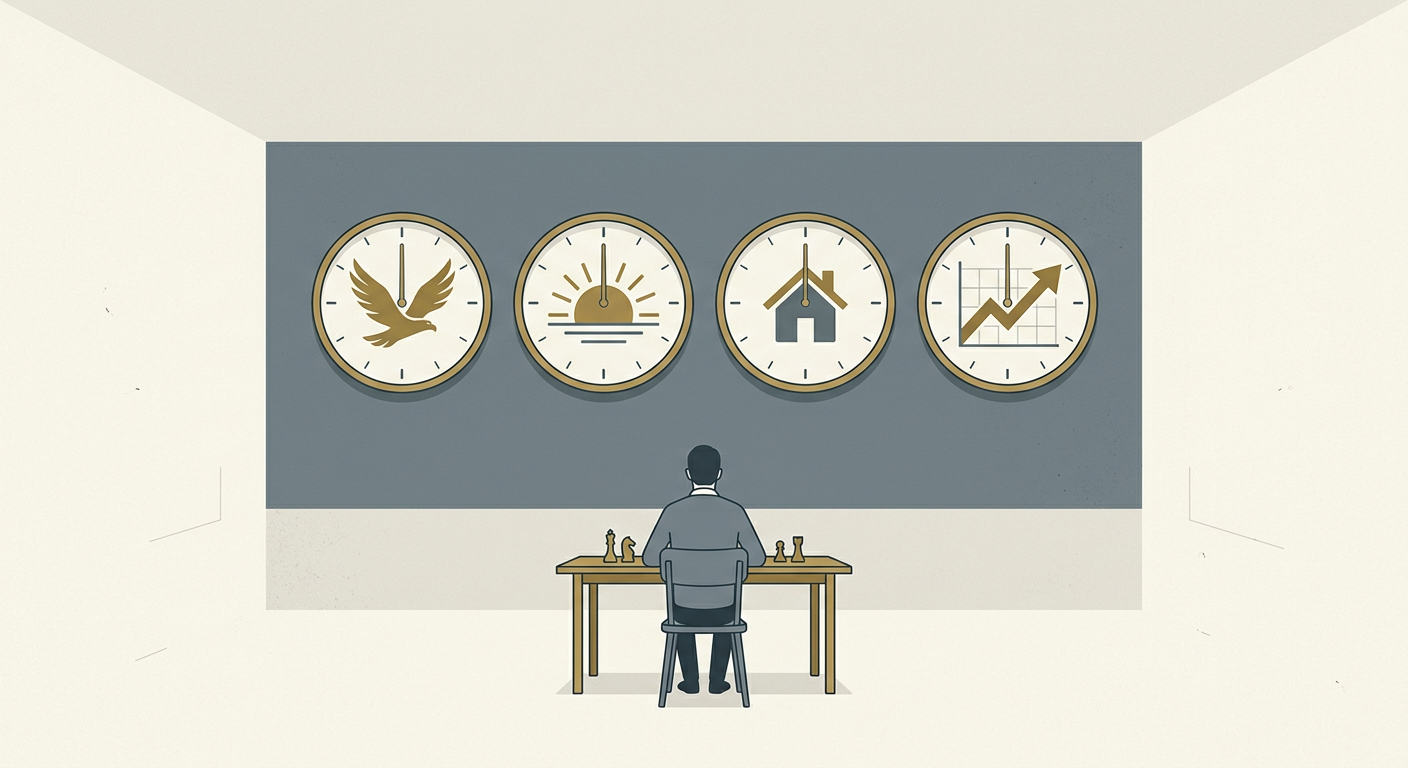
Morning Watchlist: Sunday Edition
A quick note from Behind the Markets
It's Sunday morning, and the week ahead is the one the whole quarter has been pointing at. The Fed votes Wednesday — and after Friday morning's inflation report, futures put the odds of a hike near 85%. The Bank of Japan follows Friday, with a hike of its own about 90% priced. In between: retail sales, a homebuilder's confession, and — at Friday's closing bell — one of the year's biggest forced-trading events, when the S&P 500 reshuffles its membership.
Four stories this morning. Four pairings. Let's get into it.
1) The First Hike of the Warsh Era?
Wednesday at 2:00 PM Eastern, the Fed announces. The last input arrived Friday morning: August consumer prices rose 0.4% on the month — accelerating from July's 0.1%, with gasoline up 3.9% doing the pushing — holding the annual rate at 3.4%. Core inflation cooled to 2.4% annually but ran 0.3% for the month against the 0.2% expected. Stacked on Thursday's hot producer prices, that was enough: futures odds of a quarter-point hike — to 3.75%–4.00% — jumped from about 70% to roughly 85% within hours. Chair Kevin Warsh told Jackson Hole in August: "Otherwise, we have work to do." Wednesday we learn if he meant it.
Here's the part of a hike almost nobody prices: some businesses get a raise the moment the Fed moves. Think of an insurer as a toll bridge where drivers pay in January for crossings they'll make all year. Between the collecting and the paying, the money sits in the insurer's pocket, parked in bonds, earning interest. The industry calls that pile "float." When the Fed raises rates, every insurer's float gets a raise — no new customers required.
The pairing: W. R. Berkley (WRB) — Buy
W. R. Berkley is one of America's premier specialty insurers — the harder-to-price corners of commercial coverage, where underwriting skill matters. The second quarter set a company record with $4.1 billion in premiums written, earnings of $1.27 a share beat the $1.08 expected, and operating earnings grew 21% — driven, in the company's own words, by strong investment income. That's the float collecting its raise from the hikes that already happened. Wednesday may add another.
The stock closed Thursday at $70.05, about 11% off its high, at roughly 14 times earnings. The S&P 500: 21 times. It yields 2.7%, and here's our favorite detail: the average analyst target is $69.53 — below the price, at a consensus Hold. We've seen that shape in Eldorado Gold and Federated Hermes: targets chasing a stock the models haven't caught up to. The honest risks: a fast turn to rate cuts shrinks the float's raise, commercial insurance pricing could soften after strong years, and any insurer can surprise you with old claims reserved too thin.
2) The Lemonade Was Free for a Generation
Friday, while America sleeps, the Bank of Japan is expected to raise its policy rate to 1.25% — about 90% priced, with 70% odds of another increase by December. Japanese real wages are growing at their best pace in five years, the yen touched 153 to the dollar Tuesday — its strongest since February — and the 10-year Japanese government bond hit 2.945% in August, its highest yield since 1996.
Imagine running a lemonade stand where, by law, the lemonade had to be free. That was lending money in Japan for most of a generation. Since 2024 the law has changed — the lemonade has a price again, and it rises a quarter-point at a time.
The pairing: Mitsubishi UFJ Financial Group (MUFG) — Watch
MUFG is Japan's largest bank — since July, Japan's most valuable company outright, worth about ¥41 trillion, ahead of Toyota. The rate math is simple: the bank estimates every additional quarter-point eventually adds about ¥180 billion a year — over a billion dollars — to its interest income. First-quarter profit rose 48%. The shares trade in New York as an ADR under MUFG; in Tokyo they closed Wednesday at ¥3,601, yielding about 2.6%.
So why Watch and not Buy? Because a 90%-priced hike is not an edge — it's an entrance fee, and the stock sits near record highs after a monster run. This trade also has an air-pocket problem: on August 19th, one bond-market scare knocked the megabanks down 4–5% in a session. That's the entrance we want — a carry-trade wobble or sell-the-news dip with the hike path intact. What kills it: the BoJ blinking and the yen sliding back toward 160. Ledger note: Friday's decision is also the bell we named for our Aflac watch on September 9th.
3) The Builder Confesses Four Hours After the Fed Votes
Wednesday after the close — the same day as the Fed decision — Lennar, one of America's two biggest homebuilders, reports earnings. Thursday morning brings August housing starts. In one 18-hour window, we learn what 6.85% mortgages are doing to the biggest purchase most families ever make.
Wall Street expects about $1.30 a share, down roughly 35% from a year ago. Last quarter, revenue missed and operating margins fell to 5.9% from 7.5% — because the only way to move houses at these rates is incentives, mostly mortgage-rate buydowns. A builder buying down your rate is a car dealer paying your gas bill for three years: the car moves, the profit stays on the lot. The stock closed Thursday at $77.20, down 2.8%, more than 40% below its 52-week high near $140; the options market braces for a 5% move on the report.
The pairing: Lennar (LEN) — Watch
Regular readers know our position: we flipped M/I Homes to Sell on September 3rd because builder estimates are made of mortgage rates, and rates went the wrong way. A hike Wednesday afternoon would harden that. So why watch the confession at all? Because of who's on the other side: seven of 18 analysts now say Strong Sell — a rare depth of gloom — while the average target still sits near $85. When the last optimist leaves, cyclical bottoms get made. Our entrance: margins finding a floor while the Fed's path turns friendly — both, not either. Until then we own the freeze through the landlord and the repairman — Invitation Homes and Frontdoor — and let the builders report.
4) On Friday, the Index Fires a Stock
The week's strangest scheduled event: on September 4th, S&P announced its quarterly reshuffle. Effective before Monday the 21st's open, Bloom Energy and Illumina headline the additions to the S&P 500 — and The Trade Desk is out, Illumina taking its seat. Index funds tracking trillions don't get an opinion; they must finish selling by Friday's close — which is also quadruple witching, the quarterly expiration crush that makes that bell the loudest print of the season.
Fourteen months ago, The Trade Desk entered the index around $80. It leaves around $14.
We flagged this one on September 3rd at $13.78, as a Watch — and named our entrance in writing: a capitulation washout. The index just put a date on it. When a store gets kicked out of the mall, the everything-must-go sale isn't a judgment on the merchandise — it's a deadline. Forced sellers with a calendar are the most honest counterparties in markets.
The pairing: The Trade Desk (TTD) — Still Watch
What's changed since September 3rd: the company cut 15% of its workforce, and now comes Friday's forced selling. What hasn't: the reason we didn't buy — growth broke, 3% last quarter, and the business still has to prove the ad dollars come back. The stock closed Thursday at $13.97, about 15 times next year's expected earnings, with a 52-week low of $12.83. The plan: let the index funds finish. If the washout prints and the price holds after the 21st, that's our entrance. Buying before Friday's bell is volunteering to stand under a scheduled anvil. What kills it: revenue actually shrinking at the next report — a cheap stock becoming a value trap with good manners.
Before You Go
That's the watchlist: the toll bridge collecting a raise from the Fed, the lemonade stand that finally gets to charge, the builder's confession, and the index showing a stock the door. Notice that three of the four are Watches — this week's outcomes are binary and mostly priced, so we'd rather name our entrances now and let the week come to us.
Your map: Wednesday is the hinge — retail sales at 8:30 AM (July's fell 0.6%), the Fed at 2:00 PM, Warsh's press conference after, Lennar at the close. Thursday: housing starts and the Bank of England. Friday: the Bank of Japan and the quadruple-witching close. The week's biggest moment is Wednesday, 2:00 PM Eastern — the first rate hike of the Warsh era, now about 85% priced, with every rate-sensitive call on our ledger listening. The only surprise left is a hold.
Found this helpful? Share it with others.
Written by Behind the Markets