Morning Watchlist: Monday Edition
A quick note from Behind the Markets
It's Monday, and the loud part of the week is still ahead of us — the Fed speaks Wednesday, and Sunday's note has your full map for that. So this morning we're doing something different. We're rewinding to three things that happened last week while everyone was staring at inflation charts.
Companies talk constantly. Guidance, conference calls, carefully worded press releases. But last week, three companies did something more honest than talking. One wrote a $1.9 billion check. One authorized a $1 billion buyback. And one hit a milestone no software company had ever reached — and watched the crowd yawn anyway, which tells you something too.
When the words and the money disagree, follow the money.
Three stories this morning. Three pairings. Let's get into it.
1) The $1.9 Billion Compliment
On Thursday, Copart — the salvage-auction giant that sells wrecked and totaled cars for insurance companies — announced the biggest acquisition in its history. It's buying ACV Auctions, the digital marketplace where car dealers wholesale used vehicles to each other, for $10.50 a share in cash. Total bill: about $1.9 billion, expected to close by year-end.
Here's the number that matters. That price is a 45% premium to where ACV traded a month earlier, before deal talk reached the tape. Copart is famously one of the best-run, most patient companies in America — it looked at the market's sticker price for a digital car auction and said: wrong, it's worth half again more.
When the shrewdest developer in town pays 45% over asking for the house next door, every appraisal on the block just changed.
So who else runs a digital wholesale car marketplace at scale? Essentially one public company.
The pairing: OPENLANE (OPLN) — Watch
OPENLANE — the former KAR Auction Services, reborn under a new ticker last December — runs the biggest independent digital auction where dealers buy and sell used cars, plus a lending arm that finances those purchases. Business is good: second-quarter revenue of $555 million beat estimates, adjusted earnings of 40 cents topped the 35 expected, and management raised full-year guidance in August. Revenue over the past year: $2.08 billion, growing about 12%. Nine analysts rate it a consensus Buy, with an average target of $46.22 — about a third above the roughly $35 it traded at Friday morning.
So why Watch and not Buy? Because this compliment cuts both ways. Copart's check validates everything OPENLANE does — and simultaneously hands OPENLANE's closest digital rival the deepest pockets in the industry. There's also the price of admission: OPENLANE still loses money on a GAAP basis, and $35 is roughly 24 times this year's guided adjusted earnings — no bargain bin. We like being the last independent name in a consolidating industry; we don't like paying full freight for it the week the spotlight arrives. Our entrance: a pullback toward $30, or proof after the deal closes that dealer volumes stay home. What kills it: Copart using ACV to start a fee war — a price fight with Copart's balance sheet is one you lose slowly, then suddenly.
2) A Billion Users, Marked Down
Thursday night, Adobe reported a quarter that would have thrilled the market five years ago. Revenue rose 13% to a record $6.76 billion. Adjusted earnings of $6.13 a share beat estimates. Operating cash flow set a company record at $2.52 billion. Full-year guidance: raised. And buried in the release was a milestone: monthly active users across Adobe's products crossed one billion.
The stock closed Thursday at $248.95 — and slipped further after hours on a fourth-quarter outlook the crowd found merely fine. It now sits about a third below its 52-week high of $370.
Now the math the market is choosing not to do. Adobe just guided this fiscal year's adjusted earnings to about $24.47 a share. At Thursday's close, that's roughly 10 times this year's profit — and closer to nine times next year's estimates. The S&P 500: 21 times.
Why so cheap? One word: AI. The fear is that image-generating models make Photoshop a relic, and it's not a silly fear — Morgan Stanley is telling clients to sell on monetization concerns. But look at what the company reported: its AI-first products now carry over $650 million in annual recurring revenue, growing more than 150% a year. Imagine the only art-supply store in a city where a billion people make things. Sales at record highs, margins near 45% — and the landlord marks the building down by a third because a robot store might open across town someday. Meanwhile the art store started selling robots, and that's its fastest-growing aisle.
The pairing: Adobe (ADBE) — Buy
One more wrinkle worth knowing: this is a changing of the guard. On September 3rd, Adobe announced that Anil Chakravarthy will take over as CEO on December 1st, ending Shantanu Narayen's run of nearly two decades. New leadership plus a single-digit forward multiple on a franchise with a billion users is, historically, an interesting cocktail. The honest risks: this is a falling knife with a hostile analyst crowd (consensus: Hold), the fourth-quarter outlook really was soft, and the AI threat is real — if recurring-revenue growth breaks below 10%, the cheap multiple was a warning, not a gift.
4) The Cruise Line Bought Its Own Ticket
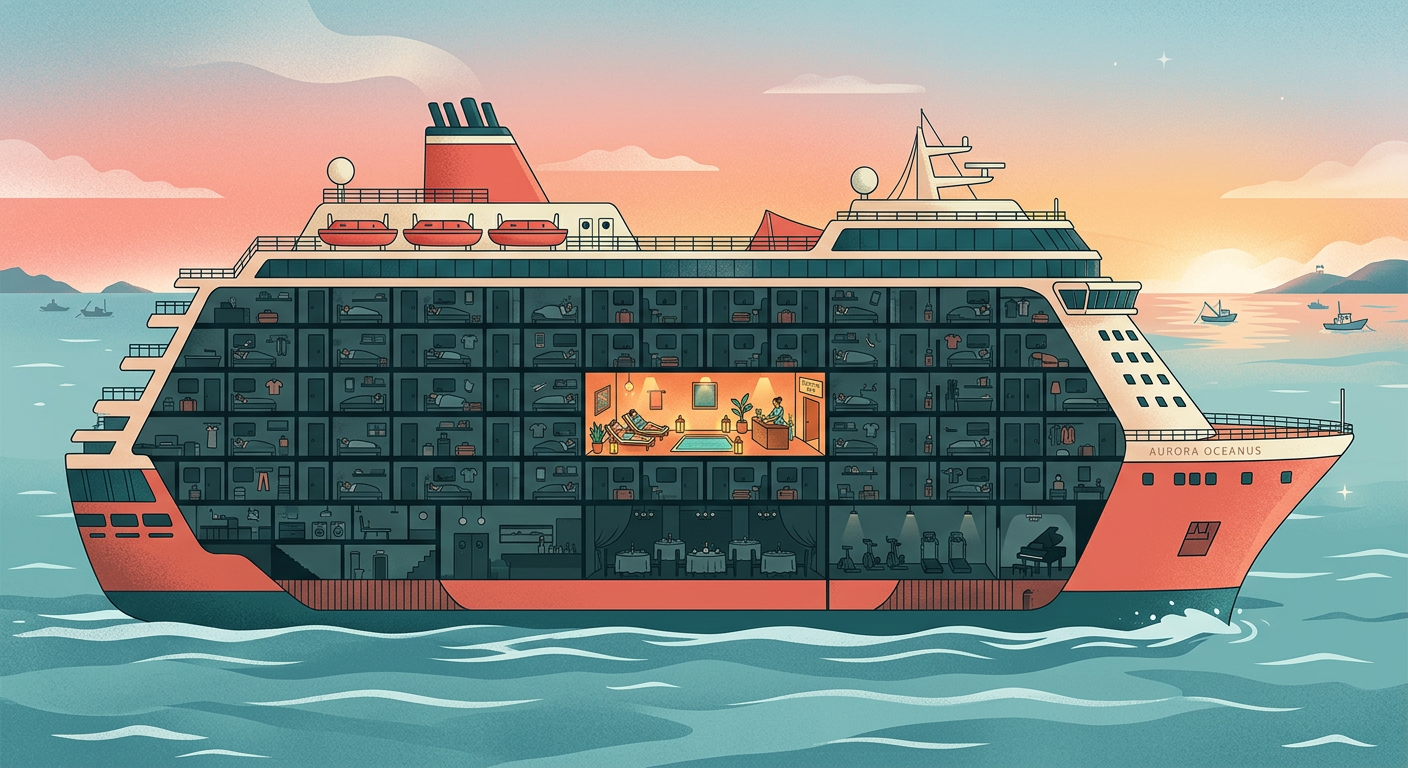
Also Thursday: Viking, the river-and-ocean cruise operator with a fleet of more than 100 ships, authorized a $1 billion share buyback. The shares rose about 2% after hours. A buyback is a company buying a ticket on itself — and Viking's confidence isn't lonely. Carnival has reported record demand with bookings stretching further out than ever, and Royal Caribbean said this spring it was sailing above full occupancy.
Here's the thing about cruise lines, though: they compete ferociously — on ships, on prices, on which one builds the bigger waterslide. We'd rather not referee that fight. Because on 208 of those ships, no matter whose flag flies on the funnel, the spa is run by the same company.
When every hotel on the beach is full, own the massage table in all of them.
The pairing: OneSpaWorld (OSW) — Buy
OneSpaWorld operates the health and wellness centers — spas, salons, fitness, medi-spa services — aboard 208 cruise ships across the industry's biggest lines, and it just reported its 21st consecutive quarter of record revenue and adjusted EBITDA: sales up 9% to $261.2 million, profit up 16%, with new wellness-center expansions alongside Royal Caribbean and Azamara. Full-year guidance calls for about 10% growth.
At about $22.40 Friday morning, it's a $2.3 billion company at roughly 19 times next year's expected earnings — under the S&P's 21 — and the six analysts covering it rate it a consensus Strong Buy, with an average target of $31.20, some 39% higher. A near-monopoly service inside a booming industry, priced below the market. The honest risks: the same squeezed consumer we've flagged on Polaris and Tanger could trim vacation extras; the trailing multiple reads richer at 28 times, so next year's earnings must arrive; and the business lives on contracts with a handful of giant cruise lines — renewals are the whole ballgame.
Before You Go
A $1.9 billion check that re-appraised an industry, a billion-user franchise priced for decline, and a $1 billion buyback pointing at the calmest business on the ship.
One theme this morning: companies tell you the truth with money more often than with words. And a housekeeping note — Wednesday afternoon the Fed decides, with a hike mostly priced in; Sunday's edition has the full map, and every rate-sensitive call on our ledger will be listening.
Found this helpful? Share it with others.
Written by Behind the Markets