The Federal Open Market Committee lifted the federal funds target range to 3.75%–4.00% on Wednesday afternoon and told the market to expect at least one more increase before New Year's. The entire point of the exercise is to make capital expensive enough that companies spend less.
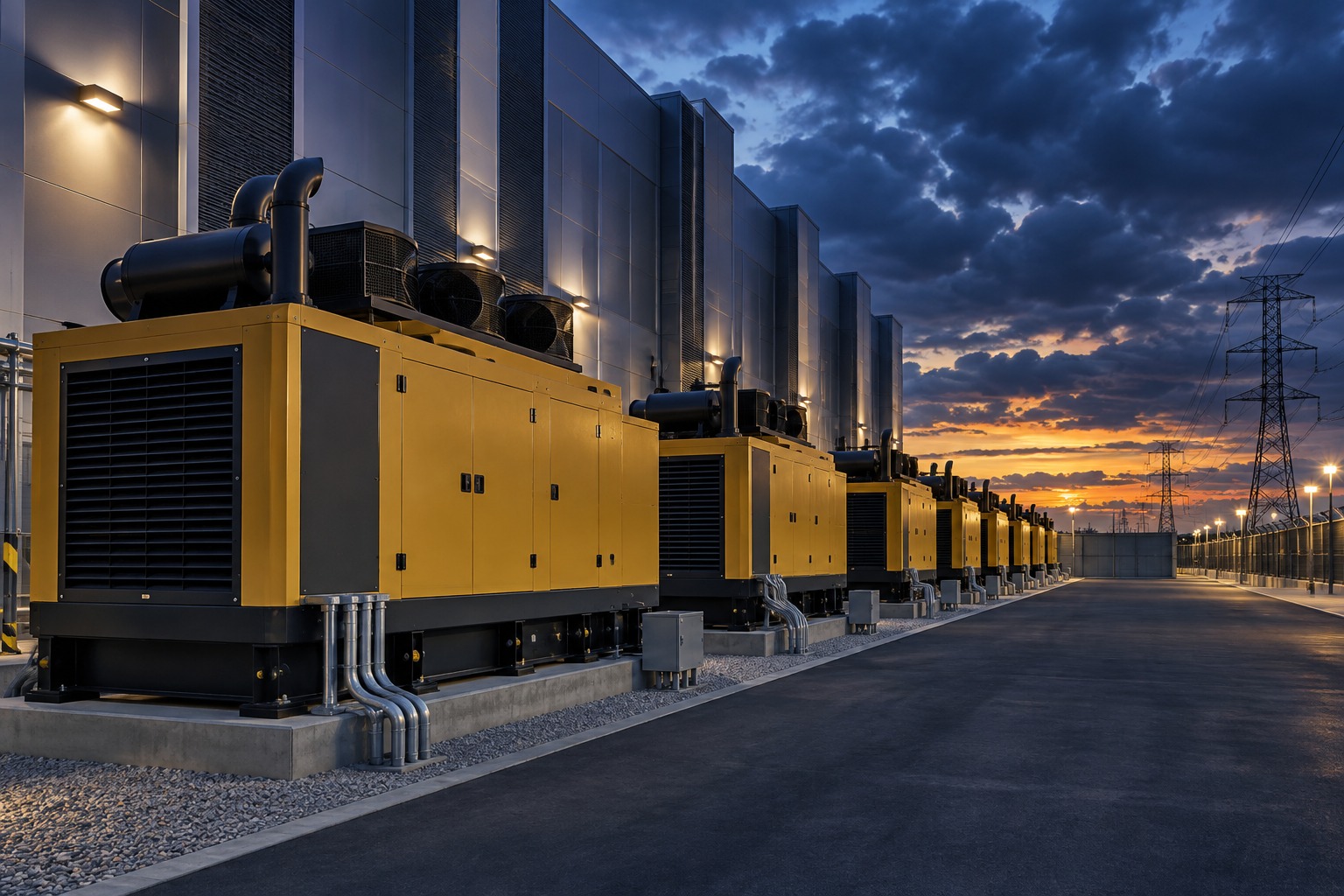
Eighteen hours later, a regulatory filing revealed that Amazon (NASDAQ: AMZN) has agreed to buy roughly $2.4 billion of backup generators from Generac Holdings (NYSE: GNRC) for delivery in 2027 and 2028 — with a contractual path toward $8 billion.
Generac closed Thursday at $207.23, up $32.12, or 18.34%, on 7.5 million shares, in a 52-week range of $134.80 to $296.44. Amazon closed at $251.19, up 2.13%. The Fed spent Wednesday trying to cool an economy that spent Thursday demonstrating exactly why it won't cool.
What the filing actually says
Generac's 8-K, filed Wednesday evening, describes a transaction agreement and a long-term supply agreement signed the same day:
Initial deliveries of backup generators are expected to total $2.4 billion in 2027 and 2028. For scale, Generac's total company revenue in 2025 was $4.2 billion.
Generac issued Amazon.com NV Investment Holdings LLC a warrant for up to 1,693,745 shares at an exercise price of $200.9266 — close to 3% of shares outstanding.
307,954 of those shares vested immediately. The rest vest in tranches tied to aggregate payments Amazon makes for data-center backup generators, up to $8 billion.
The warrant is exercisable, in cash or cashless form, through September 16, 2033.
Read the vesting mechanism twice, because it is the interesting part. Amazon only earns the bulk of that equity if it actually spends up to $8 billion with Generac over the next several years. The customer has been handed an incentive to keep buying. Amazon has run this play before — it holds or has held similar supplier warrants with Plug Power and air-cargo operator ATSG.
Why a generator maker
Generac is not new to this. In its second-quarter results on July 29, net sales rose 11% to $1.17 billion, while Commercial & Industrial external sales — the data-center segment — rose 29% to $556 million. CEO Aaron Jagdfeld said the Waukesha, Wisconsin company had taken in roughly $1 billion of additional orders since the prior update, lifting its data-center backlog to about $1.6 billion, with nearly $700 million of 2027 volume already committed under an agreement with a first hyperscale customer and a second hyperscale agreement signed during the quarter.
The demand behind that backlog is physical, not financial. Gas-fired generating capacity proposed to sit directly alongside U.S. data centers reached 189 gigawatts by mid-2026, up from 97 GW at the start of the year, according to Global Energy Monitor's tracker — with Texas alone accounting for 77 GW. Reciprocating engines, the kind that arrive on a truck rather than after a multi-year turbine queue, make up roughly a quarter of that pipeline. Developers are buying engines because they cannot wait. That is the same buildout logic we wrote about heading into this Fed meeting: a 25-basis-point move does not change a company's decision when the alternative is not having power at all.
Wall Street responded with a wall of upgrades. Brian Drab at William Blair called the deal a "massive win," noting the agreement "provides strong visibility — with an indication of $8 billion in spend over seven years — for Generac at a time when many investors are questioning the durability of capital spending trends in the data center industry." Michael Halloran at Baird named it a "top idea" with a $305 price target. Citi's Vikram Bagri was the skeptic, keeping a neutral rating despite a $300 target: the after-hours move, he wrote, implied "roughly 15x the implied ~$1.2B annual revenue at a 20% EBITDA margin, which appears aggressive."
The rest of Thursday agreed with the buildout, not the Fed
The data that landed at 8:30 a.m. ET made the case that the economy is not slowing:
Initial jobless claims fell 10,000 to 196,000 for the week ended September 12 — the lowest since mid-July, against a 208,000 consensus. This was also the survey week for the September payroll report, though the Labor Day holiday likely exaggerated the drop.
The Philadelphia Fed manufacturing index came in at 37.8 versus 30.5 expected. Prices paid rose to 48.6 from 40.9; prices received rose to 31.3 from 17.7. Both price gauges moving up is not what a tightening cycle wants to see in month one.
Housing was the exception. Total starts fell 2.6% to a 1.28 million annual rate and permits fell 2.7% to 1.39 million, even as single-family starts jumped 7.6% to 918,000. Single-family production is down 4.7% year-to-date, per NAHB.
Bonds rallied anyway, which tells you what investors thought of Chair Kevin Warsh's first press conference. The 10-year Treasury yield fell to 4.934% from 5.023% Wednesday, back under the 5% line that had been unnerving equity investors all month.
Where the tape closed
S&P 500: 7,637.76, up 85.95 (+1.14%)
Dow Jones Industrial Average: 51,778.04, up 316.14 (+0.61%)
Nasdaq Composite: 26,418.30, up 439.87 (+1.69%)
CBOE Volatility Index: 15.44, down 2.27 (−12.82%)
10-year Treasury: 4.934%
WTI crude (Oct): $101.29, down $1.14 (−1.11%)
Volatility collapsing nearly 13% in a session is the market saying the uncertainty was the meeting, not the rate. Power names led: Vicor closed at $216.39, up 17.66%, and Oklo at $39.65, up 11.31%. Energy was the weakest sector as crude slipped for a second day on Saudi ship-to-ship cargo offers off Oman; Chevron finished flat at $211.57, holding near its 52-week high. Oil's role in this inflation problem is the part monetary policy cannot touch. CoreWeave fell about 4% after announcing a $3 billion convertible bond sale — a reminder that the market is beginning to separate buildout winners who get paid from buildout participants who borrow.
What to watch Friday
Whether the generator trade broadens or stalls. Thursday's move priced a single contract. The question is whether investors extend it to switchgear, transformers and engine suppliers, or treat Generac as a one-off.
The 10-year at 4.93%. It fell on confidence in the Fed's resolve. If the next inflation print disagrees, that confidence reverses quickly and the equity multiple goes with it. We flagged the split between the rate market and the capex market earlier this week.
Saudi pipeline repairs. Riyadh is targeting half of East-West capacity within days and full capacity in six weeks, with Yanbu storage below 15 million barrels against nearly 21 million in July. That timeline, not the funds rate, sets the next several months of headline inflation.
The tension on display Thursday is the defining one of this cycle. The Fed can raise the cost of money. It cannot lower the cost of electricity, and it cannot talk a hyperscaler out of a contract it has already signed.
This article is for informational and educational purposes only and does not constitute investment advice or a recommendation to buy or sell any security.
Found this helpful? Share it with others.