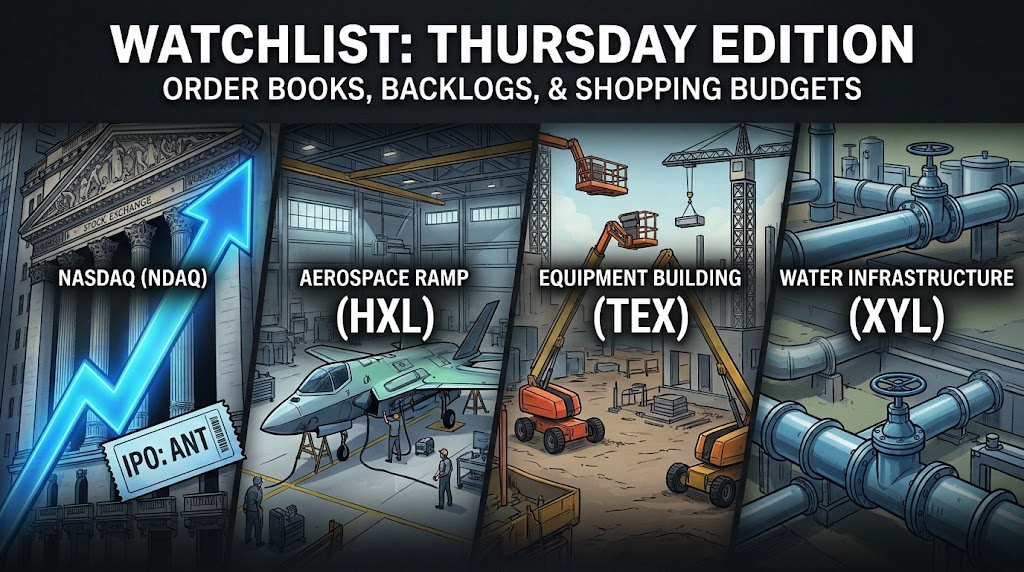
Morning Watchlist: Thursday Edition
A quick note from Behind the Markets
The Fed made its call Wednesday afternoon, and Chair Warsh explained it at 2:30. We go to press before the podium, so we won't pretend we heard it — and we picked four stories that don't need it.
Because the loudest document of the week wasn't going to be the Fed statement anyway. It was filed with the SEC on Monday: Anthropic, the AI lab behind the Claude models, wants to list on the Nasdaq under the ticker ANT — at a valuation reportedly headed for as much as $2 trillion. While the crowd argues about that number, the quieter tape kept talking in order books, backlogs, and shopping budgets.
Four stories this morning. Four pairings.
Let's get into it.
1) The Two-Trillion-Dollar Ticket
Start with the numbers, because nobody has seen numbers like these. Anthropic's prospectus shows $16.3 billion of revenue in the first half of 2026 — against $4.6 billion for all of last year. It also shows a net loss of $80.7 billion for the half, and commitments to spend up to $120.5 billion on computing power through 2029. The filing even warns that AI models could pose "catastrophic or existential risk to humanity." A first for a risk-factors section.
The valuation under discussion: a reported $1.5 to $2 trillion, which would make this the largest IPO in history. The market voted Tuesday — AMD jumped 5.5% after committing more than $20 billion of chips to Anthropic, Broadcom rose 4%, and the Philadelphia chip index climbed 3.6%.
So — is an AI lab worth two trillion dollars? That's the argument Wall Street will have until the stock prices later this fall, and it's not one we need to win. Whichever studio made the movie, the theater sells the popcorn.
The pairing: Nasdaq (NDAQ) — Watch
The listing fee isn't the point — listing fees are pocket change. The real business: when a stock this size eventually joins the Nasdaq-100, every fund tracking the index pays Nasdaq fees on more assets; a stock this argued-about trades heavily on Nasdaq's exchanges; and a reopened IPO window — OpenAI is reportedly eyeing early 2027 — refills the pipeline for years. Last week Nasdaq itself beat again, with revenue up 14% to about $1.5 billion.
So why not Buy? Because the crowd got there Monday. At about $104, the stock sits at a record, up roughly 8% since the filing, at about 22 times next year's expected earnings — a fair ticket for a famous theater, not a cheap one. The entrance: the mid-$90s where it traded before the filing, or a sell-the-news markdown around the debut — traders remember SpaceX falling 15% in its first week as an index stock. The kill: a market cold enough to slam the IPO window shut; the calendar, not one listing, is the thesis. Housekeeping: Goldman Sachs, our October 2nd Buy, is co-leading the deal.
2) A Record Backlog Walked In Wearing a Red Number
On Tuesday, Boeing managed to disappoint and reassure in the same breakfast. The disappointment: a wider-than-expected loss of 26 cents a share, with the commercial airplane division losing $697 million. The stock fell nearly 11%.
The reassurance was everything else. Revenue rose 4% to $24.2 billion. Free cash flow turned positive. The 737-7 and 737-10 finally won certification, production is climbing toward 47 737s a month with the 787 steady at eight — and the backlog hit a record $745 billion. More than 6,300 airplanes, sold and waiting.
So Boeing loses money building planes, and the world has never wanted its planes more. The punishment went to Boeing. But suppliers aren't paid out of Boeing's margins — a wedding caterer gets paid per plate, even when the couple blows the budget. In aerospace, the caterers are paid by the shipset.
The pairing: Hexcel (HXL) — Buy
Hexcel makes the carbon-fiber composites modern jets are built from, and it gets paid by the airplane — a set amount of material per 787, per A350, per 737. Last week it reported commercial aerospace sales up 21%, earnings up 35%, margins climbing, a reaffirmed full-year forecast, and a buyback raised to $750 million. The market's response: a 12% markdown over a 1% revenue miss.
So a $6 billion company now trades at $79 — about 26% below the average analyst target of $99.80 — in the same week its biggest customers confirmed record demand: Boeing pulling 90 to 100 787 shipsets this year, Airbus taking Hexcel's A350 count from 80 toward 100 next year. Fair warning: that's roughly 29 times this year's guided earnings, because you're buying the ramp, not the trailing number. The honest risks: defense sales fell 9%, several banks trimmed targets after the print, and aircraft production increases have a long history of slipping. The kill: a 737 or A350 ramp pushed to the right again. The shipset count is the whole thesis.
3) The Rental Shop Raised Its Shopping Budget
Tuesday's biggest winner wasn't an AI stock. Herc Holdings — the equipment-rental company — jumped nearly 23% after earnings of $3.91 a share crushed the $2.96 estimate, rental revenue grew 12% to a record, and management raised guidance for the second time this year. CEO Larry Silber said the large-project pipeline is growing faster than expected: data centers, infrastructure, manufacturing, energy. The same work orders behind our Sterling and Dycom calls, confirmed from the rental yard.
But the line the headlines skipped sat lower in the release: Herc raised its equipment-buying budget, taking fleet spending guidance from $1.25–$1.4 billion to $1.45–$1.6 billion. A landlord bragging about full buildings is nice for the landlord. A landlord buying more buildings is lovely for the builder.
The pairing: Terex (TEX) — Buy
Terex builds what the rental industry rents — Genie lifts and aerial platforms among them. On Wednesday morning it reported its own quarter: earnings of $1.50 a share against a $1.42 estimate, sales up 11.6% (adjusting for last year's big environmental acquisition), a $7 billion backlog up 13%, more orders arriving than shipping out, and a fresh $500 million buyback. The stock's thank-you: a markdown of about 4% in early Wednesday trading, to around $49.50, over cautious profit guidance.
Which leaves it at about 10 times this year's guided earnings. The S&P 500: 21. Analysts expect earnings to grow 13% over the next year, and the company is exploring a separation of the aerials unit — the kind of move that tends to surface value rather than bury it. The honest risks: aerials margins fell even as those sales jumped 32%, the environmental unit shrank 8%, and this is a cyclical — if the rental industry's spending wave stalls, the orders stop first. The kill: Herc and its peers cutting fleet budgets at the next guide.
4) The Water Bill Got Postponed
Tuesday's quietest wreck was a water company. Xylem — one of the world's largest makers of water pumps, meters, and treatment equipment — fell 14% to a 52-week low after cutting its 2026 outlook: revenue now seen down about 1% instead of up 2%, earnings guided to $5.40–$5.45 from $5.55–$5.70. The reasons: utility customers turning cautious, metering upgrades postponed, project timing slipping.
Here's the wrinkle that kept us reading. In the same quarter revenue went flat, orders rose 10% organically. The waiting room is filling while the register sits quiet. A town that postpones fixing its pipes hasn't canceled the repair — it's rescheduled the bill. Water infrastructure is about the least optional spending on earth; pipes age on a schedule that doesn't read the Fed statement. And every data center the AI buildout promises needs its water moved, metered, and treated.
The pairing: Xylem (XYL) — Watch
At about $93 — below the old 52-week low of $97.52 — the stock costs roughly 17 times the newly lowered guide. The business isn't broken: Xylem kept its margin target even while cutting revenue, and it's selling two slower units to sharpen the rest. So why Watch and not Buy? Because "delayed" only becomes "deferred, not dead" when the orders convert, and we want one quarter of proof — or a price that pays us to wait. The entrance: the order book turning into revenue at the next print, or a slide into the mid-$80s. The kill: order growth rolling over too — the postponed bill actually torn up — or a second guidance cut.
Before You Go
That's the watchlist. A two-trillion-dollar ticket and the theater selling the seats, a record backlog wearing a red number, a rental shop raising its shopping budget, and a water bill postponed — not canceled. One theme this morning: in the loudest week of earnings season, we'd rather read order books than podiums.
The homework stack: Wednesday night's papers — Microsoft and Alphabet, plus our own Antero, FormFactor, and Flex — are on your desk this morning; we went to press first and we'll grade them in the coming editions. Today brings the first read on third-quarter GDP, with Amazon reporting after the close. Friday: Exxon, Chevron, Cboe — and Magna, Wednesday's toll-bridge Buy, hands in its report card.
Found this helpful? Share it with others.
Written by Behind The Markets