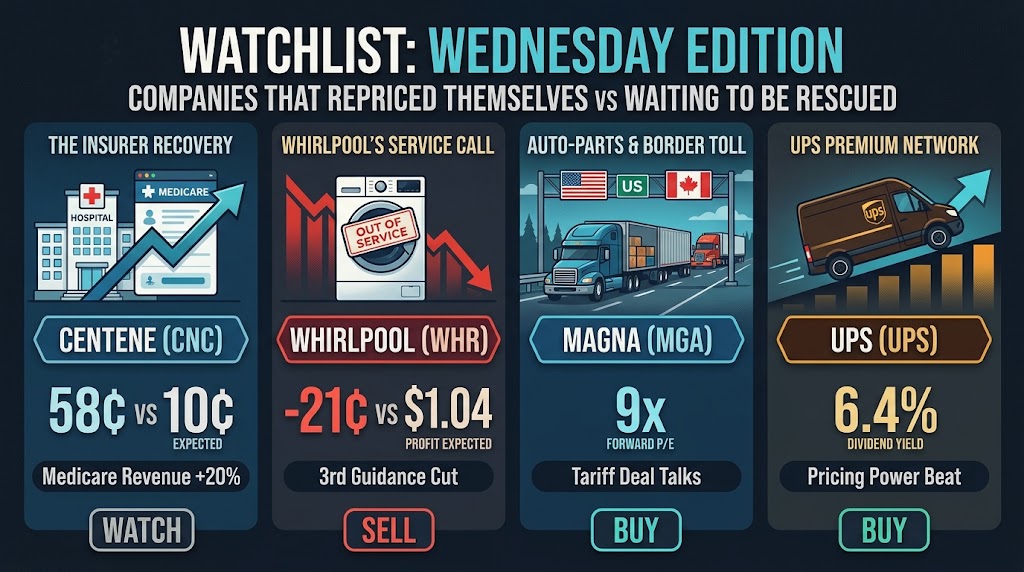
Morning Watchlist: Wednesday Edition
A quick note from Behind the Markets
The answer comes this afternoon at 2. The Fed wraps its two-day meeting, Chair Warsh explains himself at 2:30, and the market has already graded the exam — better than 90% odds of a hold, with the real argument pushed to December.
But while everyone camps out in front of that one clock, Tuesday quietly delivered the heaviest earnings tape of the season — roughly a third of the S&P 500 reports this week. And the results sorted into two piles: companies that repriced themselves, and companies still waiting to be rescued.
Four stories this morning. Four pairings.
Let's get into it.
1) The Insurer That Came Back From the Dead
A year ago, Centene — one of the country's biggest government-focused health insurers — reported a quarterly loss of $13.50 a share. The stock fell as low as $31.63. The obituary practically wrote itself.
On Tuesday, Centene reported adjusted earnings of 58 cents a share. Wall Street expected 10 cents. Revenue came in at $50.65 billion against $47.11 billion expected, Medicare revenue grew 20%, and management raised its full-year earnings forecast to more than $5.20 a share — up 40 cents from the last guide and well above the Street's $4.88. CEO Sarah London credited "solid underlying fundamentals."
Here's the plain-English version of what went wrong and what got fixed. A health insurer is an all-you-can-eat buffet that sets its price before anyone walks in. In 2025, sicker-than-expected customers showed up and ate the buffet into the ground. But menus get reprinted every year. 2026 is the reprinted menu — and Tuesday was the proof it's priced right.
The pairing: Centene (CNC) — Watch
So why not buy the comeback? Because the market found it first. The stock has roughly doubled in a year to about $68 — near a two-year high — and the average analyst target sits at $71.78, barely 5% above. At about 13 times the newly raised guide (the S&P 500: 21), it isn't expensive. It just isn't ignored anymore, and the shares slipped about 2% on the good news — a crowd taking profits, not finding a bargain. The entrance: analyst targets resetting higher after this print, or any markdown toward the low $60s. The warts we're watching: commercial revenue fell 21%, and the bottom line is still negative on a GAAP basis. The kill: next year's repricing season giving the margin back. Two weeks ago we bought CVS on the recovering-insurer aisle; Centene is the aisle's loudest proof yet that the recovery is real.
2) The Appliance on Its Third Service Call
On Monday night, Whirlpool reported the quarter nobody should have to read twice. Wall Street expected a $1.04 profit. The company delivered a 21-cent loss. Sales fell 8.8%, North American operating profit dropped 44.7%, and the bankruptcy of a major Brazilian retail customer dragged free cash flow negative.
Then the forecast: full-year guidance cut for the third time this year — to a loss of about $1.30 a share, where analysts had modeled a $1.21 profit. By Tuesday the stock had carved a fresh 52-week low at $25.73, down more than 60% this year. Stifel cut its target to $30 and kept its Hold.
Everyone knows this rule at home. When the same machine needs a third service call in one year, you stop paying the repairman. Three guidance cuts is three service calls. CEO Marc Bitzer says "the pace of recovery is slower than expected" and points to a 2027 margin plan — but the recovery he's waiting on is the housing market, and that's the Fed's decision, not his.
The pairing: Whirlpool (WHR) — Sell
This one is for readers already holding it, tempted to average down because the stock looks cheap. A company guiding to a full-year loss isn't cheap — there's no E in the P/E. What would prove us wrong: a rate-cutting Fed thawing housing faster than expected, and the cost plan landing on schedule. If that happens, you'll have time to come back — turnarounds that real are long. Until the company can reprice its own problem, we'd rather not wait in this aisle.
3) The Toll Bridge Might Come Down
On Monday, Reuters broke the news that Washington and Ottawa are working on a deal to ease the Section 232 tariffs — up to 50% on Canadian steel, 25% on autos — with sources on both sides saying an agreement is possible before the November 3rd midterms. Prime Minister Carney confirmed "a slight intensification" in talks. A Canadian industry source put it more honestly: "If it happens, it'll happen fast. But my sense is it'll be a narrowed deal, if it even happens."
Why does this matter more for one company than almost any other? Because a car part doesn't cross the border once. A Magna part can cross several times before the finished vehicle rolls off the line — stamped in Ontario, assembled in Michigan, bolted on in Ontario again. It's a delivery driver whose route crosses a toll bridge six times a day. Remove the toll, and margin appears without selling a single extra part.
The pairing: Magna (MGA) — Buy
Magna is North America's largest auto-parts maker — a $16.9 billion company whose current full-year forecast of $6.70 to $7.30 a share still includes a net tariff headwind. At about $64, that's roughly 9 times earnings guided under the toll. The S&P 500: 21. You collect a 3.1% dividend while you wait, the average analyst target is $72.94, and our General Motors Buy from October 21st — fresh off a $2 billion free-cash-flow guidance raise — is one of the customers whose costs fall the day a deal signs. Note the setup: three banks downgraded Magna this month on "valuation" after its run — the crowd stepping off right before the catalyst. The honest risks: the deal arrives narrowed or not at all (August's talks collapsed outright), global car production is flat, and Magna reports earnings Friday morning. The kill: talks collapsing again and the threatened 50% auto tariff landing January 1st instead.
4) Fewer Packages, Better Packages
On Tuesday, UPS beat expectations for the fourth straight quarter: $1.69 a share against $1.62 expected, revenue of $22.9 billion — up 7%, and $620 million more than forecast. Then it raised its full-year outlook again: earnings of $7.28 a share and free cash flow of about $6.1 billion.
The story under the numbers is a company that stopped chasing volume. UPS has spent two years reconfiguring its network toward the deliveries that actually pay — healthcare logistics, international premium — like a cab driver who quits circling downtown for $6 fares and only takes airport runs. Fewer miles. Better fares. Tuesday's beat came on pricing power, not package count.
And that changes the one number everyone argues about. At about $100, UPS yields 6.4% — a dividend the market has been pricing as doomed, with a payout ratio of 94% of trailing earnings. But the new forecast covers it: the dividend costs roughly $5.5 billion a year, against $6.1 billion of guided free cash flow. The market is still pricing the dividend the old network couldn't afford, while the new network just raised its hand and said it can.
The pairing: UPS (UPS) — Buy
The honest risks: earnings have shrunk over the past three years and must now grow into that payout, the stock isn't statistically cheap at about 14 times the new guide, and parcel volume is the economy — a downturn reopens the dividend question fast. The kill: a guidance walk-back that puts free cash flow back below the dividend bill.
Before You Go
That's the watchlist. An insurer that reprinted its menu, an appliance maker on its third service call, a toll bridge that might come down, and a delivery network that quit circling the block. One theme this morning: companies that reprice themselves don't spend the day staring at the Fed clock.
Two report cards from Monday night. Cadence beat and raised its full-year guide to $8.37–$8.43 — the other drafting table confirming exactly the demand behind our Synopsys Buy. And Welltower raised its own full-year forecast — Brookdale's neighborhood keeps filling in.
The homework stack is the heaviest of the quarter: the Fed at 2, Warsh at 2:30, Microsoft and Alphabet after the close — plus tonight's papers from Antero, FormFactor, and Flex. Thursday brings the first read on third-quarter GDP, the Fed's preferred inflation gauge, and Amazon and Intel. Friday: Exxon, Chevron, Cboe — and Magna's own report card.
Found this helpful? Share it with others.
Written by Behind The Markets