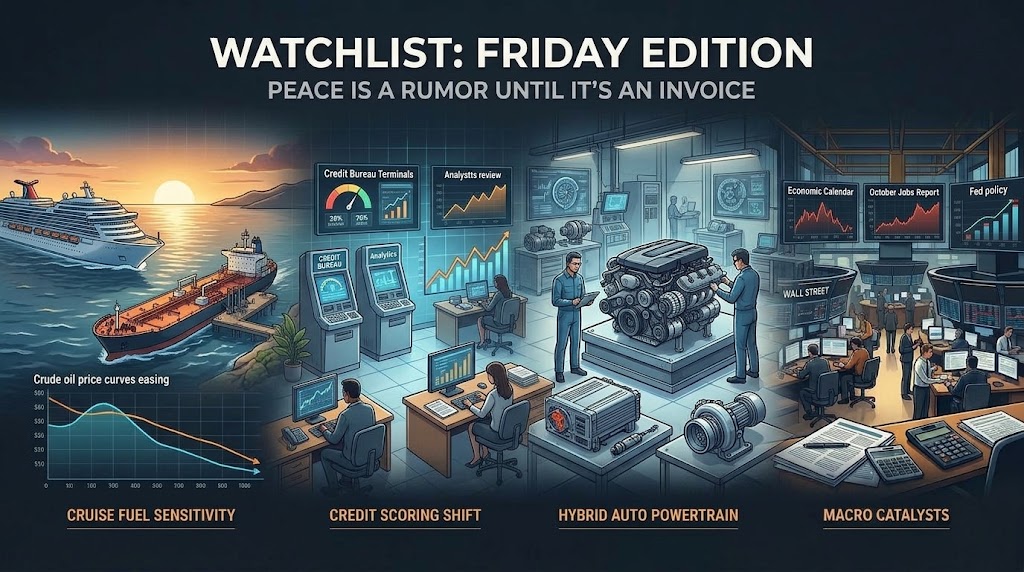
Morning Watchlist: Friday Edition
A quick note from Behind the Markets
We're closing out the week. And the war that has set the price of nearly everything this year spent it writing two very different checks: on Wednesday the oil market started pricing the peace — Brent crude fell almost 10% in a single session — and on Thursday Toyota collected on the war itself, the best day its stock has had in nearly forty years, built on hybrids that expensive gasoline sold by the millions.
Three stories this morning. Three pairings.
Let's get into it.
1) The Barrel Blinked First
Here's what actually happened. Brent opened Wednesday above $104 and closed near $94. Nobody signed anything. The president told the Financial Times there are no immediate plans to strike Iran — "We seem to be getting everything we want" — the vice president allowed that both sides have "certainly made some progress," and a senior Iranian official repeated the offer we flagged on Tuesday: Hormuz reopens within two days if sanctions lift.
That's it. Words moved the barrel ten dollars.
Longtime readers know our scar tissue here. We've watched Alaska Air through three rounds of this movie — and twice the talks collapsed and crude snapped right back. Our entrance hasn't changed: tankers actually moving, fuel falling on the invoice, not in a communiqué. The Revolutionary Guard spent Wednesday claiming four tankers hit mines near the strait — unconfirmed, but not exactly ships moving. Still Watch.
So who banks the markdown without waiting for a signature? The company that never bought the umbrella.
The pairing: Carnival (CCL) — Buy
A quick word on hedging — locking in fuel prices ahead of time, insurance against a spike. Royal Caribbean hedged about 60% of this year's fuel. Norwegian, about half. Carnival's longstanding policy: it doesn't hedge at all. When the war spiked the barrel, that bare skin cost Carnival roughly $500 million and a cut to its full-year guidance — by one analysis of the companies' disclosures, a 10% move in oil swings Carnival's earnings about 4.2%, four times Royal Caribbean's sensitivity.
The same skin works in reverse. Every dollar the barrel sheds lands whole on Carnival's engine-room bill, while the hedged lines keep paying war prices they locked in — an umbrella bought at the top of the storm, carried into the sunshine. And this is no struggling operator praying for relief: Carnival's late-September quarter was a record — record customer deposits, record 2027 booked position, raised guidance, an S&P upgrade to investment grade. With roughly 85% of this year's cabins sold by spring, cheaper fuel doesn't leak into discounts. It lands on the bottom line. At about $29, the stock costs roughly 13 times this year's guided earnings. The S&P 500: 21.
The honest risks: these talks have collapsed twice before, and a third collapse puts the fuel headwind right back; and the debt from the shutdown years, though improving, is still a pile. The kill: Brent back above $110. (Same-aisle note: our Norwegian Watch from October 1st gets the smaller, half-hedged version of this tailwind. Entrance there unchanged.)
2) The Scorekeeper Went Quiet
Wednesday night, Fair Isaac — FICO, the company whose score decides whether America gets a mortgage — reported a record year. Revenue up 27%. Earnings per share up 44%, to $42.99.
Then it declined to forecast next year. At all.
Read the explanation and you understand. Since regulators broke FICO's mortgage-scoring monopoly in September — granting pricing parity to VantageScore, the rival score the three credit bureaus own together — FICO has been negotiating custom, confidential prices with lenders one at a time, and it wouldn't say whether its average price rises or falls next year. It paused its buyback. It cut 15% of its workforce in October. The stock fell about 8% more Thursday morning, roughly two-thirds below its high of a year ago.
We've owned this fight from the bureau side since October 1st, through TransUnion — flagged at $64.40 the week its 99-cent score started the price war. A company that won't publish its prices or its forecast is telling you how the negotiations are going. Still Buy on TransUnion.
But there's a second bureau on the shelf.
The pairing: Equifax (EFX) — Watch
Equifax co-owns VantageScore too — and it owns something neither rival has: The Work Number, the database lenders use to verify income and employment. Two scorekeepers are fighting over whose scoreboard hangs in the gym; Equifax sells the game film either way. Whichever score wins the mortgage, somebody still verifies the paycheck. Third-quarter revenue grew 10%, with earnings ahead of estimates despite a weak U.S. mortgage market.
So why Watch and not Buy? Because the crowd got to the gym first. The stock rose about 32% in October to roughly $185 — near 20 times next year's expected earnings — its own fourth-quarter guide came in below Street estimates, and RBC downgraded it on valuation last week. A Fed hike on December 9th wouldn't help mortgages either. The entrance: a markdown into the $160s, or mortgage volumes finally turning. The kill: Washington cutting the three credit reports per mortgage to two — a third of bureau volume gone by rule, the same risk we flagged on TransUnion.
3) The Best Day in Forty Years
On Thursday in Tokyo, Toyota reported a 34% jump in quarterly operating profit, raised its full-year forecast 15% — to about $25 billion — and roughly doubled its planned shareholder returns for the next five years. The stock rose 17%, its best single day in almost four decades.
Behind the number sits the war, again. Expensive gasoline has been the hybrid's best salesman — when fuel prices surged, the car that burns half as much stopped being a virtue and became arithmetic. Toyota, which never abandoned the hybrid while rivals sprinted to pure electrics, is collecting on a decade of patience. But Toyota, up 17%, in euphoria, isn't our kind of ticket. Walk into the parts aisle instead.
The pairing: BorgWarner (BWA) — Buy
BorgWarner supplies what hybrids are built from — turbochargers for the gas half, motors and inverters for the electric half. A hybrid is a house with both a furnace and a heat pump; BorgWarner is the contractor who bills for both systems. Its electric-products revenue grew 33% last quarter, it beat estimates and raised full-year profit guidance, and its hybrid strength runs through the Japanese automakers — the very companies Toyota just dragged higher.
At about $52, the stock trades near 10 times this year's raised guidance of $5.20 to $5.35 a share — a third below its 52-week high — and the upgrades arrived before Toyota's blowout: Bank of America moved to Buy at $85, Morgan Stanley to Overweight at $95. The honest warts: total sales are roughly flat, because global car production is soft — the hybrid slice is growing inside a pie that isn't. And note the irony of this very page: if Wednesday's oil crash sticks, cheap gasoline cools the hybrid's best sales pitch. The kill: a production downturn, or a pump cheap enough that buyers drift back to plain gasoline.
From the Ledger
Exam grades, as promised. Cirrus Logic, our September 2nd Buy, answered Apple's record quarter with one of its own Wednesday night: revenue of $559.5 million against the roughly $540 million the Street wanted, earnings 28 cents past estimates, another $500 million added to the buyback. It slipped about 2% after hours on a cautious December-quarter guide — a quibble against a thesis just proven. Still Buy.
Expedia, our October 22nd Buy, delivered the proof we named — record $31 billion in bookings, revenue up 12%, full-year guidance raised; the named kill, bookings stalling, never printed — then a light fourth-quarter guide, blamed on the election calendar, took about 7% off the stock premarket Thursday. The bookings are cash; the guide is a mood. Still Buy.
Zoetis, Wednesday's Watch, beat Thursday morning — adjusted earnings of $1.75 against the $1.51 expected, full-year guidance raised — but the beat came from the barn, not the waiting room: livestock grew 7% while U.S. companion-animal sales fell 8%. Our entrance was pet volumes stabilizing. They didn't. Still Watch.
And our memory positions, Micron and Western Digital, were marked down 4% to 5% premarket Thursday on Washington chatter about slowing data-center approvals. Cash deposits and price floors don't expire with a news cycle. Still Buy, both.
Before You Go
That's the watchlist. An unhedged cruise line catching a falling fuel bill, the quiet bureau selling game film to both sides of a score war, and the parts bin behind Toyota's best day in forty years. One theme this morning: peace is a rumor until it's an invoice — own the businesses that get paid either way.
One housekeeping note with a clock on it. At 8:30 this morning — about half an hour before this note reached you — the October jobs report hit the tape; we went to press before the number. The Street expected roughly 60,000 jobs after ADP's stronger 86,000. A hot print all but locks the Fed's December 9th hike, priced above 80% all week; a cold one reopens the argument. Read the wage line before the headline. Brookdale, our October 26th Buy, also reports this morning — grades on both in tomorrow's week-in-review. And gold, back above $4,100 after last week's washout, is creeping toward the re-spike we named as the kill on our Signet call. Watching.
Found this helpful? Share it with others.
Written by Behind The Markets