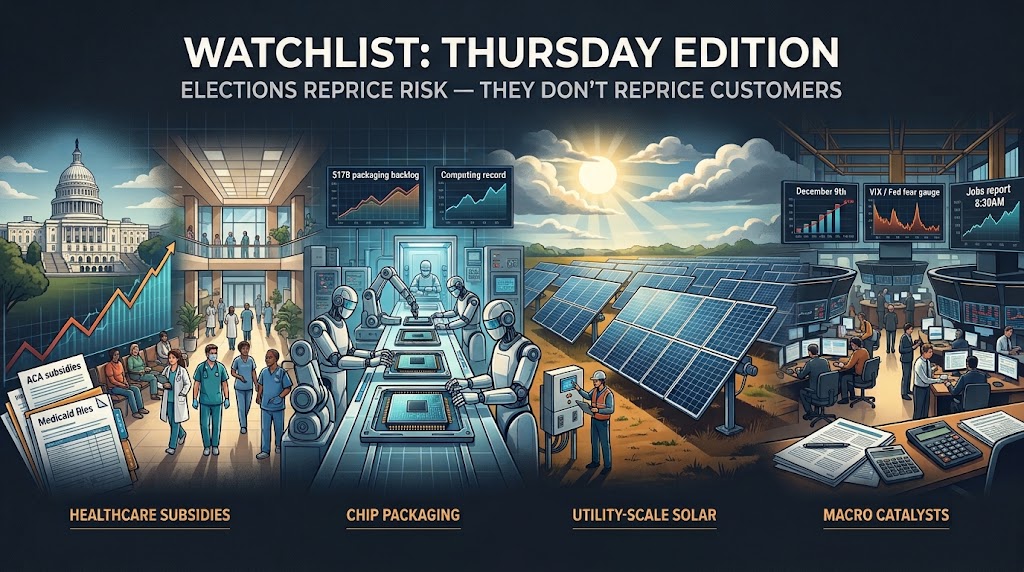
Morning Watchlist: Thursday Edition
A quick note from Behind the Markets
As the first returns pointed to Democrats taking both the House and the Senate, futures sold off — Nasdaq futures down 2% on worries a new Congress would ask expensive questions about the AI buildout. Then the result firmed, the president told CBS he'd "just veto everything," and the market did the math on that word: gridlock. Nothing big passes. Nothing big surprises. By Wednesday morning, Dow futures were up 900 points and Treasurys had rallied.
Elections change the rules. They rarely change the customers. Three stories this morning. Three pairings.
Let's get into it.
1) Washington Changed Hands. The Waiting Room Noticed
Here's what a Democratic Congress has said it wants to do, in plain terms: reverse this year's Medicaid cuts and restore the enhanced Affordable Care Act subsidies that expired at the end of 2025 — a lapse that left marketplace shoppers staring at double-digit premium increases.
The market translated that into tickers before breakfast on Wednesday. Molina Healthcare jumped 6.4% premarket, Centene 4.5%, HCA 3.8%. TD Cowen's read: hospitals and Medicaid insurers just saw their policy risk fall out of the forecast.
So the crowd grabbed the insurance cards. But think about who actually eats the bill when coverage lapses. By law, an emergency room treats everyone who walks in — insured or not.
The pairing: Universal Health Services (UHS) — Buy
UHS runs one of the largest hospital systems in the country — and the largest network of behavioral health facilities in America. The stock has fallen more than 20% this year, to about $172, knocked down most recently by legal reserve charges and — read this part twice — "Medicaid uncertainties." That's the exact uncertainty Tuesday's vote just flipped from headwind to tailwind.
A hospital is a restaurant the law requires to seat every table; subsidies decide how many diners carry a wallet. The business itself is fine — third-quarter revenue of $4.73 billion, earnings of $5.22 a share — and the stock trades near 7 times trailing earnings. The S&P 500: 21 times. The honest risks: a majority is not a signature — a veto can stall the subsidy fix until 2029 — and those liability reserves are real money. The kill: Medicaid supplemental payments getting cut anyway, or the legal tab growing another zero.
Same-aisle note: the pop carries our Tenet, CVS, and Centene calls too. Centene stays a Watch — its October 28th entrance was analyst targets resetting higher, and the sweep may finally do the resetting.
2) The Chipmaker Aced the Exam. The Crowd Checked the Politics.
Tuesday night, AMD reported the quarter the AI trade needed: revenue up 45% to a record $13.4 billion, data center revenue nearly doubling to $8.5 billion, and a fourth-quarter guide of about $17 billion — 66% growth. Remember the worry, after Intel's ugly PC warning, that AMD would catch the same cold? AMD's client segment grew 7%. The flu was Intel's alone.
On Monday we put AMD on Watch rather than pay scalper prices to find out, and our entrance — a panic markdown — never opened. The stock jumped nearly 6% premarket Wednesday instead. That's fine. A miss you can buy is worth more than a beat you have to chase. Still Watch — the ticket costs north of 30 times even next year's hopeful estimates.
But whatever a Democratic Congress thinks of data centers — and Tuesday night's selloff in AI infrastructure names says the crowd is nervous — AMD just signed up to ship $17 billion of silicon in one quarter. Every one of those chips leaves the foundry naked. Somebody has to dress it.
The pairing: Amkor Technology (AMKR) — Watch
Amkor is the largest American provider of chip packaging and testing — the unglamorous final step where bare silicon gets wired, sealed, and proven before it ships. The art world argues about the painters. The frame shop bills them all. And this frame shop is on sale: down about 60% from its February high to roughly $39, near 14 times next year's expected earnings, because its smartphone customers are cutting orders while memory prices squeeze their costs. Its latest report was a genuine miss, with a soft guide to match.
So why look at all? Because inside that miss, Amkor's computing revenue — the AI side of the shop — set a record, and Wall Street's average target sits at $67.50, 73% above the price. The entrance: the AI work growing faster than the phone work shrinks, or a washout into the low $30s that pays us for the slump. The kill: Apple's "unprecedented" memory-cost squeeze turning into real handset order cuts, emptying the biggest room in the shop.
3) The Sun Came Out Blue
Wednesday's other premarket rally was green energy — bought, it must be said, with a dartboard. First Solar up 6.6%. Sunrun up 6%. Plug Power up 10% at one point, despite years of losses. SolarEdge spiked, then fell 14%. Barclays supplied the sober version: the sweep "potentially reduces the risk of further political interference with renewable energy incentives."
When the crowd buys a whole sector on hope, find the member that never needed the hope.
The pairing: Nextpower (NXT) — Buy
Nextpower — formerly Nextracker — makes the trackers that tilt utility-scale solar panels to follow the sun, the sunflower's trick sold as hardware, squeezing as much as a quarter more electricity from the same panel. Eight days ago, before anyone voted, it reported record revenue of $1.1 billion, record bookings, a backlog above $6 billion, and raised its full-year guidance — with over $1 billion of cash and no debt. The stock popped 19% on that report, and at about $91 it still sits 44% below last fall's high, at roughly 19 times this year's guided earnings. The S&P 500: 21 — for a company that just grew revenue 22%.
The crowd bought the sector on Wednesday; the backlog was signed before the polls opened. The honest warts: gross margins slipped almost five points last quarter, a meaningful slice of earnings comes from manufacturing tax credits — a policy football that gridlock now protects but won't grow — and a patent lawsuit is pending. The kill: margins compressing again, or project delays stretching that backlog's timeline.
From the Ledger
The week's other exams, as promised. Tuesday night, Jackson Financial passed again: adjusted operating earnings of about $7.55 a share against the $7.24 the Street wanted, record third-quarter retail annuity sales up 22%, and a $1 billion boost to the buyback. The quarter the short sellers keep saying can't happen keeps happening. Still Buy. Modine got a B-minus: revenue up 35%, data-center sales up 95%, core outlook raised — but data-center margins, the wart we flagged, recovered only to 15.4% against the roughly 20% promised, and the market took the shares near $123, under our $136 flag. The margin story gets its deadline at the November 18th Investor Day. Still Buy.
Wednesday morning brought McDonald's, carrying our Lamb Weston fry thesis: U.S. comparable sales slipped 0.2% with guest counts negative — warming our named kill — but trends improved through the quarter after the "intervention on value." A value war is fry volume whoever wins, so LW stays a Buy with traffic now the formal watch item. CVS beat and raised again — at least $8.20 this year. Still Buy. And Brent slid near $104 while Washington weighs the peace plan; our Alaska entrance — fuel falling on the invoice, not in a communiqué — stays closed.
Before You Go
That's the watchlist. A hospital at 7 times earnings on the day its biggest uncertainty flipped sides, the frame shop behind a $17 billion chip quarter at a 60% markdown, and a solar supplier whose $6 billion backlog predates the rally. One theme this morning: elections reprice risk — they don't reprice customers.
The calendar stays full. Zoetis hands in its paper this morning — our Wednesday Watch, entrance already named — and Brookdale reports today too. Cirrus Logic and Expedia reported Wednesday night, after we went to press; we'll grade those tomorrow. And ADP counted 86,000 new private-sector jobs for October, a touch better than expected — the appetizer before tomorrow's 8:30 AM jobs report, which all but settles the Fed's December 9th decision.
Found this helpful? Share it with others.
Written by Behind The Markets