Key Bullet Points:
- AMD (AMD) crashed 7.9% to $455.89 on Tuesday — its worst single-day drop of the year — as a two-day semiconductor bloodbath wiped out hundreds of billions in market value: Micron fell 9.3%, Lam Research sank 9.8%, Applied Materials lost 8.1%, and Intel dropped 5.7%
- The catalyst: a Chinese company called Shanghai Aishengna has begun manufacturing immersion deep ultraviolet (DUV) lithography machines, with first units due to be delivered this year to SMIC, Hua Hong, and CXMT — threatening the Western stranglehold on chipmaking equipment that has underpinned semiconductor valuations for a decade
- ASML, the Dutch giant that has monopolized advanced lithography, crashed so violently on Monday that the Amsterdam stock exchange halted trading — and the stock fell another 4.5% on Tuesday to $1,581 - Nvidia held flat at $196.78 (+0.14%) while every other chip stock imploded — the market is now saying there's exactly one AI chip company worth owning, and even that conviction gets tested tonight when Microsoft and Meta report earnings
- Oil cratered for a second straight day as the U.S.-Iran ceasefire held through a third night, with Brent crude plunging to $84.91 (-3.9%) — now down more than 12% in two sessions — while the Federal Reserve wraps up its two-day meeting today and is expected to hold rates steady
The Chip Selloff Turned Into a Chip Purge
On Monday, semiconductor stocks fell. On Tuesday, they collapsed.
AMD dropped 7.9% to $455.89 on volume that nearly doubled its average. Micron cratered 9.3% to $816, hitting $789 intraday. Lam Research — the biggest loser among the major names — sank 9.8%. Applied Materials fell 8.1%. Intel lost 5.7%. Coherent dropped 8.7%.
And then there was Nvidia. Up 0.14%. Flat. Untouched. While every other chip stock on the Nasdaq hemorrhaged market cap, the AI king didn't even blink.
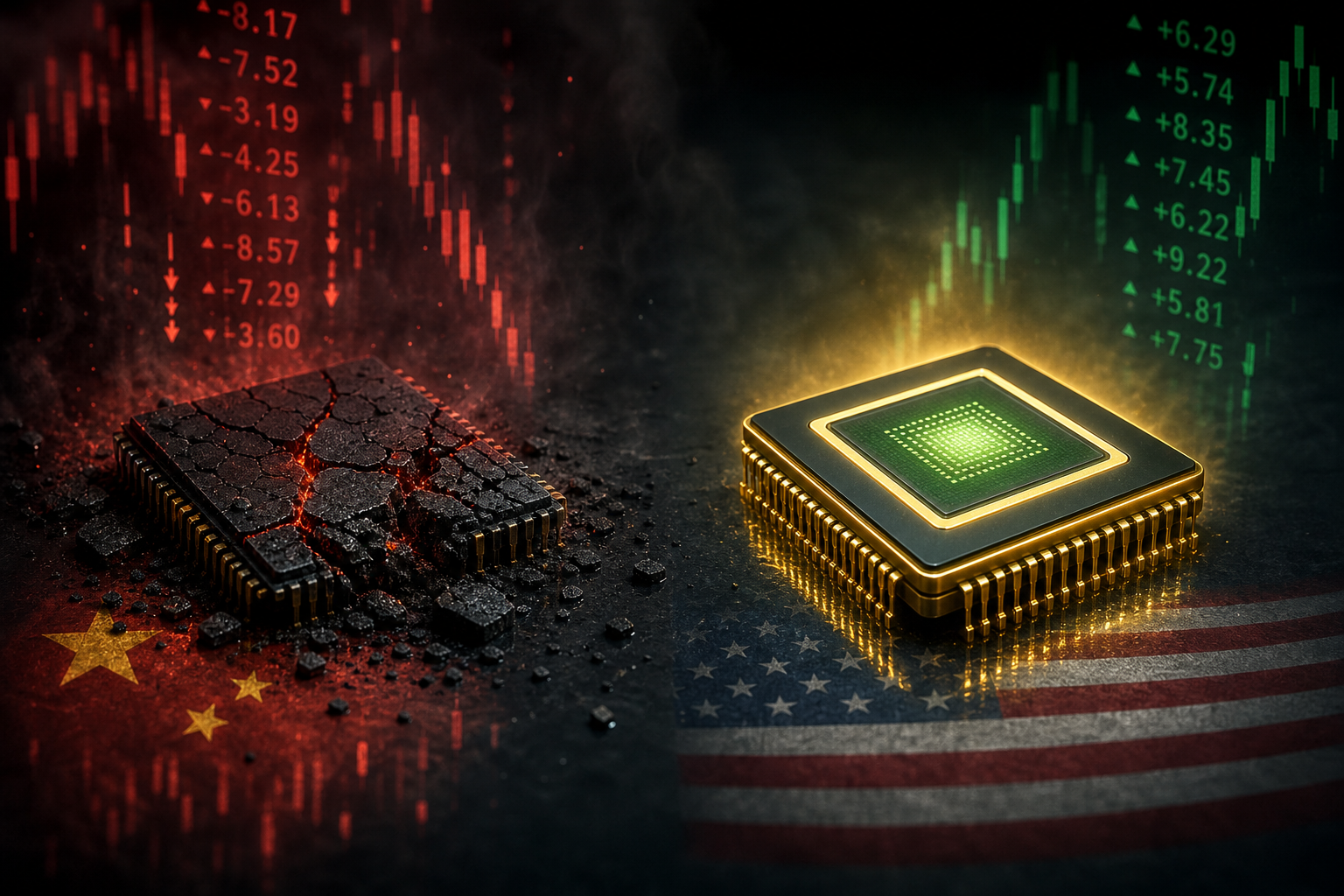
The divergence is staggering. In the span of 48 hours, the semiconductor sector has split into two worlds: Nvidia, and everything else. The market's "split screen" has never been more visible.
China Just Built the Machine the West Said It Couldn't
The trigger for Day Two of the selloff wasn't earnings. It wasn't the Fed. It was a headline out of China that landed like a bomb on every chip equipment stock on earth.
A Chinese company called Shanghai Aishengna has begun commercially manufacturing immersion deep ultraviolet (DUV) lithography machines — the most advanced chipmaking tools currently available to Chinese manufacturers. According to The Information, the first units are due for delivery this year to China's biggest chip foundries: SMIC, Hua Hong Semiconductor, and memory-chip maker ChangXin Memory Technologies (CXMT).
This is the machine that ASML has monopolized for decades. On Monday, ASML's stock crashed so hard that the Amsterdam exchange halted trading. On Tuesday, it fell another 4.5% to $1,581. Bank of America called the selloff an "overreaction." The market didn't care.
For years, Western export controls were supposed to keep China a generation behind in chipmaking. That assumption is now being tested in real time. If Chinese fabs can source DUV tools domestically, the $200 billion in equipment orders that ASML, Applied Materials, Lam Research, and their peers have been counting on from Western governments suddenly faces competition from a producer with no export restrictions and dramatically lower costs.
The impact hit memory stocks hardest. CXMT — China's leading DRAM manufacturer — getting access to domestic DUV tools is a direct competitive threat to Micron's bread-and-butter business. Micron's 9.3% drop was the market pricing in a China shock that looks less like a crash and more like a slow erosion of demand.
The Rotation Into One Stock
What makes Tuesday's selloff so unusual isn't the magnitude — it's the selectivity.
AMD fell 8% and Nvidia didn't move. Both companies make GPUs. Both are critical to AI infrastructure. Both sell into the same data centers. But the market has decided that in a world where Chinese competitors are closing the gap and AI spending is being scrutinized, only the company with the most dominant market position survives.
Nvidia controls roughly 80% of the AI GPU market. AMD, despite strong growth, sits at around 12%. In a rising tide, that spread didn't matter. In a falling one, it's everything.
This is the AI trade narrowing to its logical extreme. When investors are confident, they buy the whole sector. When they're scared, they buy the one name they can't afford to be wrong about — and sell everything else to fund the position. Tuesday was the purest expression of that dynamic this cycle has produced.
The Oil Collapse Accelerates
While chips burned, oil continued its stunning reversal. Brent crude fell another 3.9% on Tuesday to $84.91 a barrel, with West Texas Intermediate dropping 3.3% to $79.87. In just two sessions, Brent has plunged more than 12% from Friday's close above $97.
The U.S.-Iran ceasefire held through a third consecutive night with no American strikes. Trump signaled fresh diplomatic talks. The immediate supply disruption that had pushed oil toward $100 is rapidly being unwound. The 10-year Treasury yield fell to 4.598% — its third straight daily decline — as inflation fears eased alongside crude prices.
But the mines planted in the Strait of Hormuz remain. Iran and Oman report only "some progress" on navigation safety. The risk hasn't disappeared — it's just been repriced.
The Night That Decides Everything
Tonight is the most consequential 12 hours for markets since earnings season began.
The Fed delivers its rate decision this afternoon. Chair Kevin Warsh is widely expected to hold rates steady — CNBC reported three specific reasons Warsh won't hike — but the language will matter enormously. Markets are pricing an 80% probability of a September rate hike. If Warsh sounds even slightly more hawkish than expected, September goes from "likely" to "locked."
Microsoft reports fiscal Q4 after the close. Wall Street expects revenue around $68 billion. Azure cloud growth and AI capital expenditure guidance are the numbers that will move the market. If Microsoft signals even a modest pullback in AI spending, every chip stock — including Nvidia — reopens lower tomorrow.
Meta reports Q2 earnings the same evening. Consensus puts EPS around $7.18 with revenue near $60.2 billion. Meta has been among the most aggressive AI spenders on the planet. Whether it accelerates or decelerates that spending will tell the market whether the AI infrastructure buildout still has legs.
Then Thursday: Amazon reports (consensus EPS $1.81), followed 30 minutes later by Apple (consensus EPS $1.88). AWS growth is the key swing factor for Amazon; iPhone revenue and rising component costs are the focus for Apple.
AMD just got priced like the AI trade is over for everyone except Nvidia. Tonight will tell us whether even Nvidia is safe.
Found this helpful? Share it with others.