Morning Watchlist: Sunday Edition
The Week in Review A quick note from Behind the Markets
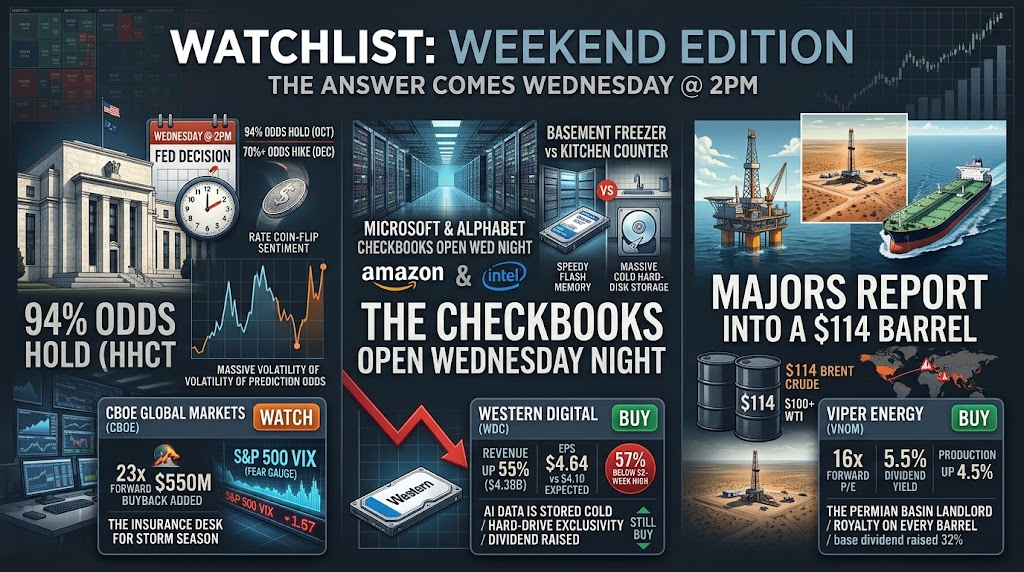
Wednesday at 2 PM, the Federal Reserve decides. Wednesday night, Microsoft and Alphabet open the biggest checkbooks in the AI argument. Thursday brings Amazon, Intel, the first official read on third-quarter growth, and the inflation gauge the Fed actually watches. And Friday, Exxon and Chevron close the week reporting into a barrel that cost $114 on Friday morning — repriced by a shooting war.
Three stories this morning. Three pairings.
Let's get into it.
1) The Answer Comes Wednesday at 2pm
Start with how violently the market has changed its mind about this one meeting. In late August, futures put the odds of an October rate hike near 9%. By late September, above 70%. By October 9th, back under 20%. Then September's inflation report landed hot — 3.7%, gasoline up 9% in a month — and the odds jumped past 40%. As of Friday morning, prediction markets had swung all the way back: roughly 94% for a hold, with the next hike priced at better-than-70% odds for December.
Eight weeks. Five different answers. Same economy.
There's a reason the market keeps flinching. The Fed already hiked in September, to 3.75%–4.00%, and this meeting ends six days before the midterm elections — the Fed has raised rates within a week of a national election exactly once since 1990. So the likely script is a hold, a hawkish press conference from Chair Warsh at 2:30, and every sentence parsed for December. Then Thursday grades the whole debate: the first estimate of third-quarter GDP is expected near 3.2%, and September's core PCE — the Fed's preferred inflation measure — is expected at 3.1%, drifting the wrong way. A strong economy and sticky inflation is exactly the mix that keeps this argument running into winter.
We're not going to pretend we know what Warsh says. We'd rather look at who gets paid while everyone argues.
The pairing: Cboe Global Markets (CBOE) — Watch
Cboe runs the exchanges where investors buy insurance against weeks like this one — it owns the S&P 500 options complex and the VIX, the market's fear gauge. When nobody knows the answer, everybody pays to hedge the question. Trailing earnings per share are up more than 50% over the past year, the company just added $550 million to its buyback, and on Thursday — while the chip aisle bled — the stock rose almost 3% to $327.72. It reports its own earnings Friday morning, the day after the Fed and two days after the megacaps.
So why Watch and not Buy? Price and calendar. At roughly 23 times next year's expected earnings against the S&P's 21, the insurance desk trades at a premium during flood season — and the calendar that justifies it empties fast: Fed Wednesday, midterms the following Tuesday. Volatility franchises get marked down the moment the weather clears. The average analyst target actually sits below the price.
The entrance: a post-election calm that knocks the stock back toward $300 — buy the umbrella shop in the dry week, not the storm. The kill: a long, genuine calm that shrinks hedging volumes for quarters, not days.
2) The Checkbooks Open Wednesday Night
October's central argument — who pays for the AI build-out — gets its widest data set yet this week. Microsoft and Alphabet report Wednesday after the close, Amazon and Intel on Thursday, and the memory-and-storage aisle takes its exams in between: SK hynix and Seagate on Tuesday, Sandisk on Thursday.
Last week taught us how this market grades perfect papers. Five giants beat on Wednesday night; the Nasdaq fell anyway. Which is why we're drawn to the student who already handed in next week's exam.
On Thursday, Western Digital reported a quarter that would have been a fantasy two years ago: revenue of $4.38 billion, up 55%, earnings of $4.64 a share against $4.10 expected — up 161% — and guidance for next quarter of $5.80 a share with gross margins of 60 to 61%. Bloomberg's headline noted it raised its dividend too. And by Friday morning the stock traded near $345 — down for the week with the rest of the aisle, and nearly 57% below its 52-week high.
Here's the setup the crowd is missing while it watches flash memory prices go vertical (Intel's CEO says memory now costs five to seven times its old price). Western Digital spun off its flash business — that's Sandisk — last year. What's left is the hard-drive company. Flash is the kitchen counter: fast, expensive, always full. Hard drives are the basement freezer — slow, cheap by the pound, and where everything actually gets kept. AI cooks all day and throws nothing out. Every chat log, every video model, every training set ends up stored cold, and only two companies on Earth make the freezer at scale.
The pairing: Western Digital (WDC) — Buy
After Thursday's report, the stock costs roughly 13 times trailing earnings — with earnings still accelerating. The S&P 500: 21 times. The average analyst target sits near $668, almost double Friday morning's price; even the bear who just cut a target landed at $625.
The honest risks: if Microsoft, Alphabet, or Amazon guide capital spending down this week, the whole storage aisle gets marked down with them; memory is a cycle, and cycles end badly; and that $800 high is a reminder of what the crowd once paid — multiples can keep compressing even while earnings grow. It's the same markdown that hit Lam, our Friday flip, and we're answering it the same way.
3) The Majors Report Into a $114 Barrel
The quietest assumption in most portfolios — that oil stays polite — had a loud week. By Friday morning: Iran's Revolutionary Guard claimed strikes on tankers in the Gulf, with state TV claiming seven vessels hit (unverified by the Associated Press); Saudi Aramco told staff to evacuate its Dhahran headquarters; a second U.S. carrier was reported heading to the region; and President Trump accused Iran of driving up oil prices before the midterms. Brent traded near $114 Friday morning, up about $6 on the week, with WTI back above $100.
Exxon and Chevron report Friday, and the question isn't their profits — at these prices, that math does itself. The question is what they do with the windfall: buy back stock, or drill. Either answer is good news for one kind of company.
The pairing: Viper Energy (VNOM) — Buy
Viper doesn't drill anything. It owns the mineral rights under a large swath of the Permian Basin in Texas — the landlord, not the farmer. Operators, led by its parent Diamondback Energy, pay for the rigs, the crews, and the fuel; Viper collects a royalty on every barrel that comes up. The farmer buys seed and prays for weather. The landlord gets a share of the harvest in any weather. And this landlord's fields are in West Texas — about as far from Hormuz as oil gets.
The rent is already rising: production grew 4.5% last quarter to roughly 65,000 barrels a day, the base dividend was just raised 32%, and the yield sits near 5.5% at Thursday's $45.35 close — about 16 times next year's expected earnings, with twenty analysts averaging a $55 target.
The honest risks: the payout floats with oil — this is not a bond — and foreign-minister talks in Istanbul could shake hands any weekend and take the war premium out of the barrel by Monday. We'd still own the landlord at $90 crude; we just wouldn't expect the same rent. The kill: a durable ceasefire plus a Permian slowdown, shrinking both the price and the barrels.
Before You Go
That's the watchlist: the house that sells insurance against Wednesday, the freezer aisle behind the AI kitchen, and the landlord under the oil patch. One theme, as always: when the week is full of loud questions, own whoever gets paid regardless of the answers.
Our own report cards stack up fast. Brazil votes today — by Monday morning you'll know whether StoneCo's entrance printed, win or washout. Verizon, our October 12th Buy, reports Monday. Freeport-McMoRan Tuesday, Flex Wednesday, and Thursday is the pile-up: Belden, FTI Consulting, Tenet, and PBF — the referee's whistle on the refinery spread.
The week's biggest moment is Wednesday afternoon, and it comes in two acts: the Fed at 2 PM, Warsh at 2:30, and Microsoft and Alphabet after the close — the loudest afternoon of the quarter. Thursday morning's GDP and inflation numbers will tell you whether the economy noticed any of it.
Have a wonderful Sunday.
Found this helpful? Share it with others.
Written by Behind The Markets