Morning Watchlist: Monday Edition
A quick note from Behind the Markets
It's the start of another week, and everyone has already decided which day of it matters: Wednesday — the Fed at 2, the megacaps at 4. The crowd can have Wednesday. We're more interested in Friday's strangest fact, and in two quiet reports landing tonight, after the close.
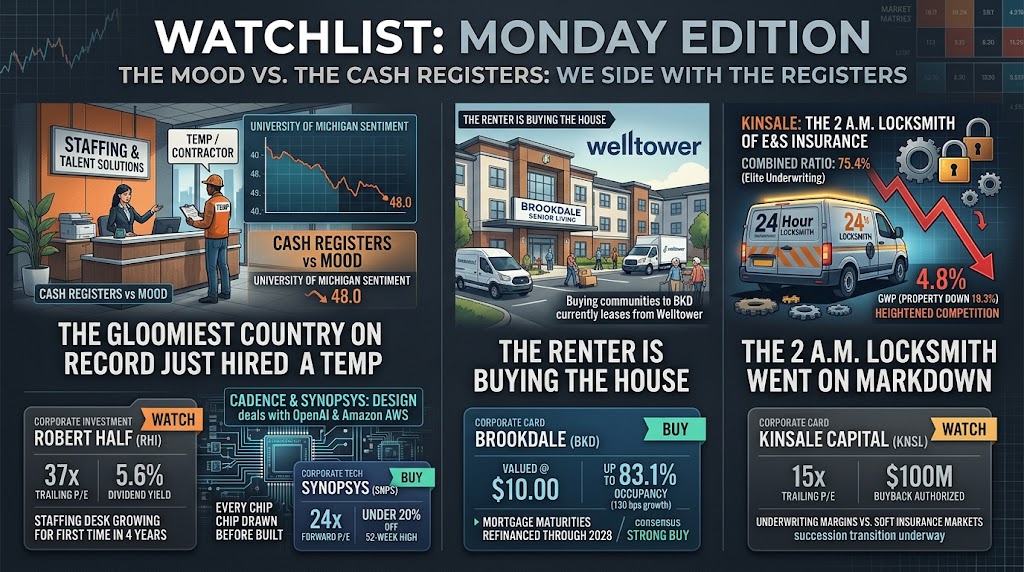
The strange fact: on Friday morning, the University of Michigan said consumer sentiment fell to 48.0, the second-lowest reading in the survey's history. The same morning, American Express said it would cut about 4,000 jobs. And the same morning, the company whose entire business is hiring — Robert Half — jumped 13%, because its staffing desk just grew for the first time in four years.
When the mood and the cash registers disagree, we side with the registers.
Four stories this morning. Four pairings.
Let's get into it.
1) The Gloomiest Country on Record Just Hired a Temp
Start with the gloom, because it's real: households in that same survey are bracing for 4.7% inflation over the next year, and American Express is cutting roughly 5% of its 77,000 employees, with a $336 million charge to do it. But read the fine print — AmEx beat profit expectations and raised its full-year forecast. The cuts aren't distress. They're belt-tightening by a business doing fine.
Then Thursday night, Robert Half reported: revenue above the midpoint of its own guidance, earnings of 49 cents a share against 47 expected, up 14% from a year ago. The detail that matters: its talent solutions business — the staffing desk — grew 2%, its first growth since 2022, with U.S. staffing up 3%.
Here's why that small number is bigger than it looks. Businesses rent before they buy. A company unsure about the future hires a contractor before it signs a full-timer, so the temp desk feels every turn in the job market first — in both directions. The desk that cut first just started growing again.
The pairing: Robert Half (RHI) — Watch
So why not buy the turn? The stock jumped 13% Friday morning, to $42.58, and we don't chase 13% pops. At that price it costs about 37 times trailing earnings — nearly double its five-year norm of around 20 — because those earnings sit at the bottom of the cycle. The 5.6% dividend currently costs roughly twice what the company earns: a bet management is making on the recovery, and we'd like one more quarter of evidence before making it with them. The entrance: permanent placements following the temps at the next print, or a drift back toward Thursday's $37.68. The kill: the turn proves a head fake and the dividend math forces a cut.
2) Every Chip Gets Drawn Before It Gets Built
Wall Street's AI argument right now is about financing — who borrows what to build which data center. Step past the argument and look at the work orders: Meta just put its AI infrastructure budget at $135 to $145 billion, Broadcom is assembling $60 billion of debt to build custom chips for Anthropic, and Tesla spent Wednesday night talking up its own chip factories. Everyone wants their own silicon now. Not Nvidia's — theirs.
And every one of those chips, whoever's name ends up on it, is designed in software from effectively two companies: Cadence and Synopsys. In a building boom, the developers compete; the architects don't. Every tower in the skyline starts at a drafting table — and in chips, there are only two tables.
Cadence reports tonight after the close — the Street expects $1.61 a share, up from $1.51 a year ago. But the table we'd rather own is the other one.
The pairing: Synopsys (SNPS) — Buy
Three weeks ago, Synopsys raised its forecast past expectations and announced design deals with OpenAI and Amazon Web Services; the stock jumped 13% in a day. The AI selloff has since dragged it back to $431.39 Friday morning — about 20% below its 52-week high — even as the company launched a $1 billion buyback and Morgan Stanley raised its target to $574. The average target sits near $584.
At about 24 times next year's expected earnings — the S&P 500: 21 — you're paying a modest premium for half of a two-table town. (Footnote: the headline 46% revenue growth is flattered by the Ansys acquisition.) The risks: Cadence stumbles tonight and the aisle gets marked down together; the China file is a live wire (Nikkei reports Synopsys exploring work with Chinese AI labs); and if the capex argument becomes capex cuts — Tesla just trimmed its own budget 20% — even the architects feel it.
3) The Renter Is Buying the House
Tonight's other quiet report is Welltower, the giant of senior-housing real estate. The Street expects about $1.64 a share of funds from operations — a property company's version of earnings — up from $1.34 a year ago. Last reported quarter: occupancy of 89.4%, senior-housing income up more than 20% for the fifteenth straight quarter, a 15% dividend raise. The market knows: near $238, the stock is up about 29% this year and costs roughly 37 times this year's guided funds from operations.
We love the story. We won't pay 37 times for it — especially since it isn't a secret, it's arithmetic. Everyone who will turn 80 in 2031 is 75 today. No forecast required.
So look one step down, at a company that actually runs the buildings. Brookdale Senior Living is one of the country's largest senior-living operators — a $2.4 billion market cap, a stock around $10. On October 13th, Brookdale completed the purchase of 17 of its communities and agreed to buy 30 more that it currently leases — from Welltower itself. The renter is buying the house. Renters only do that when they can see the neighborhood filling up: Brookdale's September occupancy of 83.1% is up 130 basis points in a year, with six full points of runway before it reaches Welltower's average.
The turnaround math is moving. Last quarter's earnings of 10 cents a share beat the 4 cents expected, the full-year guide was held at $502 to $516 million of adjusted EBITDA (profit before the accountants subtract interest, taxes, and depreciation), and every mortgage maturity is refinanced through 2028. The analyst consensus is Strong Buy with an average target of $19.08 — nearly double — and even Barclays, which just trimmed its target to $17, kept its Overweight.
The pairing: Brookdale Senior Living (BKD) — Buy
The honest risks: Brookdale still loses money at the bottom line — about $138 million over the past year — the debt is heavy, and the industry's occupancy gains are decelerating; even Welltower's year-over-year improvement has shrunk for four straight quarters. The exam is November 5th. The kill: occupancy stalls in the mid-80s while rate growth fades, leaving new mortgages waiting on residents who don't arrive.
4) The 2 A.M. Locksmith Went on Markdown
Kinsale Capital is the insurer you call when nobody else picks up. It writes excess-and-surplus policies — the odd, hard-to-place risks that standard carriers decline — and it prices like the only locksmith awake at 2 a.m.: you pay his rate, because there's no one else to call.
Thursday night, Kinsale beat again: operating earnings of $5.70 a share against $5.11 expected, investment income up 17.5%, a $100 million buyback, and a combined ratio of 75.4% — meaning claims and costs ate just 75 cents of every premium dollar. (Under 100 is an underwriting profit; 75 is elite.) The shares fell anyway — down about 6% in Friday's premarket from Thursday's close near $391 — with headlines blaming the CFO's retirement.
A retirement dated March 2027, with the successor already named, is not news. It's a transition plan. The real news sat lower in the release: gross written premiums fell 4.8%, with property premiums down 19.3% on what the company called heightened competition. More locksmiths are moving to town.
The pairing: Kinsale Capital (KNSL) — Watch
Here's the tension. Fifteen times trailing earnings for the best underwriting margins in the business is a tempting ticket — this company grew revenue from $839 million to $2 billion in four years. But shrinking premiums are how soft insurance markets introduce themselves, and most of Wall Street is unconvinced: 1 Buy, 9 Hold, 2 Sell, with the average target below the price. The entrance: property pricing stabilizing while casualty holds, or a markdown into the low $300s that pays us for the uncertainty. The kill: a genuine multi-year soft market, where even great underwriters shrink.
Before You Go
That's the watchlist. The temp desk turned while the country hit peak gloom, every custom chip runs through one of two drafting tables, the renter in senior housing is buying the house, and the 2 a.m. locksmith went on markdown. One theme this morning: the crowd reads the mood; we read the registers. Two of these stories hand in homework tonight — Cadence and Welltower, after the close — while everybody waits for Wednesday.
Have a wonderful day.
Found this helpful? Share it with others.
Written by Behind The Markets