Key Bullet Points:
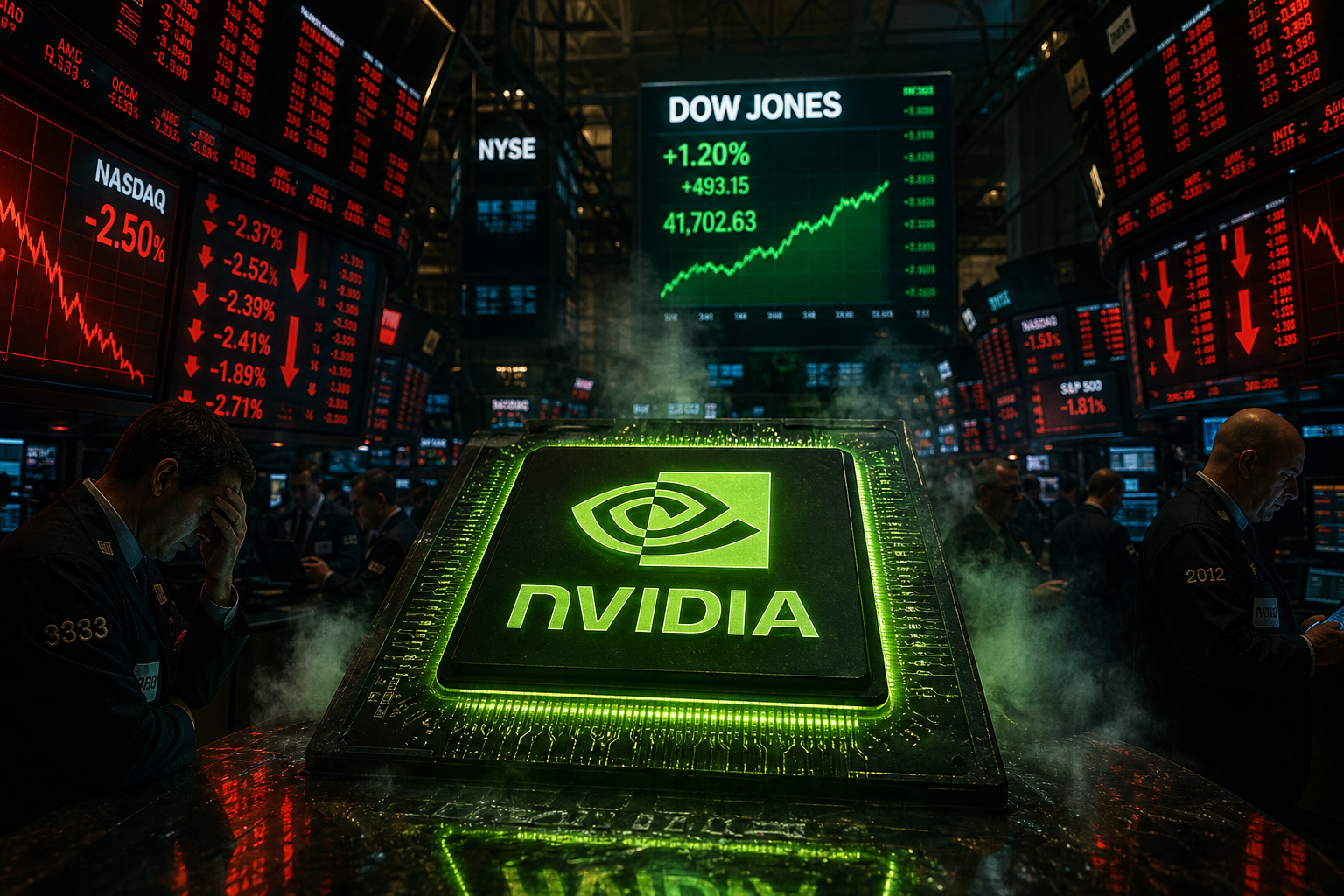
- Nvidia (NVDA) plunged 5.1% to $196.35 on Monday — falling below $200 for the first time since May — even as the Dow rallied 557 points and the S&P 500 gained 0.7% after the U.S. and Iran paused hostilities over the weekend
- Oil cratered more than 9% on the ceasefire news, with Brent crude plunging from above $100 to as low as $87.59, its sharpest single-day decline of the year — but an oil tanker exploded in the Strait of Hormuz on Sunday after striking a naval mine, a reminder that the war's damage is far from over
- The semiconductor selloff accelerated despite the broader rally, with Micron falling 4.9%, SanDisk crashing 11.2%, and Nvidia dropping on 101 million shares of volume — more than double its average — as investors dumped chip stocks ahead of mega-cap earnings this week
- Microsoft and Meta report earnings Wednesday; Amazon and Apple report Thursday — their combined AI capital expenditure guidance will determine whether Nvidia's $3 trillion valuation is justified or a house of cards
- The Federal Reserve begins its two-day policy meeting today, with markets now pricing a 33% chance of a rate hike this month and an 80% probability of one by September — but Monday's weak durable goods data (+0.3% vs. 1.6% expected) adds a new wrinkle to the growth-versus-inflation debate
The AI King Is Bleeding — And Nobody on Wall Street Is Buying the Dip
Every signal on Monday said "buy." The United States and Iran paused hostilities. Oil prices cratered. The Dow surged 557 points. Bond yields fell. The geopolitical risk that had suffocated markets for two weeks suddenly lifted.
And Nvidia — the stock that built the AI boom — dropped 5%.
Nvidia closed at $196.35, falling below $200 for the first time since May, on 101 million shares of volume — more than double its daily average. The stock opened at $208 and never recovered, grinding lower all day while the Dow celebrated the ceasefire. By the close, Nvidia had shed more than $25 billion in market cap on a day when nearly everything else went up.
That kind of divergence doesn't happen by accident. It's the kind of signal that separates a pullback from something far more serious.
The Ceasefire That Broke the Oil Trade
The catalyst for Monday's broad rally was dramatic. Over the weekend, the United States suspended its 13-night airstrike campaign against Iran to allow for diplomacy and assess its munitions stocks. A senior Iranian official confirmed Tehran would also halt retaliatory strikes as long as the American pause continued.
Oil prices responded immediately. Brent crude plunged more than 9% to $87.59 a barrel at its lowest point — erasing nearly the entire rally that had pushed prices above $100 last week. By Monday afternoon, Brent had settled around $90.60, still down over 6% for the day. It was the sharpest single-session oil decline of 2026.
But the relief came with an asterisk. On Sunday, an oil tanker exploded in the Strait of Hormuz after striking one of the naval mines Iran planted during its monthslong campaign to disrupt commercial shipping. Iran and Oman reported only "some progress" in talks over navigation safety — and no one knows exactly how many mines remain. The ceasefire may have paused the bombing, but the strait is still mined.
The 10-year Treasury yield dipped to 4.65%, reflecting eased inflation fears from falling oil. But markets still price an 80% probability of a Fed rate hike by September. The danger hasn't gone away — it's just changed shape.
The Chip Selloff That Defied the Rally
If oil's collapse explained Monday's rally, it also exposed an uncomfortable truth: the semiconductor trade is breaking independently of the macro picture.
Nvidia fell 5.1%. Micron dropped 4.9% to $884. SanDisk crashed 11.2%. The Technology Equipment sector fell 2.3% even as the broader market surged. On a day when literally every macro signal pointed higher, chip stocks went the opposite direction.
This isn't an isolated event. Marvell Technology lost a third of its value in thirty days. The chip selloff has now erased over $1 trillion in semiconductor market cap since mid-June. What started as profit-taking in smaller names has escalated into a systematic rotation out of the entire AI hardware complex — and now it's reached the king.
The logic is simple: if the companies spending hundreds of billions on AI infrastructure start signaling that the returns aren't materializing fast enough, Nvidia is the stock with the most to lose. And those companies start reporting in less than 48 hours.
The 48 Hours That Will Define the Rest of 2026
This week's earnings calendar is the most consequential since the AI boom began:
Wednesday, July 29: Microsoft reports fiscal Q4 after the close. Wall Street expects revenue around $68 billion and will be laser-focused on Azure cloud growth and AI capital expenditure. The same evening, Meta reports Q2 earnings — consensus estimates EPS around $7.13–$7.23 with revenue near $60.2 billion. Meta's AI spending has been among the most aggressive of any company on earth.
Also Wednesday: The Federal Reserve delivers its rate decision. The central bank is expected to hold rates unchanged, but the language from Chair Kevin Warsh will set the tone for September. Monday's durable goods report — which came in at just +0.3% versus the 1.6% Wall Street expected — adds new evidence of a slowing economy. If the Fed sounds hawkish while manufacturing is weakening, the stagflation narrative gets louder.
Thursday, July 30: Amazon reports after the close, with consensus EPS of $1.81 and AWS growth as the key swing factor. Thirty minutes later, Apple reports its fiscal Q3 — consensus EPS of $1.88 — with investors watching iPhone revenue and margin pressure from rising component costs.
Each of these four companies is a major Nvidia customer. Their combined AI capital expenditure guidance will tell the market whether the infrastructure buildout is accelerating, plateauing, or about to slow. Data centers are the new steel mills — and how much these companies plan to keep building will move Nvidia more than any Fed decision or geopolitical headline.
The Question Nobody Is Answering
Nvidia is still up over the past year. Its data center business generated $51 billion in a single quarter. The company dominates GPU computing so thoroughly that its closest competitor isn't within a factor of five. By every fundamental measure, Nvidia should be untouchable.
But everyone wants the AI story — nobody wants to do the AI math. And the math is getting harder to ignore. The stock fell 5% on a day the market rallied 557 points. It fell below $200. Volume doubled. And the biggest buyers of Nvidia's chips are about to tell the world how much more they plan to spend — or not.
SpaceX hit another post-IPO low on Monday, falling to $108.66 intraday — now down 48% from its all-time high and 12% below its IPO price. Tesla slid another 1.8% to $307, extending its losses to 18% in a single week. The stocks that defined this era of market excess are all moving in the same direction.
Wednesday will tell us whether anyone was paying attention.
Found this helpful? Share it with others.