Key Bullet Points:
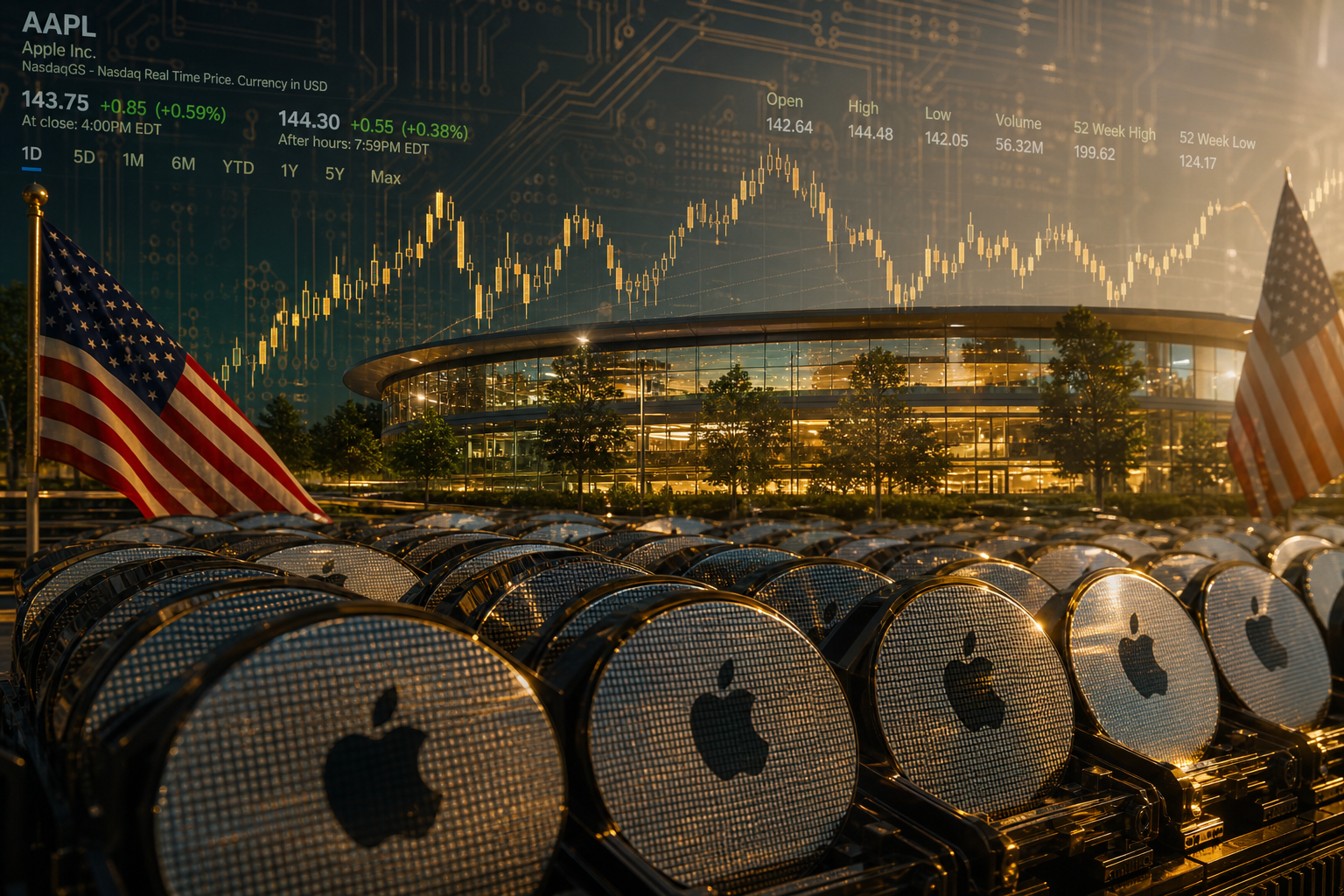
- Apple announced a deal worth more than $30 billion with Broadcom to design and produce over 15 billion custom chips on American soil — the largest U.S. manufacturing commitment in the company's history — and the stock rose more than 1% on a day when nearly everything else was bleeding red
- President Trump declared the Iran ceasefire "over" at the NATO summit in Ankara after U.S. and Iranian forces traded strikes near the Strait of Hormuz, sending oil prices surging 7% — Brent crude hit $79.68 and WTI blasted past $75 — while the Dow cratered 500 points before partially recovering
- The Fed released the FOMC minutes from Chairman Warsh's first meeting, revealing a committee deeply split — 9 members favoring rate hikes versus 9 preferring to hold or cut — with Warsh himself refusing to submit a dot plot projection, leaving Wall Street guessing about his true policy leanings
- Energy stocks surged on the oil spike — Occidental Petroleum jumped 5.9%, Devon Energy climbed 5.1%, and ConocoPhillips gained 4.7% — while chip stocks continued their multi-day bleed, with Intel crashing 9.7% as foundry doubts piled onto the Samsung-triggered semiconductor selloff
- The Nasdaq fell 1.16% to close at 25,819, the S&P 500 dropped 0.45% to 7,504, and the Dow slipped 0.25% to 52,930 after recovering from its 500-point intraday plunge — marking the third consecutive day of losses for the tech-heavy index
A $30 Billion Bet on American Silicon
While the rest of Wall Street was dodging shrapnel from a geopolitical crisis and a third straight day of chip-sector carnage, Apple quietly dropped the biggest manufacturing announcement in its history.
On Wednesday, Apple revealed a multiyear agreement with Broadcom worth more than $30 billion to design and produce custom silicon components and cutting-edge wireless connectivity technologies — all on American soil. The deal will result in the production of more than 15 billion U.S.-made chips for use across Apple's product lineup.
It is, by any measure, Apple's largest domestic manufacturing investment ever.
The timing was no accident. With President Trump ratcheting up pressure on tech companies to bring supply chains home — and with the geopolitical landscape shifting rapidly as U.S.-Iran tensions flared again — Apple positioned itself as the company willing to put real money behind the "Made in America" narrative.
Apple stock closed at roughly $314, up more than 1% on the day — one of the few bright spots in a market that was otherwise on fire.
Trump Kills the Ceasefire — and Oil Explodes
The broader market had a very different kind of day.
Speaking at the NATO summit in Ankara, Turkey, President Trump declared that the interim ceasefire agreement with Iran was "over." The announcement came roughly three weeks after the U.S. and Iran had signed a memorandum of understanding to cease fighting, lift the U.S. naval blockade, and reopen the Strait of Hormuz to commercial shipping.
But the MOU unraveled quickly. Iran attacked three ships in the Strait of Hormuz. The U.S. military responded with strikes against Iranian targets. Iranian state media warned of a full closure of the strait — a chokepoint through which roughly 20% of the world's oil supply passes.
Trump's reaction was blunt: "The ceasefire is over. We will hit them hard again."
Oil prices detonated. Brent crude surged 7.4% to $79.68 per barrel. West Texas Intermediate blasted 7.3% higher to $75.59. Both benchmarks hit their highest levels since late June, when the war was still raging.
The Dow Jones Industrial Average crashed more than 500 points at the open as energy fears rippled through the market. By the close, however, bargain hunters and Trump's subsequent comment that "negotiators will continue talking" helped the blue-chip index claw back most of its losses, ending down just 0.25% at 52,930.
Energy stocks were the clear winners. Occidental Petroleum surged 5.9%. Devon Energy climbed 5.1%. ConocoPhillips gained 4.7%. Exxon Mobil rallied as analysts reaffirmed targets near $170.
The Chip Selloff Grinds Into Day Three
If Wednesday's session proved anything, it's that the semiconductor selloff that began with Samsung's paradoxical earnings crash on Tuesday has not run its course.
Intel was the day's biggest casualty in the S&P 500, plunging 9.7% as reports surfaced that its closely watched 18A foundry process may not reach profitable yields until late 2026 or 2027. The stock — still up roughly 180% year-to-date despite the recent pullback — is now down more than 25% from its June 3 all-time high.
SpaceX continued its post-Nasdaq-100 implosion, falling to $145.77 — below its June 12 IPO debut price of $150. The stock has now lost more than 35% from its peak of $225.64 in less than a month. One widely followed analyst — dubbed a "Bubble Prophet" for his track record calling tech tops — warned of a potential 90% crash risk.
The Nasdaq Composite fell 1.16% to 25,819, its third consecutive decline. The S&P 500 dropped 0.45% to 7,504.
Warsh's Minutes: Shorter, Sharper, and Silent on Where He Stands
At 2 p.m. ET, the Federal Reserve released the minutes from Chairman Kevin Warsh's historic first FOMC meeting on June 16-17 — and they were unlike anything Wall Street had seen from the Fed in years.
The minutes were notably shorter and more austere than those produced under the previous chairman's tenure. Warsh had already signaled his preference for eliminating forward guidance, and the minutes reflected that philosophy: less hand-holding, less speculation about future policy, and more focus on what the committee actually discussed.
What it discussed was a committee in open disagreement. The dot plot from the June meeting had split 9-9 — nine members favoring at least one rate hike this year, nine preferring to hold or cut. Only 18 of 19 policymakers submitted projections; Warsh confirmed during his post-meeting press conference that he was the one who abstained.
The minutes showed that some participants saw a path where inflation eases and allows for lower rates, while others envisioned persistent price pressures that would require additional tightening. The federal funds rate remains anchored at 3.5%-3.75%, where it has been throughout 2026.
With June payrolls at just 57,000 — roughly half what economists expected — the labor market is flashing warning signs. But inflation remains above the Fed's 2% target. And now, with oil surging 7% on renewed Middle East hostilities, the inflation picture just got more complicated.
What It Means for Your Portfolio
Wednesday delivered three stories that, taken together, paint a picture of a market at a crossroads.
Apple's $30 billion Broadcom deal signals that the biggest company on Earth sees the future of American chip manufacturing as a long-term bet worth making — even as chip stocks collapse around it. The deal positions Apple as a beneficiary of the reshoring trend, not a victim of it.
The Trump-Iran crisis reminds investors that geopolitics can obliterate months of market progress in hours. Oil was approaching pre-war levels last week; now it's back above $79. If the Strait of Hormuz closes — even partially — the implications for inflation, consumer spending, and corporate earnings would be severe.
And the Fed minutes confirm what the dot plot already suggested: nobody — not even the chairman — knows what comes next on interest rates.
PepsiCo kicks off Q2 earnings season this morning before the bell. Delta Air Lines follows on Friday. The big banks — JPMorgan, Goldman Sachs, Bank of America, Wells Fargo, and Citigroup — report July 14.
The market is handing investors war, inflation uncertainty, a chip meltdown, and the start of earnings season — all at the same time. Apple just bet $30 billion that it can navigate all of it. The question is whether the rest of the market can follow.
Found this helpful? Share it with others.