Key Bullet Points:
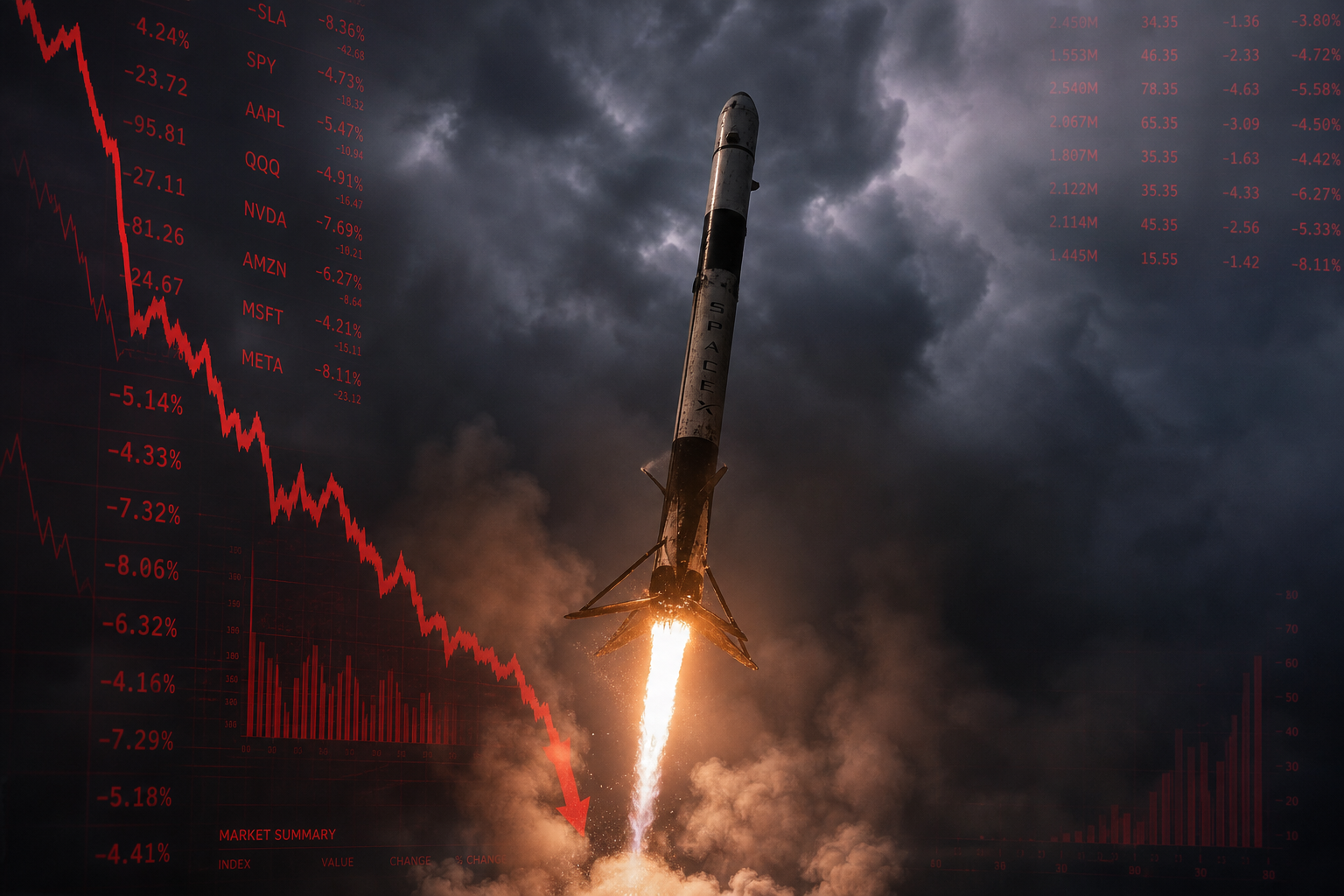
- SpaceX shares fell to $145.77 on Wednesday — crashing below the company's June 12 IPO debut price of $150 for the first time — after the most anticipated stock listing in a generation went from peak euphoria at $225.64 to a 35% wipeout in less than four weeks
- The Nasdaq-100 inclusion that was supposed to be SpaceX's next major catalyst instead became a trap: on its first full day in the index on Tuesday, the stock plunged 7% as the expected $4.3 billion in forced passive buying failed to materialize against a wall of institutional selling
- A widely followed market analyst — known for calling previous tech tops — warned that SpaceX could face a 90% crash risk, pointing to an extreme valuation detached from fundamentals and the approaching initial lockup expiration that will unleash hundreds of millions of insider shares onto the market
- The meltdown comes as the broader market buckles under a triple threat: Trump's declaration that the Iran ceasefire is "over" sent oil surging 7%, the FOMC minutes revealed a deeply divided Fed with Chairman Warsh refusing to show his hand, and chip stocks have shed more than $2 trillion in the sector's worst weekly rout since the AI boom began
- Q2 earnings season kicks off today with PepsiCo reporting before the bell, followed by Delta Air Lines — setting the stage for next week's mega-bank earnings blitz from JPMorgan, Goldman Sachs, Bank of America, Wells Fargo, and Citigroup starting July 14
From $225 to $145 — The Fastest IPO Crash of the Decade
Four weeks ago, SpaceX was the most exciting stock on the planet.
Its June 12 initial public offering raised $85.7 billion — the largest IPO in history. The stock priced at $135, opened above $150, and within days rocketed to an all-time high of $225.64 as retail investors, institutional funds, and momentum traders piled in. It was the trade that couldn't lose.
On Wednesday, SpaceX closed at $145.77.
That means the stock has now fallen below its IPO debut-day price for the first time, erasing every dollar of gains that public market investors ever had. From peak to trough, SpaceX has lost more than 35% of its value in less than a month. The company that pioneered reusable rockets couldn't keep its stock price from burning up on re-entry.
The Nasdaq-100 Trap
The turning point was supposed to be the opposite of a collapse.
On Tuesday, SpaceX was added to the Nasdaq-100 index — a milestone that typically triggers billions of dollars in forced buying from passive index funds. JPMorgan estimated that approximately $4.3 billion would flow into the stock from QQQ and other Nasdaq-100-tracking ETFs alone, with the low float creating a potential 3x multiplier effect on price.
Instead, SpaceX dropped 7% on its first day in the index, closing at $149.
The problem was simple but devastating: smart money had front-run the inclusion for weeks, buying ahead of the expected index fund demand. By the time the actual inclusion day arrived, those same investors were selling into the forced buying. It was the textbook "buy the rumor, sell the news" — applied to the biggest IPO in history.
By Wednesday, with no forced buying left and the broader market cratering on Trump's Iran remarks, SpaceX fell another 2.6% to $145.77.
The Lockup Ticking Time Bomb
If the Nasdaq-100 inclusion was supposed to be the floor, the approaching lockup expiration could be the trapdoor.
When SpaceX went public on June 12, insiders — including employees, early investors, and pre-IPO shareholders — were locked into agreements preventing them from selling their shares for a set period. That lockup is expected to expire in the coming weeks, potentially unleashing hundreds of millions of additional shares onto a market that is already struggling to absorb the existing float.
Fund managers are warning that the combination of an extreme valuation, evaporating momentum, and a massive increase in available shares could create a perfect storm of selling pressure.
One widely followed analyst — known as a "Bubble Prophet" for his track record of calling tops in high-flying tech names — went further. He warned that SpaceX faces a potential 90% crash risk from current levels, arguing that the stock's valuation is fundamentally detached from reality for a company that, despite its historic achievements in space technology, has yet to demonstrate the kind of recurring revenue and profitability metrics that justify a market capitalization of this size.
A Market Under Siege
SpaceX's implosion didn't happen in a vacuum. The broader market has been under assault from every direction this week.
On Wednesday, President Trump declared the U.S.-Iran ceasefire "over" at the NATO summit in Ankara, Turkey, after both nations traded military strikes near the Strait of Hormuz. Oil surged 7% — Brent crude blasted to $79.68 per barrel and WTI topped $75 — while Iran's state media threatened a full closure of the strait, through which 20% of the world's oil passes.
The Dow Jones Industrial Average crashed more than 500 points before recovering to close down 0.25% at 52,930. The S&P 500 fell 0.45% to 7,504. The Nasdaq dropped 1.16% to 25,819 — its third straight day of losses.
Chip stocks continued their brutal selloff. Intel plunged 9.7% on Tuesday — the S&P 500's biggest single-stock loser — on reports that its 18A foundry process won't reach profitable yields until late 2026. Samsung's record-shattering Q2 earnings failed to stop a $2 trillion sector-wide rout that has erased weeks of AI-fueled gains.
The Federal Reserve's FOMC minutes from Chairman Warsh's first meeting revealed a committee split down the middle — 9 members favoring rate hikes, 9 preferring to hold or cut — with Warsh himself refusing to submit a dot plot projection. The hawkish tone, combined with oil's surge and sticky inflation, has markets pricing in roughly 35 basis points of potential tightening by December.
Earnings Season Arrives Into the Storm
As if the geopolitical chaos and the tech wreck weren't enough, Q2 earnings season officially begins today.
PepsiCo reports before the bell this morning, with Wall Street expecting earnings per share of $2.21 on revenue of $23.96 billion. The snack and beverage giant's results will serve as the first real test of the American consumer's resilience in a quarter marked by rising gas prices, elevated food costs, and a labor market that added just 57,000 jobs in June.
Delta Air Lines follows with its earnings webcast at 10 a.m. ET, where analysts are expecting EPS of $1.48 on revenue of $18.78 billion — a sharp drop from $2.10 per share a year ago. The airline's results will be watched closely for signals about whether surging jet fuel costs are squeezing margins and whether consumers are still willing to spend on travel.
But the real test comes next week, when the financial sector takes center stage. JPMorgan Chase, Goldman Sachs, Bank of America, Wells Fargo, and Citigroup all report on July 14 — a single-day earnings bonanza that will reveal how the nation's largest banks navigated a quarter of war, rate uncertainty, and volatile markets.
What It Means for Your Portfolio
SpaceX's trajectory from $225 to $145 in four weeks is a stark reminder that no stock — no matter how iconic the company behind it — is immune to gravity.
The biggest IPO in history has become a cautionary tale about what happens when hype, momentum, and index mechanics collide with reality. The Nasdaq-100 inclusion was supposed to be a launchpad; instead, it became a distribution event. And with the lockup expiration approaching, the selling pressure may only be getting started.
For investors who bought SpaceX near its peak, the losses are already staggering. For those watching from the sidelines, the lesson is equally important: when the entire market — from oil to chips to the Fed — is flashing warning signals, even the most exciting name on the planet can't escape the pull of a market that is rapidly repricing risk.
Earnings season will determine whether this week's carnage was a buying opportunity or just the beginning. The first answers arrive today.
Found this helpful? Share it with others.