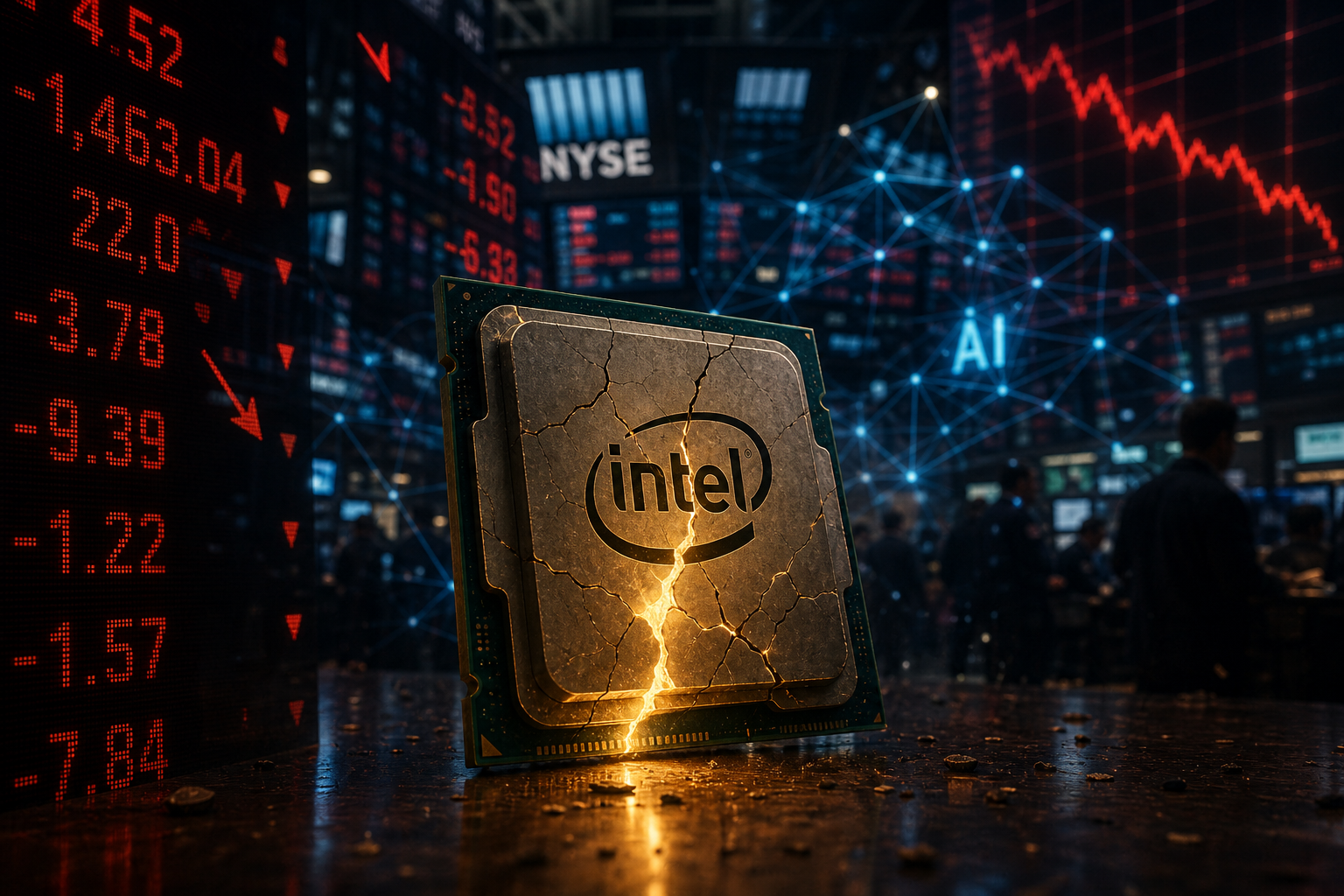
Key Bullet Points:
- Intel (INTC) crashed 7.9% to $92.30 on Friday despite posting a Q2 earnings beat — revenue of $16.1 billion surged 25% year-over-year, non-GAAP earnings hit $0.42 per share, and gross margins expanded nearly 13 points to 40.4%
- The selloff mirrors the same pattern that crushed Alphabet earlier in the week — the market is systematically punishing every company that beats on earnings but spends aggressively on AI infrastructure
- Memory chip stocks were caught in a brutal sympathy selloff as a Korea-led KOSPI crash dragged Micron down 6%, SanDisk down 9%, and SK Hynix down 6%, confirming a sector-wide retreat
- The Dow rallied 344 points on Friday while the Nasdaq fell 1.3% for the week — a widening divergence that signals money is rotating out of technology and into defensive names at the fastest pace this year
- With the Federal Reserve meeting this Wednesday, new tariffs on 60 countries now in effect, and oil still near $97 a barrel, the most dangerous week of 2026 begins Monday
The AI Spending Curse Just Claimed Another Victim
Intel did everything Wall Street asked. Revenue surged 25% year-over-year to $16.1 billion. Non-GAAP earnings came in at $0.42 per share, handily beating estimates. Gross margins expanded nearly 13 percentage points to 40.4%. Operating margins swung from negative 3.9% to positive 17.2%. After years of decline and restructuring, Intel's turnaround was finally showing up in the numbers.
The stock crashed 7.9%.
Intel closed Friday at $92.30, shedding nearly $8 per share on volume of 145 million — more than triple its daily average. It was the kind of reaction that would have been unthinkable even a month ago, when Intel shares were riding one of the strongest rallies in the company's history.
But this isn't about Intel anymore. It's about a pattern — and the question of whether an AI collapse is already underway.
Beat Earnings, Spend More, Crash
Three days before Intel reported, Alphabet delivered a quarter for the ages: $119.8 billion in revenue, 24% growth, Google Cloud up 82%. The stock dropped 7% in two days and wiped out $138 billion in market cap. The reason? Alphabet raised its full-year AI capital expenditure target to $195–$205 billion — roughly $550 million per day.
Tesla told a similar story: record deliveries, revenue beat, but a 39% earnings miss, negative free cash flow, and CapEx surging 142%. The stock fell 15.4% in a single session.
Now Intel has joined them. Despite the turnaround in earnings, Intel's own capital spending plans call for continued heavy investment in its foundry operations and AI chip manufacturing. The GAAP bottom line showed a $11 billion net loss, driven by restructuring charges — a reminder that the turnaround is expensive and far from complete.
The message from the market is getting louder: AI has fundamentally changed the economics of Big Tech, and investors are no longer willing to fund the transformation on faith.
The Memory Chip Meltdown
Intel's crash didn't happen in isolation. On the same day, a brutal Korea-led selloff tore through the entire semiconductor complex.
An overnight KOSPI crash in Seoul, led by Samsung and SK Hynix, triggered a sympathy selloff across U.S. memory stocks. Micron fell 6% to $929. SanDisk plunged 9% to $1,467. Western Digital dropped 6% to $523. SK Hynix ADRs slid 6% to $158.56. The Roundhill Memory ETF (DRAM) fell 7%, confirming a broad group retreat.
These are stocks that have been the biggest winners of the AI boom. Micron is up 227% year-to-date. SanDisk has gained 526%. Western Digital is up 209%. Friday's selloff didn't erase those gains — but it raised a question that every AI investor needs to answer: when every stock in the sector drops 6-9% in a single session, is this a buying opportunity, or the beginning of a broader correction?
Micron still trades at a forward P/E of just 6x, with analyst targets near $1,507, well above its current price. But valuations only matter if the cycle holds — and with new tariffs on 60 countries now in effect, the cost structure for the entire chip industry just changed overnight.
The Rotation Nobody Expected
While technology stocks bled, something unusual happened on Friday: the Dow Jones Industrial Average rallied 344 points.
The Dow rose 0.67% to close at 52,056, nearly erasing its losses for the week. The S&P 500 gained 0.60%. But the Nasdaq — the benchmark for the AI and technology trade — rose just 0.19% and finished the week down 1.3%.
That divergence is significant. Money is rotating out of high-multiple tech names and into defensive, value-oriented industrials at the fastest pace this year. It's exactly the warning sign that BofA flagged earlier this month — fund managers are record-long on risk but starting to hedge against the very bets they've been making.
The Most Dangerous Week of 2026 Starts Monday
The calendar ahead is unforgiving. On Monday, new U.S. tariffs of 10% to 12.5% on imports from 60 countries — covering 99.4% of all U.S. goods imports — take full effect. On Wednesday, the Federal Reserve delivers its rate decision, with markets pricing roughly a 50% chance of a rate hike by December. Oil, despite pulling back from $100, still sits near $97 — up 65% year-to-date — as Hormuz shipping traffic has collapsed to just one tanker per day.
And looming over all of it: President Trump said Friday he will "soon decide" whether to launch what he called a "massive attack" on Iran.
For Intel shareholders, the question is whether Friday's crash was a one-day profit-taking event or the start of a deeper selloff. For the broader market, the question is bigger: can a market that punishes its best earnings reports survive a week of tariffs, a Fed decision, and a Middle East crisis all at once?
Found this helpful? Share it with others.