Key Bullet Points:
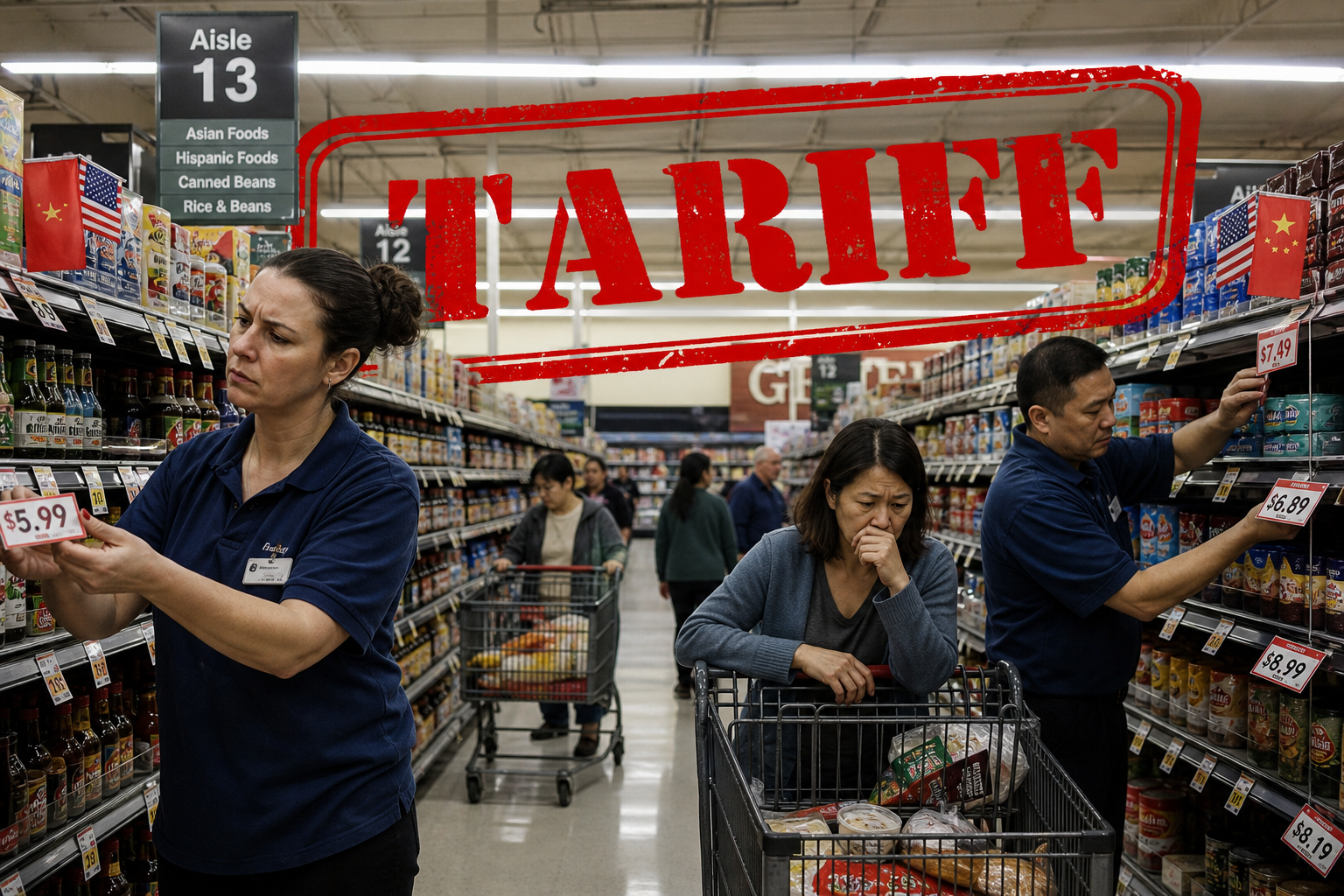
- New U.S. tariffs of 10% to 12.5% on goods from 60 trading partners — covering 99.4% of all American imports — took effect Friday, replacing the "reciprocal" tariffs the Supreme Court struck down in February 2025
- The Federal Reserve begins its two-day policy meeting Tuesday, with markets pricing roughly 50% odds of a rate hike by December — but surging oil prices and the new tariff-driven inflation pressure could force the Fed's hand sooner than anyone expects
- Only one oil tanker crossed the Strait of Hormuz on Thursday — the lowest daily total since May 7 — as U.S. strikes on Iran entered a 13th consecutive night and President Trump said he would "soon decide" whether to launch a "massive attack"
- Brent crude pulled back to $97 on Friday after briefly crossing $100, but Goldman Sachs warns prices could spike to $120 if Hormuz disruptions persist — and the 30-year Treasury yield hit 5.16%, its highest since 2007
- The Dow rallied 344 points Friday while the Nasdaq fell for the week, as the Great Rotation from technology into defensive stocks accelerated — setting up a collision between tariff-driven inflation, a hawkish Fed, and a market that can no longer agree on which direction to run
Three Crises Are Converging on Wall Street This Week
The last time the market faced this many simultaneous threats was March 2020. And back then, it only had to deal with one.
This week, investors face three at once: the largest new tariff action since last year's "Liberation Day," a Federal Reserve meeting where the wrong word could trigger a selloff, and a Middle East conflict that has reduced the world's most important oil shipping route to a single tanker per day.
Any one of these would move markets. Together, they create the kind of risk that nobody was pricing just two weeks ago — and that the market is only beginning to absorb.
The Tariff Bomb
On Thursday, the Trump administration announced new tariffs of 10% to 12.5% on goods from 60 trading partners. They took effect Friday morning. The affected countries account for 99.4% of all U.S. imports.
The timing was not coincidental. In February 2025, the Supreme Court struck down President Trump's original "reciprocal" tariffs of 10% to 50%. In response, the administration imposed a temporary 10% blanket tariff. That temporary tariff expired this week — and the new ones replaced it instantly, justified under a monthslong investigation into forced labor practices among trading partners.
The practical effect is sweeping. Everything from consumer electronics to auto parts to clothing now carries a 10% to 12.5% surcharge. Australia rejected the tariff. Brazil refused to comply. But the tariffs are in force, and the prices American consumers pay for imported goods just went up.
For a market already grappling with oil-driven inflation and rising Treasury yields, this is gasoline on a fire. The 30-year Treasury yield hit 5.16% on Friday — its highest since 2007 — and the dollar index posted its biggest weekly jump in a month as traders priced in the inflationary impact.
The Fed's Impossible Choice
The Federal Reserve begins its two-day policy meeting on Tuesday. The decision comes Wednesday afternoon. Markets overwhelmingly expect the Fed to hold rates unchanged — but the ground is shifting under that assumption fast.
In June, the FOMC split right down the middle on whether to raise interest rates this year: nine members projected a hike, nine did not. Since then, oil has surged from $73 to $97. New tariffs have added 10% to nearly every import category. And Jamie Dimon has warned publicly that he is not buying stocks or long-duration Treasuries.
The June jobs report showed just 57,000 new payrolls — the weakest in months. CPI came in softer than expected. Under normal circumstances, that data would argue for patience. But these are not normal circumstances. Oil at $97, tariffs on everything, and a 30-year yield above 5% create a stagflationary cocktail that the Fed hasn't faced since the 1970s.
The most dangerous outcome isn't a rate hike — it's the language. If Chair Kevin Warsh signals that a hike is coming at the September meeting, markets could reprice overnight. If he sounds dovish while inflation is visibly accelerating, the bond market could revolt. Either way, Wednesday's press conference is the most consequential Fed event of the year.
Hormuz: Down to One
Meanwhile, the chokepoint nobody wanted to watch just got worse.
Kpler ship-tracking data showed that only one oil tanker crossed the Strait of Hormuz on Thursday — a very large crude carrier carrying 2 million barrels of Iraqi Basrah crude bound for China. No tankers entered the waterway. It was the lowest daily total since May 7.
U.S. strikes on Iran have now entered a 13th consecutive night. Iran's IRGC attacked U.S. assets in Kuwait. Houthi forces bombed two Saudi oil tankers in the Red Sea. And President Trump said Friday he would "soon decide" whether to launch what he called a "massive attack" on Iran.
Brent crude pulled back to $97 on Friday after briefly touching $100 on Thursday, but the weekly gain was still more than 9% — the third consecutive weekly advance. Goldman Sachs has warned that prices could spike to $120 if Hormuz disruptions persist. Persian Gulf oil flows are now below 45% of pre-war levels.
Oil at $100 is uncomfortable. Oil at $120 would be a different kind of crisis — one that hits every consumer, every airline, every manufacturer, and every central banker's inflation forecast simultaneously.
The Rotation Tells the Story
Friday's market action revealed something important. The Dow Jones Industrial Average rallied 344 points — gaining 0.67% — while the Nasdaq barely moved, rising just 0.19% and finishing the week down 1.3%.
This is the warning sign that keeps getting louder. Money is leaving high-multiple technology stocks — the Alphabets, the Teslas, the Intels that crash after beating earnings — and flowing into value-oriented, defensive names. The Dow, weighted toward industrials, financials, and healthcare, is outperforming the Nasdaq for the first time in months.
When the safety trade outperforms the growth trade during earnings season, it means institutional investors are positioning for something they don't want to say out loud: that the best-case scenario has already been priced in, and the risks ahead are bigger than the rewards.
What to Watch This Week
Monday: Durable goods orders, the first test of whether the tariff announcement is already chilling business investment. Tuesday-Wednesday: The Fed meeting and press conference — watch for any shift in language on inflation or rates. All week: Oil prices and Hormuz shipping traffic, which will determine whether $100 crude becomes the new floor or a temporary spike.
The market finished last week pretending Friday's bounce was a reset. This week will determine whether that bounce was a relief rally — or a trap.
Found this helpful? Share it with others.