Key Bullet Points:
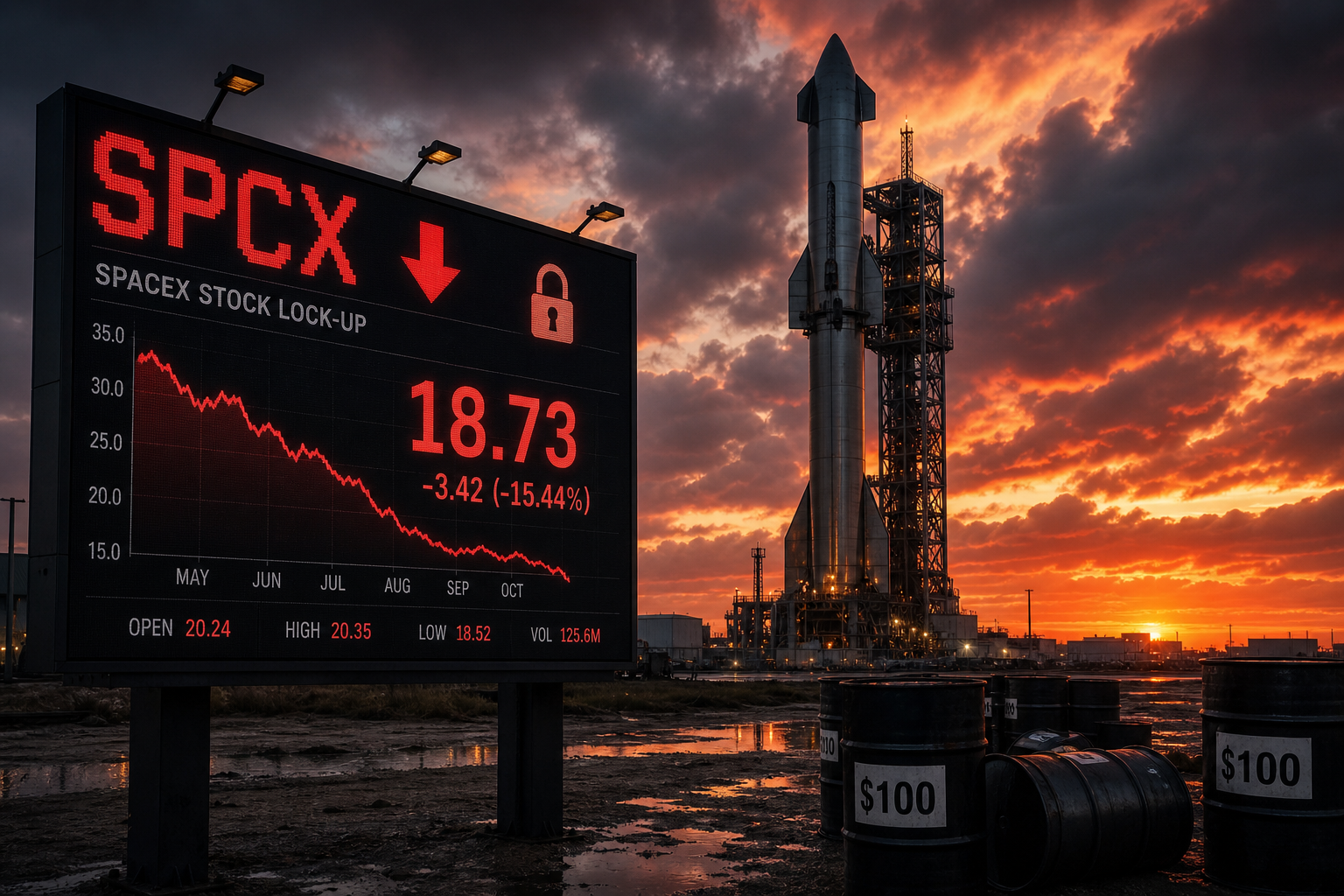
- SpaceX (SPCX) bounced 2.6% to $118.24 on Thursday after hitting a post-IPO low of $115.26 the day before — but the stock is still down 48% from its all-time high and 12% below its $135 IPO price, with short sellers sitting on $15.5 billion in paper profits and one-third of the public float sold short
- The company will release its first-ever public earnings report on August 4, followed just two days later by the unlock of 1.37 billion previously restricted shares on August 6 — potentially flooding the market with up to $116 billion worth of insider stock in the first phase of a staggered lock-up expiration
- Tesla (TSLA) closed at $316.42 — down 15.4% and its worst single-day decline since June 2025 — after missing Q2 earnings by 39%, erasing $18 billion from Elon Musk's net worth in a single session and leaving the stock 28% lower year to date
- Brent crude closed near $100 a barrel — crossing the $100 mark intraday for the first time since late May — as Houthi attacks on Saudi oil tankers widened the Middle East supply disruption to both the Strait of Hormuz and the Red Sea, with Goldman Sachs warning oil could hit $120 if disruptions persist
- The Dow fell more than 500 points, the Nasdaq dropped roughly 2%, and Alphabet (GOOGL) sank nearly 7% to $318.39 after raising its full-year AI capital expenditure forecast to $195–$205 billion — while the 10-year Treasury yield climbed to 4.66%, its highest level since January 2025
The Most Dangerous Two Weeks in SpaceX History Are About to Begin
SpaceX went public six weeks ago as the most hyped IPO of the decade. The stock debuted at $135, rocketed to an all-time high of $225.64, and Wall Street tripped over itself declaring Elon Musk's space company the next trillion-dollar certainty.
On Wednesday, SpaceX hit $115.26 — the lowest close since the IPO, down 49% from the peak. On Thursday it bounced 2.6% to $118.24. But that bounce does nothing to change the math of what's coming: the most consequential twelve days in SpaceX's short public history.
On August 4, the company will publish its first-ever public earnings report. Two days later, on August 6, the first tranche of SpaceX's staggered lock-up expires — and 1.37 billion shares that have been frozen since the IPO become eligible for sale. According to CNBC, up to 911.5 million shares in the first tranche alone will be available for transfer, representing stock worth as much as $116 billion at current prices.
That is not a theoretical risk. It is the single largest potential supply event for any stock in 2026.
Short sellers already sense blood. One-third of SpaceX's public float is now sold short — an extraordinary level of bearish conviction. Through Wednesday, shorts had accumulated $15.5 billion in paper profits, one of the largest short-selling wins in recent market history. When Elon Musk publicly warned short sellers in a post on X last month, the stock was trading above $180. It has fallen 35% since.
The company's valuation remains the central question. SpaceX still trades at roughly 64 times trailing revenue — a premium that would be generous for a high-growth software company, let alone a capital-intensive rocket and satellite business. Bank of America analysts cautioned investors this week to avoid placing excessive weight on SpaceX's headline revenue number, arguing that Starlink subscriber growth rates, launch cadence, and CapEx levels will matter far more than the top line.
The Starship program adds another layer of uncertainty. SpaceX's 13th test flight — the second attempt of the upgraded Starship V3 — was scheduled for Thursday evening after the previous launch on July 16 was aborted one second before liftoff when four of 33 booster engines failed to ignite. The V3 is larger and equipped with more efficient Raptor engines, but two consecutive failures would raise serious questions about the timeline for operational Starship flights.
Here is the uncomfortable reality: if SpaceX's August 4 earnings disappoint — or even if they merely meet expectations without offering a compelling narrative for growth — the August 6 lock-up expiry could trigger a wave of insider selling into an already devastated stock. Early employees, venture capital firms, and pre-IPO investors who watched their paper fortunes shrink by nearly half have every incentive to lock in whatever gains remain before the stock potentially falls further.
And if the earnings report is strong? Then SpaceX has a real shot at establishing a bottom. But even in that scenario, the supply of newly unlocked shares will likely cap any rally, creating a ceiling of sellers that the stock will need months — not days — to absorb.
Musk's Worst Day: Tesla Crashes 15% to $316
While SpaceX bounced on Thursday, Elon Musk's other company delivered his worst day in over a year.
Tesla closed at $316.42, down 15.4% — the largest single-day decline since June 2025. The crash erased roughly $18 billion from Musk's personal net worth and left the stock 28% below where it started the year.
The catalyst was Tesla's Q2 earnings report, released Wednesday after the close. Revenue of $28.24 billion beat estimates, and record deliveries of 480,126 vehicles confirmed the car business is firing. But adjusted earnings of $0.33 per share missed the $0.53 consensus by 39%. Free cash flow turned negative at minus $1.1 billion. Capital expenditures surged 142% year-over-year, with full-year guidance now above $25 billion as Tesla pours cash into AI computing, robotaxi infrastructure, Optimus robot production, and semiconductor facilities.
Analysts responded by slashing price targets across the board. BofA cut its earnings forecast for 2026 by 17.4%. Oppenheimer followed with its own downward revision. Wells Fargo maintained its Sell rating with a $130 target — implying another 59% downside from Thursday's close. The operating margin plummeted to 1.4%, and the break below the $340 technical support level raised concerns about a correction toward $220.
For a stock that entered the week trading at 177 times forward earnings, the market's message was clear: revenue growth means nothing if it comes at the cost of profitability, and AI ambitions do not justify infinite patience with negative free cash flow.
Oil at $100 and Rising: Goldman Says $120 Is Next
Brent crude crossed $100 a barrel on Thursday for the first time since late May, hitting $102 intraday before settling near $100. West Texas Intermediate surged above $91. Oil prices have now risen more than 30% this month alone.
The trigger was an attack by Yemen's Houthis on two Saudi oil tankers in the Red Sea — opening a second chokepoint in a conflict that has already shut down roughly 55% of Persian Gulf shipping flows through the Strait of Hormuz. The U.S. military confirmed a 12th consecutive night of strikes against Iran, deploying B-1 long-range bombers. Iran retaliated by striking U.S. assets in Kuwait and claiming attacks via the IRGC. A U.S. strike near the Iraq border killed two Iranians. Regional mediators, led by Oman, are now pushing for a new 10-day ceasefire — but Trump signaled Thursday that the conflict will continue, calling Iran's intentions "evil."
Goldman Sachs warned earlier this week that Brent could spike to $120 per barrel if disruptions through the Strait of Hormuz persist. The bank's base case assumes tensions ease and prices average $80 in Q4, but with Persian Gulf flows now below 45% of pre-war levels and both the Strait and the Red Sea effectively compromised, the base case looks increasingly optimistic.
The 10-year Treasury yield climbed to 4.66% — its highest since January 2025 — as rising oil prices reignited inflation fears. The Dow fell more than 500 points. The Nasdaq dropped roughly 2%. Alphabet sank nearly 7% to $318.39, wiping out roughly $138 billion in market capitalization despite posting $119.8 billion in revenue and 82% cloud growth.
This market is being squeezed from three directions at once: AI spending that consumes cash faster than it generates returns, an oil crisis that threatens to push inflation higher and consumer spending lower, and a military conflict that shows no sign of ending. For investors, the next two weeks — SpaceX earnings on August 4, the lock-up on August 6, and the trajectory of oil prices — will determine whether this selloff is a healthy correction or the beginning of something much worse.
Found this helpful? Share it with others.