Key Bullet Points:
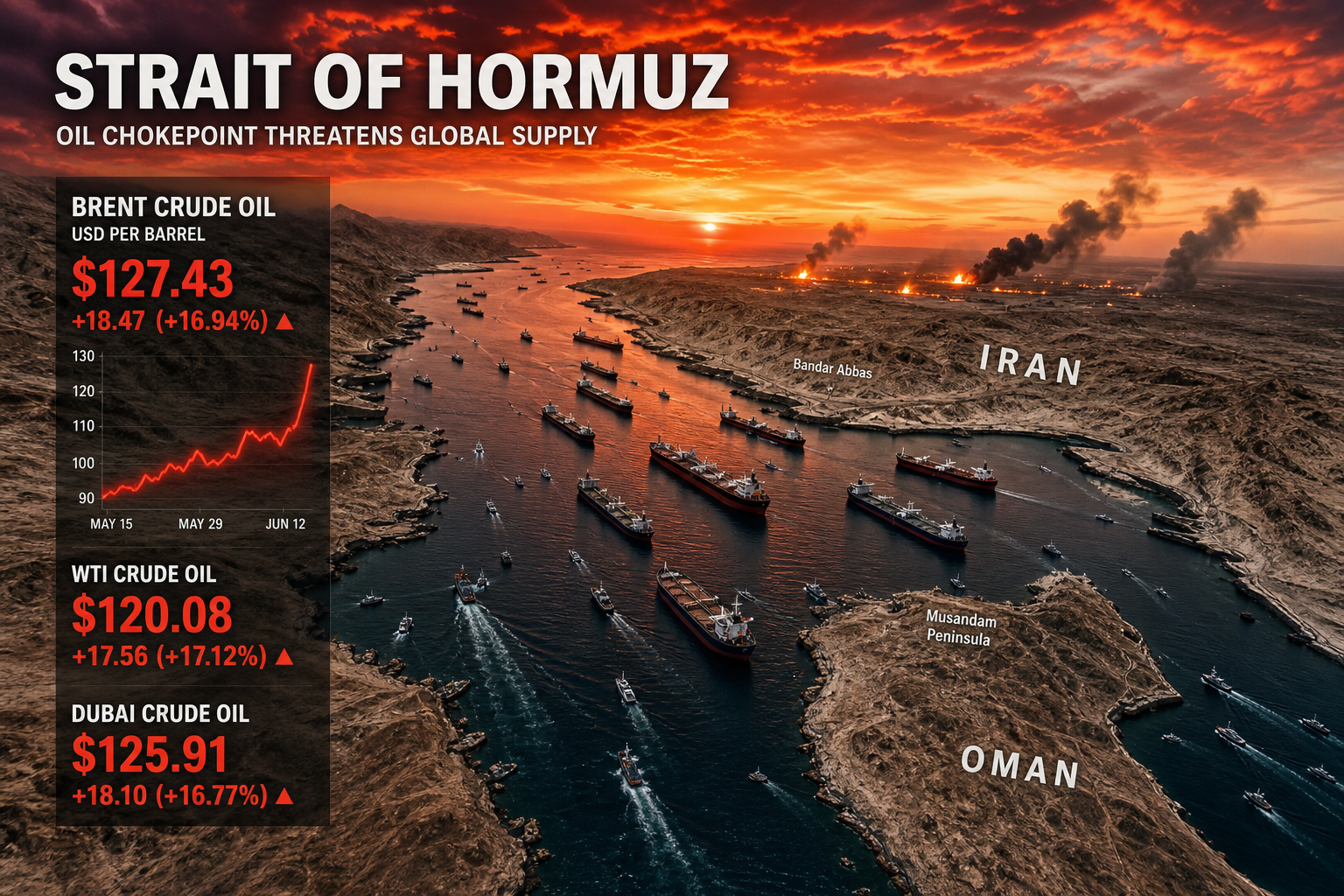
- Iran's Revolutionary Guard Navy announced late Saturday that the Strait of Hormuz — the narrow waterway between Iran and Oman through which roughly 20% of the world's oil supply passes daily — is officially closed "until further notice" and "until the end of America's interventions in the region," with no vessels permitted to pass through
- The closure came hours after Iran's new Supreme Leader Ayatollah Mojtaba Khamenei issued his first public statement since assuming power, declaring that avenging the killing of his father — former Supreme Leader Ali Khamenei — is "the demand of the nation" and "must certainly take place," a direct threat that escalates the U.S.-Iran conflict to its most dangerous phase yet
- Oil futures are expected to surge when trading resumes Sunday evening at 6 p.m. ET — Brent crude closed Friday at $76.01 and WTI at $71.41, but analysts warn that a sustained Hormuz closure could send prices above $100 per barrel within days, triggering a global energy crisis not seen since the 1973 Arab oil embargo
- Five of the six largest U.S. banks — JPMorgan Chase, Goldman Sachs, Bank of America, Wells Fargo, and Citigroup — report Q2 earnings Monday morning before the opening bell, with JPMorgan expected to post EPS of $5.67 on revenue of $50.5 billion and Goldman Sachs expected to deliver EPS of $14.16 on revenue of $16.3 billion
- Monday is shaping up to be the most consequential single trading day of 2026 — a collision between a potential oil supply crisis, the biggest day of bank earnings in the quarter, and a stock market that closed Friday just 0.6% below its all-time high with no hedging against a Hormuz shutdown baked into prices
The Strait Is Closed
Late Saturday night, Iran's Revolutionary Guard Navy issued a statement that will likely reshape financial markets when they open Monday morning.
"The Strait of Hormuz is closed until further notice and until the end of America's interventions in the region, and no vessel will be permitted to pass through."
That single sentence — issued after an incident in which Iranian forces struck a vessel accused of ignoring navigation orders — effectively shuts down the most important oil chokepoint on Earth. Approximately 21 million barrels of crude oil pass through the Strait of Hormuz every day, representing roughly 20% of global supply. Saudi Arabia, Iraq, Kuwait, the UAE, and Qatar all depend on this 21-mile-wide passage to export their oil to the world.
The closure announcement came from the IRGC Navy, not Iran's civilian government — a distinction that signals military control over the decision and makes a quick diplomatic reversal less likely. The Persian Gulf Waterway Management Authority separately confirmed that the strait would "remain closed until further notice."
Tanker traffic through Hormuz had already collapsed to a near standstill over the past week. On Thursday, just two tankers made the passage. Now, zero are expected.
The New Supreme Leader's First Words
The timing of the closure is not coincidental.
Hours before the IRGC Navy's announcement, Iran's new Supreme Leader Ayatollah Mojtaba Khamenei issued his first public statement since assuming power following the killing of his father, Ali Khamenei, more than four months ago in an Israeli strike that triggered the current U.S.-Iran war.
"This matter depends neither on my personal existence nor on that of other officials," he wrote on Telegram. "Whether we are present or not, it will come to pass."
He called vengeance "the demand of the nation" and said it "must certainly" take place.
This is the most direct and threatening language from Iran's supreme leadership since the conflict began. Mojtaba Khamenei is not simply continuing his father's policies — he is escalating them. And the Hormuz closure is the first concrete action to back up his words.
President Trump, who declared the ceasefire "over" at a NATO summit on Wednesday and authorized a second day of strikes on Thursday, responded Friday by threatening to "decimate" Iran. He also claimed, without elaboration, that he is "first on the kill list for Iran."
The diplomatic off-ramp that existed a week ago — when both sides were at least nominally honoring a memorandum of understanding — appears to have collapsed entirely.
What $100 Oil Means for Everything
When oil futures begin trading at 6 p.m. Eastern on Sunday evening, the market will be pricing in a reality it has not faced since the 1973 Arab oil embargo: the complete closure of the Strait of Hormuz.
Brent crude closed Friday at $76.01. WTI settled at $71.41. Both had already gained roughly 5% for the week on escalating tensions alone — and that was before the official closure announcement.
Analysts and traders have long modeled a Hormuz closure as a tail-risk scenario that would send oil above $100 per barrel within days and potentially toward $120 or higher if the blockade persists. At those levels, gasoline prices in the United States — already elevated above $4 per gallon in many states — would likely spike toward $6 or more, reigniting the inflation crisis that the Federal Reserve has been fighting for three years.
The implications cascade through every asset class. Higher oil means higher transportation costs, higher food prices, higher input costs for manufacturers, and tighter margins for every company in the S&P 500 that isn't an energy producer. It also means the Fed — already split 9-9 on its rate path — faces an impossible choice: hold rates steady while inflation re-accelerates, or cut into an oil shock and risk its credibility entirely.
Delta Air Lines, which reported record revenue on Friday, absorbed fuel costs of $2.66 per gallon last quarter — the highest in its history. If oil goes to $100, Delta's fuel bill rises dramatically, and the airline's unchanged full-year guidance becomes immediately stale.
Five Banks, One Morning
Into this chaos, five of America's largest banks will report quarterly earnings before the market opens Monday.
JPMorgan Chase — the nation's largest bank by assets — is expected to report earnings per share of $5.67 on revenue of $50.5 billion. Goldman Sachs is projected at $14.16 in EPS on $16.3 billion in revenue. Wells Fargo is forecast at $1.42 EPS on $21.1 billion. Citigroup at $1.68 EPS on $20.9 billion. Bank of America rounds out the group.
The trading desks at these banks almost certainly had a historic quarter. The combination of SpaceX's $25.7 billion IPO, SK Hynix's record $26.5 billion Nasdaq listing, extreme oil volatility, a $2 trillion semiconductor selloff, and wild swings in Treasury markets would have generated enormous fixed-income and equities trading revenue.
But that's the bullish side. The bearish side is what their consumer lending books reveal. If PepsiCo's warning about "tight consumer budgets" last week was a canary in the coal mine, then the banks' credit card delinquency rates, auto loan defaults, and mortgage demand numbers will confirm it — or refute it.
And now those earnings will drop into a market that has to simultaneously digest a potential $100 oil spike.
What It Means for Your Portfolio
Here is what you need to understand about Monday: the market closed Friday at 7,575 on the S&P 500 — just 0.6% below its all-time high — with effectively zero hedging against a Strait of Hormuz closure priced in. Oil at $76 was the market's way of saying "this won't actually happen."
It just happened.
The most likely Monday scenario is a gap down at the open as futures reprice oil risk overnight, followed by intense volatility as bank earnings roll in between 6:30 a.m. and 8:00 a.m. ET. If the banks beat — and their trading revenue should be strong — the question is whether that's enough to offset the panic from the Hormuz headlines.
Energy stocks will likely surge. Airlines, trucking, and consumer discretionary names will likely fall. Tech is a wild card — higher oil means higher inflation, which means higher rates, which means lower multiples on growth stocks. But the AI infrastructure build-out is not oil-dependent in the short term, so there may be a flight to quality within tech toward names like Nvidia, Broadcom, and the newly listed SK Hynix.
The last time a major oil chokepoint faced closure — the Suez Canal in 2021 — it lasted six days and caused a relatively modest disruption. But the Strait of Hormuz handles ten times the oil volume of the Suez Canal. A sustained closure here is not a supply chain inconvenience. It is a potential global economic crisis.
Sunday evening oil futures. Monday morning bank earnings. The Strait of Hormuz at zero traffic.
This is the kind of Monday that defines portfolios for the rest of the year.
Found this helpful? Share it with others.