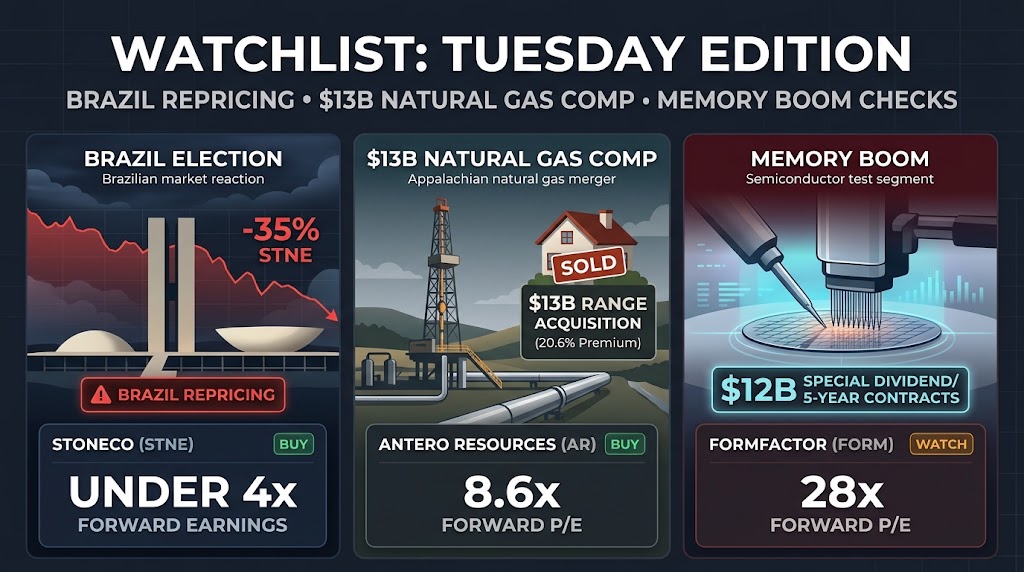
Morning Watchlist: Tuesday Edition
A quick note from Behind the Markets
The Fed sits down this morning. The answer comes tomorrow at 2 PM, and the market has already graded it — better than 90% odds of a hold, per CME's FedWatch. So the loudest story of the week wasn't supposed to come from Washington.
It came from Brasília. On Sunday, Brazil re-elected Lula, the polls missed again, and by Monday morning a whole country was being repriced before New York finished its coffee. And while every screen turned south, somebody quietly wrote a $13 billion check in Appalachia that resets the price of every gas field on the road.
Three stories this morning. Three pairings.
Let's get into it.
1) The Election the Market Got Wrong Twice
Three weeks ago, Brazil's first round shocked the market one way: Flávio Bolsonaro led, the Ibovespa had its best day since 2020, and Brazilian stocks priced in a business-friendly government. On Sunday the runoff shocked it back: Lula won, 51.8% to 48.2%, per Brazil's electoral court — and Bolsonaro is demanding the result be annulled.
Monday morning was the bill. In early U.S. trading, Itaú fell more than 26%, Petrobras 22%, and a Tokyo-listed fund tracking Brazilian stocks dropped as much as 16%, its worst day since 2020. Currency markets indicated the real could weaken past 5.60 to the dollar, and São Paulo trading desks openly discussed circuit breakers at the open.
We planned for this exact morning. On October 7th, with StoneCo up 21% on the first-round euphoria, we refused to buy what we called a halftime celebration — and we named our price: "a Lula-win washout toward the ~$9 low that pays for the politics."
In Monday's premarket, StoneCo traded at $7.38, down more than 35%.
The pairing: StoneCo (STNE) — Buy
We named a price three weeks ago, when naming it cost nothing. The auctioneer just called it — lower than we asked. StoneCo processes card payments and makes loans for roughly four million Brazilian merchants, and at Monday's premarket price it costs under 4 times next year's expected earnings. The S&P 500: 21. Seventeen analysts rate it Buy with an average target near $13.68 — above the price even before Monday's panic.
Here's the part the selling forgets: the bull case that died on Sunday — fiscal discipline, then falling rates — was never how this company made its money. StoneCo built its entire business under high-rate, high-drama Brazil. The crowd is panic-selling a fish for the crime of being returned to water. The honest risks: a real in free fall raises funding costs before it raises volumes, a contested election can stay ugly for months, and our stated kill is unchanged — the merchant-credit book souring. The exam is November 12th, and this is a volatile ticket; size it like one.
2) Somebody Bought the House Next Door
While Brazil burned, the biggest U.S. energy deal of the year landed almost unnoticed. EQT agreed on Monday to buy Range Resources in an all-stock deal — roughly $13 billion of stock, $54.91 per Range share, a 20.6% premium — creating a $50 billion-plus gas giant: over 9 billion cubic feet a day, nearly 3 million Appalachian acres, more than 30 years of drilling inventory, and a cash-flow breakeven below $2 per million BTU. Reuters tied the logic directly to data-center electricity demand.
Regular readers know Range. We flagged it August 28th around $42 as "the firewood lot in a town of new wood stoves." The deal values it at $54.91 — about 31% above our flag. When an acquirer rings the register for you, you let them. That call is closed.
But ask any homeowner what actually sets the price of their house. Not the renovation. Not the mortgage rate. The sale next door — what realtors call a comp. Appalachia just got a comp, 20% over Friday's asking.
The pairing: Antero Resources (AR) — Buy
Antero is one of the largest remaining independents on the same street — a $12.3 billion Appalachian producer of gas and gas liquids. Earnings per share are up 130% over the past year, revenue up 19%, and at Friday's $40.16 close it trades near 8.6 times next year's expected earnings. Twenty-two analysts average a $49.64 target.
To be clear about what we're buying: not a lottery ticket on a takeover. At under 9 times earnings, with AI data centers turning gas demand into a growth story, Antero is cheap with no deal at all — a buyer showing up at a Range-style premium would be the tip, not the meal. The honest risks: gas producers don't set their own prices, a warm winter or a supply glut sinks the whole street, and Antero hands in its own report card tomorrow. The kill: a miss plus a mild December, which would tell you the comp came at the top.
3) The Memory Boom Started Writing Checks
The memory-chip shortage has graduated from forecast to payout. On Monday, reports said SK Hynix is weighing a special dividend of roughly $12 billion. Bank of America reiterated its Buy on Micron with a $1,550 target, noting customer contracts now run three to five years — about 35% of Micron's sales locked in, headed toward half by 2030. SanDisk, reporting Thursday, has guided to $44 to $46 a share for a single quarter. Intel's CEO says memory now costs five to seven times its old price.
When an industry famous for boom-and-bust starts signing five-year contracts and mulling special dividends, something structural is being admitted. And every one of those frantically redesigned chips — new DRAM, new high-bandwidth stacks, new flash — has to pass a test before it ships. Testing a fresh wafer takes a probe card: a custom-built plate of microscopic needles pressed against the silicon to see which chips work. New design, new card, no exceptions. It's the fitting room of the chip industry, and the world's biggest maker of probe cards is FormFactor. More new designs means more fittings — whoever ends up selling the most memory, the tailor measures everyone.
The pairing: FormFactor (FORM) — Watch
We watched this one on August 26th at $108, waiting for a memory-complex dip at 31 times forward earnings. The dip arrived sideways: the stock sat near $98.51 Friday — below our flag — while the memory story got stronger, compressing the price to about 28 times next year's earnings. The average analyst target is $152.
So why still Watch? Calendar and a twitchy tape. FormFactor was up 2.5% in Monday's premarket, its earnings land tomorrow night, and this market's recent habit — see Lam, down 11% after a beat — is to mark the chip aisle down on perfect papers. A miss you can buy is worth more than a beat you have to chase. The entrance: tomorrow's print confirming record probe-card demand with the stock still under $110, or any aisle-wide markdown toward $90. The kill: a genuine memory downturn — our rule since August.
Before You Go
That's the watchlist. A country repriced overnight and the washout we pre-ordered three weeks ago, a $13 billion comp on the Appalachian street, and the tailor measuring every chip in the memory boom. One theme this morning: the best time to decide what you'd buy in a panic is before the panic.
Two report cards worth a line. Range Resources, our August firewood lot, is leaving the portfolio the best way a stock can — acquired, 31% above the flag. And Verizon, our October 12th Buy, passed Monday's exam: 406,000 phone additions against 209,000 expected, a raised profit forecast, and a $2 billion AI deal with Amazon Web Services.
The homework stack: Freeport-McMoRan reports today, Antero and FormFactor hand in papers tomorrow alongside Flex — and tomorrow at 2 PM, the Fed answers the only question it's being asked, six days before the midterms.
Found this helpful? Share it with others.
Written by Behind The Markets