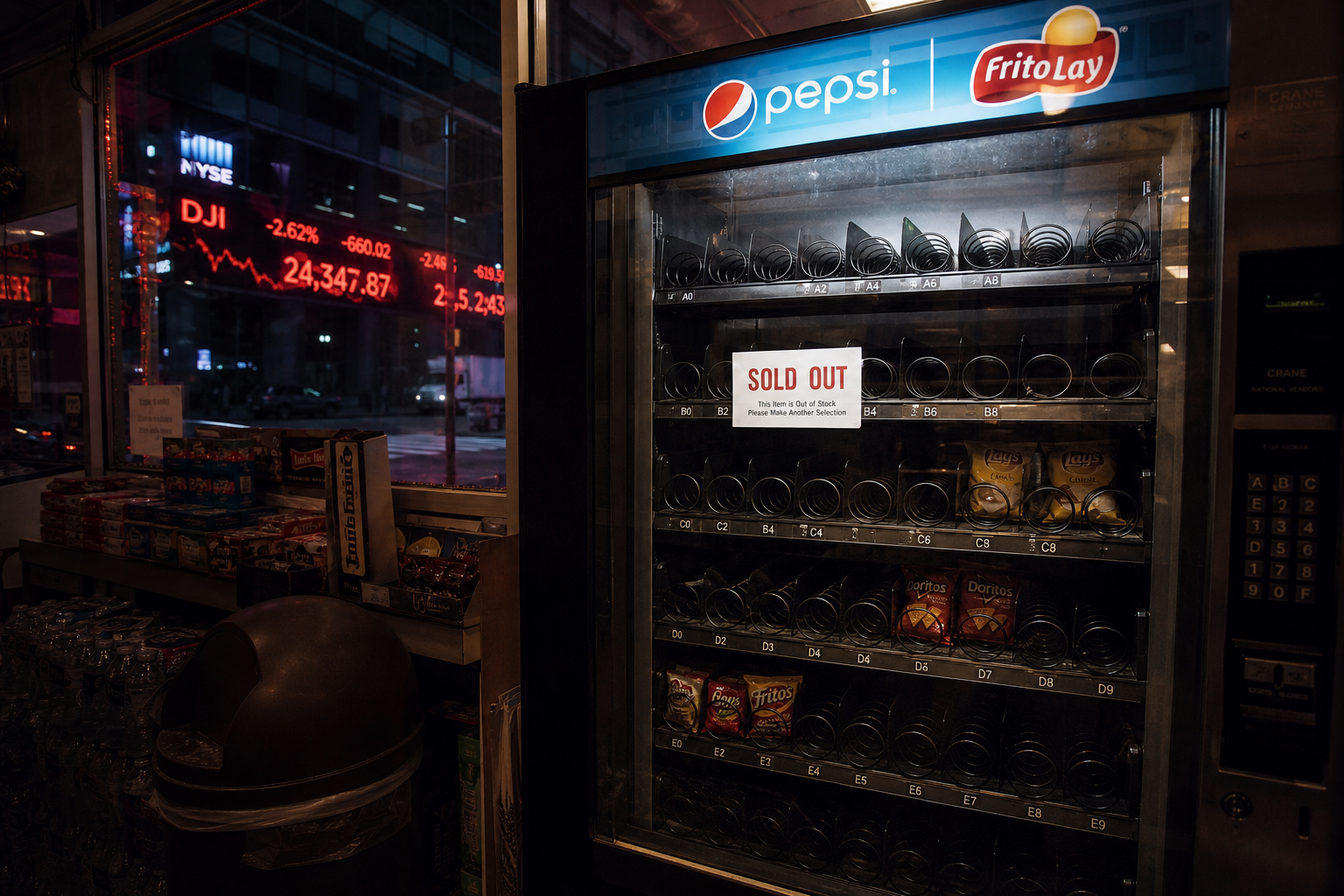
Key Bullet Points:
- PepsiCo reported Q2 revenue of $24.18 billion — beating Wall Street's $23.96 billion consensus by $220 million and growing 6.4% year-over-year — but the stock plunged as much as 5.5% after management warned that tight consumer budgets are slowing U.S. food and beverage demand and the company's snack rebound has stalled
- Core earnings per share came in at $2.20, barely edging the $2.19 consensus by a penny, while the company's Frito-Lay North America division — which generates roughly a third of total profits — continued to disappoint as Americans cut back on chips, snacks, and convenience-store purchases
- The broader market shrugged off PepsiCo's consumer warning and rallied on Thursday: the Nasdaq surged 0.66% to 26,041, the S&P 500 rose 0.42% to 7,514, and the Dow edged up 0.10% to 52,403 — powered by a violent semiconductor rebound as Applied Materials surged 10% and Lam Research jumped 9%
- Oil tanker traffic through the Strait of Hormuz ground to a near standstill on Thursday — with just two tankers making the passage — as the U.S. and Iran traded attacks for a second consecutive day following Trump's declaration that the ceasefire is "over"
- Earnings season accelerates today with Delta Air Lines reporting Q2 results at 10 a.m. ET, while the real test arrives Monday when JPMorgan Chase, Goldman Sachs, Bank of America, Wells Fargo, and Citigroup all report on the same day — a single-session earnings blitz that will reveal how the nation's biggest banks navigated a quarter of war, rate chaos, and a $2 trillion semiconductor selloff
The Revenue Beat That Nobody Wanted
On paper, PepsiCo crushed it.
Revenue of $24.18 billion — up 6.4% year-over-year — sailed past Wall Street's $23.96 billion estimate by $220 million. International markets delivered outsized strength, and core earnings per share of $2.20 edged the consensus by a penny. Management reaffirmed full-year guidance: organic revenue growth of 2% to 4%, core constant-currency EPS growth of 4% to 6%.
By every standard earnings metric, PepsiCo beat.
So why did the stock crater as much as 5.5% on Thursday — dropping below $136 in early trading — and close near its worst levels of the session?
Because Wall Street wasn't trading the headline numbers. It was trading the warning buried underneath them.
The American Consumer Is Pulling Back
For the first time in this economic cycle, the company that sells Doritos, Lay's, Cheetos, Gatorade, and Mountain Dew to more than 200 million Americans told investors something they didn't want to hear: the American consumer is cutting back.
Frito-Lay North America — the division that accounts for roughly a third of PepsiCo's total operating profit and has historically been one of the most resilient consumer businesses on the planet — saw its snack rebound stall in the second quarter. The turnaround that management had promised from lower prices and promotional activity simply didn't materialize at the pace investors expected.
Management pointed to "tight consumer budgets" and "slowing U.S. food and beverage demand" as the primary headwinds. Convenience store traffic — a key barometer for impulse purchases and discretionary snacking — continued to disappoint.
In simpler terms: Americans are choosing to skip the bag of chips at the gas station. And when the world's largest snack company says that — during a quarter when revenue grew 6.4% globally — it means the domestic consumer is weaker than the top-line number suggests.
PepsiCo's stock has now slipped roughly 5% since the start of the year, even as the S&P 500 has climbed more than 9% over the same period. The consumer staples sector, once the safe haven during volatility, is looking like a value trap.
Chips of a Different Kind Rally Hard
While PepsiCo's snack chips disappointed, semiconductor chips staged a furious comeback.
The Nasdaq surged 0.66% to 26,041 on Thursday, led by a violent rebound in the semiconductor sector that had shed more than $2 trillion in value over the previous three trading days. Applied Materials — the world's largest semiconductor equipment maker — surged nearly 10% after its CEO pointed to "multi-year equipment demand visibility" driven by AI infrastructure build-outs. Lam Research jumped 9%. Micron climbed more than 3.5% in premarket to $982.
The catalyst was a combination of bargain-hunting after the Samsung-triggered selloff, renewed confidence from memory manufacturers about high-bandwidth memory demand, and reports that Meta's AI chip plans would require massive new fabrication capacity.
Even Intel — which had crashed 21% in a single week after reports emerged that its 18A foundry process wouldn't reach profitable yields until late 2026 and AMD surpassed it in data-center revenue for the first time — bounced alongside the broader chip rally.
The S&P 500 rose 0.42% to 7,514. The Dow edged up 0.10% to 52,403. SpaceX recovered 3.3% to $153 after crashing below its IPO debut price on Wednesday.
Two Tankers Through Hormuz
The market rallied, but the geopolitical backdrop grew darker.
Oil tanker traffic through the Strait of Hormuz — the narrow waterway between Iran and Oman through which roughly 20% of the world's oil supply passes — ground to a near standstill on Thursday, according to shipping data. Just two tankers made the passage in the early hours of the day, including a crude supertanker loaded at Iran's Kharg Island that is already subject to U.S. sanctions.
The U.S. and Iran traded attacks for a second consecutive day, straining the fragile memorandum of understanding that both sides had signed roughly three weeks prior. CENTCOM warned that additional strikes were "imminent" if Iran continued acting outside the agreement. Iran, in response, insisted that the Strait of Hormuz "will only be open under Iranian arrangements."
Despite the alarming headlines, oil prices actually pulled back on Thursday. Brent crude fell roughly 1.3% to $77 per barrel, and WTI dipped about 1.2% to $72.60, retreating from Wednesday's 7% surge. Traders appeared to be betting that neither side wants a full-scale war — at least not yet.
But the two-tanker traffic figure is a number that should be making every portfolio manager nervous. If it stays at that level for more than a few days, the oil market will reprice dramatically — and the inflation outlook along with it.
The Earnings Gauntlet Begins
PepsiCo was just the opening act.
Delta Air Lines reports Q2 results this morning at 10 a.m. ET, with Wall Street expecting earnings per share of $1.48 on revenue of $18.78 billion. Analysts have slashed EPS estimates by 26% over the past three months — from $2.01 down to $1.48 — as surging jet fuel costs and softening demand for premium travel have clouded the airline's outlook. Delta's guidance will be closely watched for signals about whether the American consumer is still willing to spend on experiences even as they cut back on snacks.
But the real test comes Monday. July 14 brings the most concentrated bank earnings day of the entire season: JPMorgan Chase, Goldman Sachs, Bank of America, Wells Fargo, and Citigroup all report within hours of each other.
These five institutions — which collectively hold trillions in assets, process millions of consumer transactions daily, and sit at the center of every major lending and trading market — will reveal how the nation's biggest banks navigated a quarter defined by the Iran war, oil volatility, the Fed's historic internal split, and the wildest chip stock selloff since the AI boom began.
If the banks report strong trading revenues — likely boosted by the volatility — but weak consumer lending or rising delinquencies, it will confirm PepsiCo's warning: the American consumer is cracking under the weight of $5 gas, sticky inflation, and a job market that added just 57,000 positions in June.
What It Means for Your Portfolio
PepsiCo's earnings report is the kind of result that separates the amateurs from the professionals on Wall Street.
Amateurs see "revenue beat" and wonder why the stock fell. Professionals read the Frito-Lay numbers, hear management say "tight consumer budgets," and immediately start running scenarios for what that means across every consumer-facing company that reports over the next three weeks.
If PepsiCo — one of the most defensive, recession-resistant businesses in the S&P 500 — is telling you that Americans are cutting back on $4 bags of chips, imagine what that implies for companies selling $1,200 phones, $50,000 cars, or $300 concert tickets.
The semiconductor rebound on Thursday was encouraging, but it was a technical bounce after a $2 trillion selloff — not a fundamental re-rating. The Strait of Hormuz is practically shut. The Fed is split down the middle. And the first major earnings report of the season just told you the American consumer is more stretched than the headline GDP numbers suggest.
Delta this morning. The banks on Monday. The next week will tell us whether PepsiCo was an outlier — or a canary in the coal mine.
Found this helpful? Share it with others.